What happens in your brain when you go into a coma?
Updated
Coma stems from severe dysfunction in the brainstem's arousal system and the thalamus's relay role, while the claustrum's integration may also be impaired, leaving the cortex without the input needed for wakefulness or awareness.
Watch it light up on the 3D brain
Brain regions that light up
1. Brainstem: arousal failure
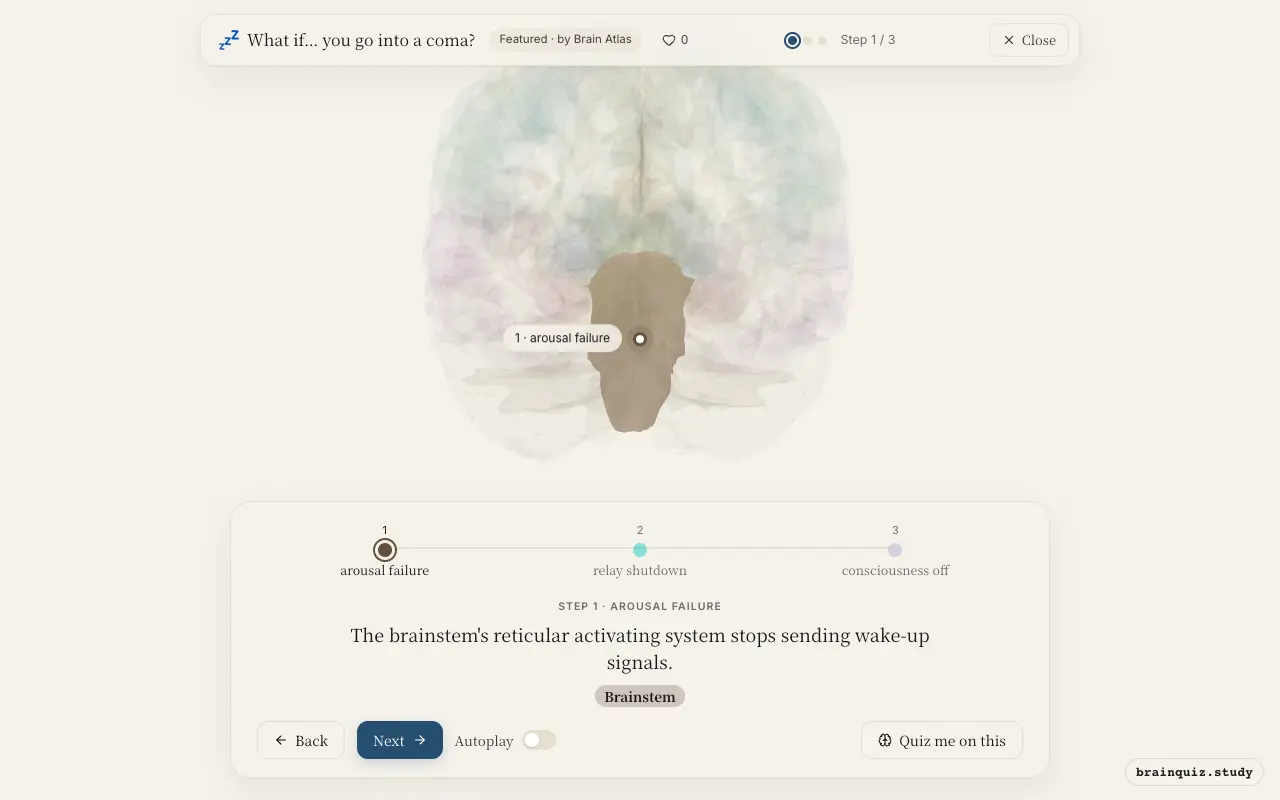
The brainstem houses the reticular activating system, which maintains cortical arousal. In coma, damage or metabolic failure here silences this system, so the brain cannot transition to a wakeful state.
2. Thalamus: relay shutdown
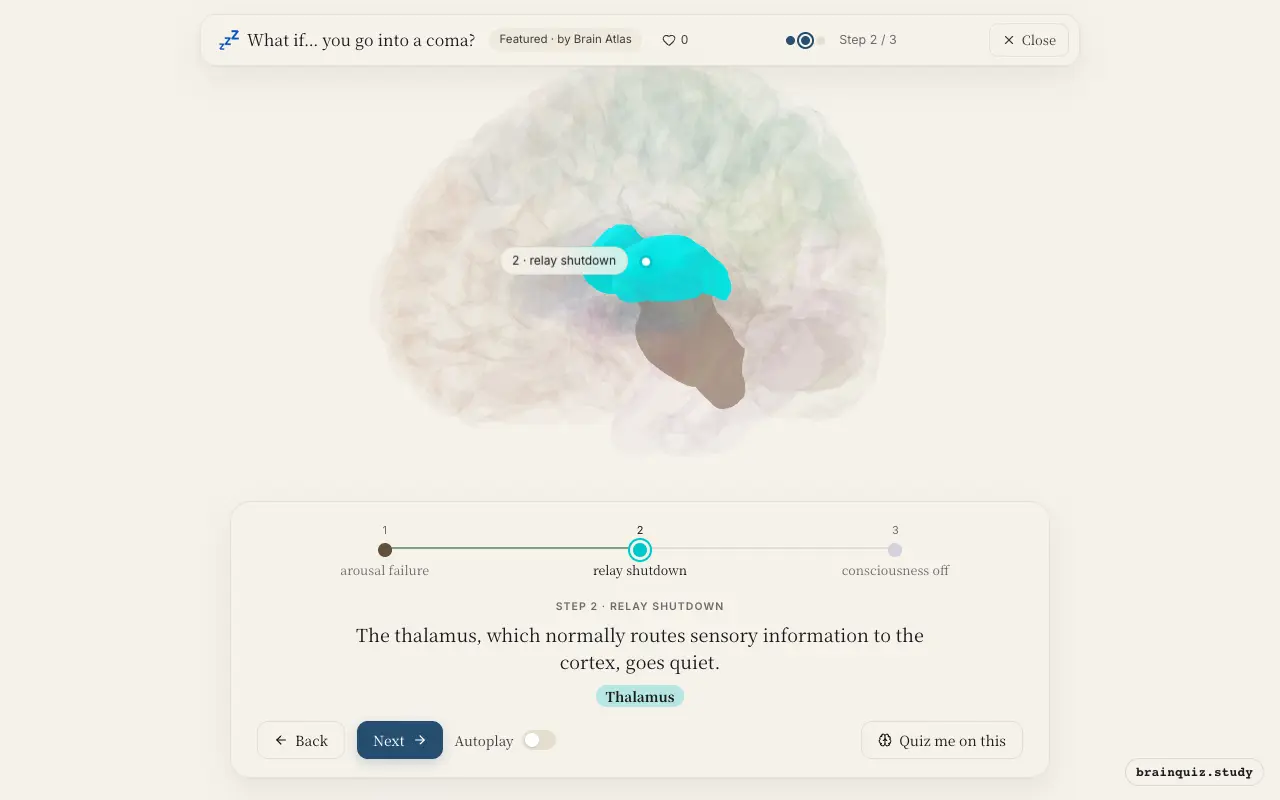
The thalamus is the gateway for sensory input to the cerebral cortex. Without brainstem activation, its neurons hyperpolarize and stop relaying signals, preventing conscious perception.
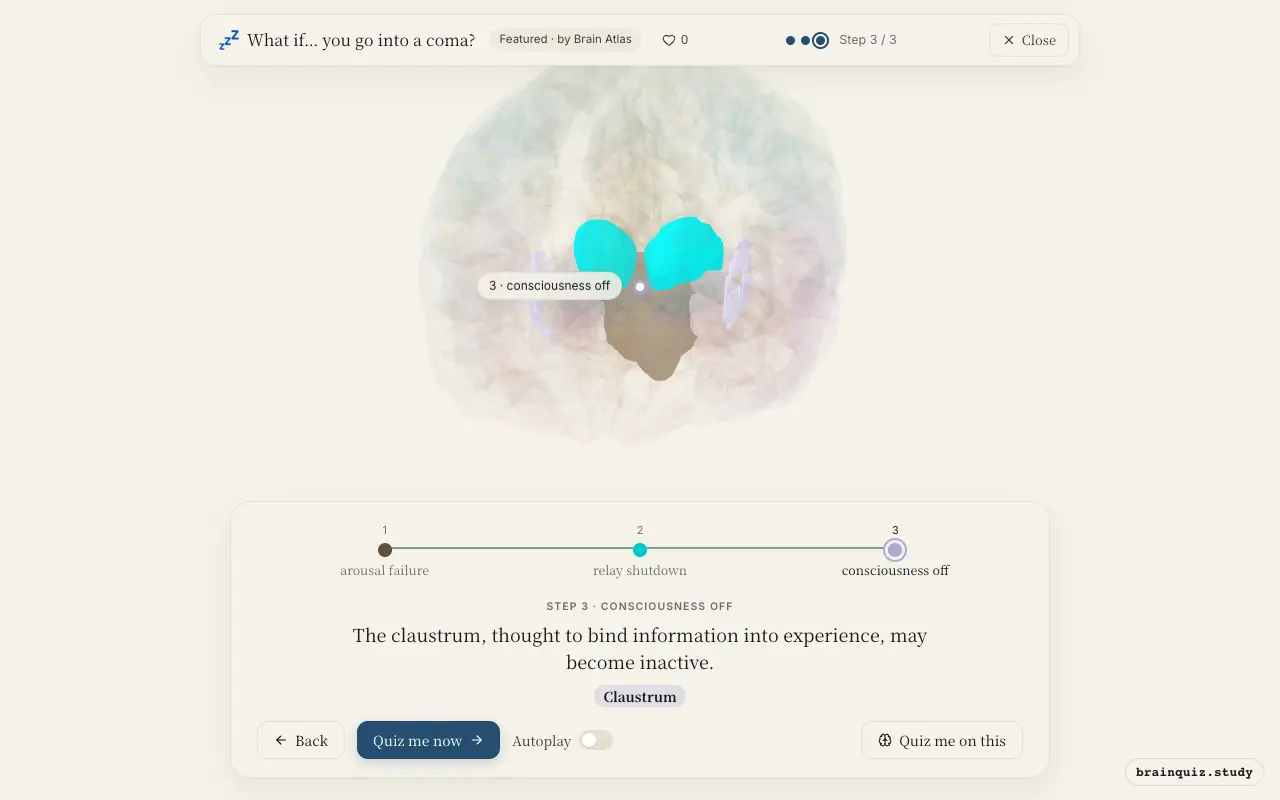
3. Claustrum: consciousness off
The claustrum is a thin sheet with connections to many cortical areas. Its activity correlates with conscious awareness, and its dysfunction may break the integration needed for a unified experience.
Good to know
- Coma is defined as a state of unarousable unresponsiveness lasting more than one hour.
- The brainstem's reticular formation is essential for wakefulness; small lesions there can cause coma.
- Metabolic disturbances like hypoglycemia or drug overdose can cause coma by impairing neuronal function diffusely.
Coma vs Vegetative State
In coma, the eyes are closed and there is no sleep-wake cycle. In a vegetative state, the brainstem may recover enough to open eyes and have sleep-wake cycles, but awareness remains absent because cortical function is severely impaired.
Test yourself
Which brain region is the primary source of wakefulness signals that fail in coma?
The thalamus contributes to coma by:
What is a key difference between coma and vegetative state?
0 of 3 answered · 0 correct
Simplified: many regions work together at once, and this shows the main players in the order they act. For learning only, not medical advice.