What happens in your brain when you have tinnitus?
Updated
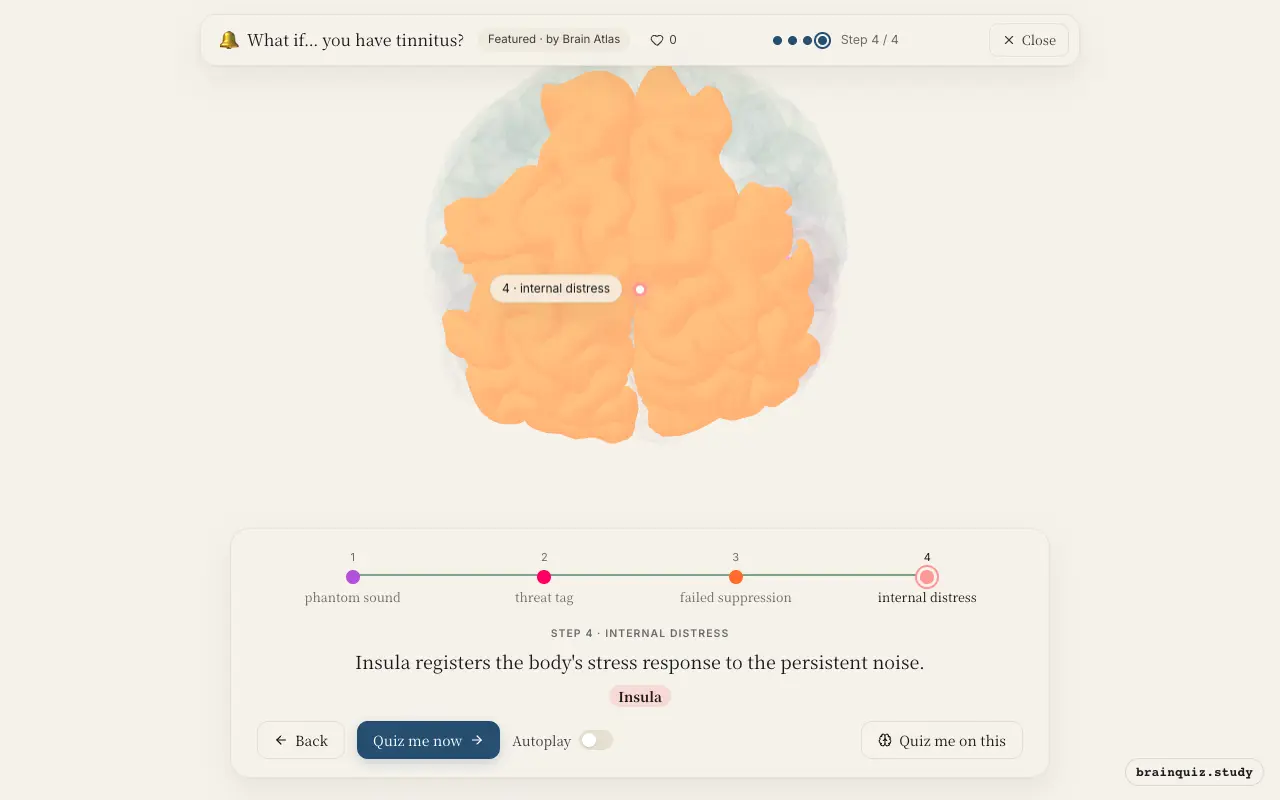
In tinnitus, the auditory cortex generates phantom sound, the amygdala tags it as threatening, the prefrontal cortex struggles to suppress attention, and the insula signals internal distress.
Watch it light up on the 3D brain
Brain regions that light up
| Order | Region | What it does here |
|---|---|---|
| 1 | Auditory Cortex | Auditory cortex fires spontaneously, creating a sound percept without external input. |
| 2 | Amygdala | Amygdala reacts to the phantom sound as if it were a real threat. |
| 3 | Prefrontal Cortex | Prefrontal cortex tries to ignore the sound but gets caught in attention loop. |
| 4 | Insula | Insula registers the body's stress response to the persistent noise. |
1. Auditory Cortex: phantom sound
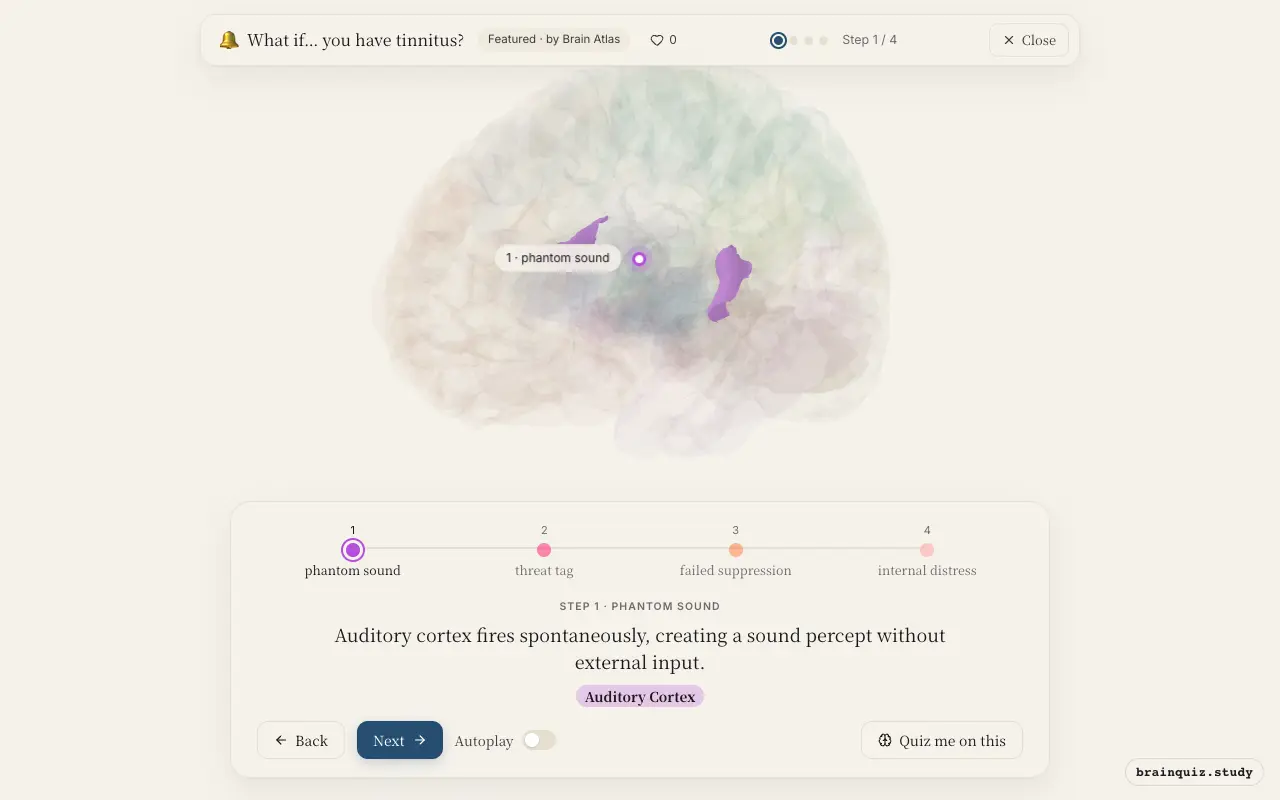
Damage to the inner ear reduces normal input, leading to increased spontaneous activity in the auditory cortex. This neural noise is interpreted as sound, the hallmark of tinnitus. The auditory cortex is a key site where the phantom percept is generated and maintained.
2. Amygdala: threat tag
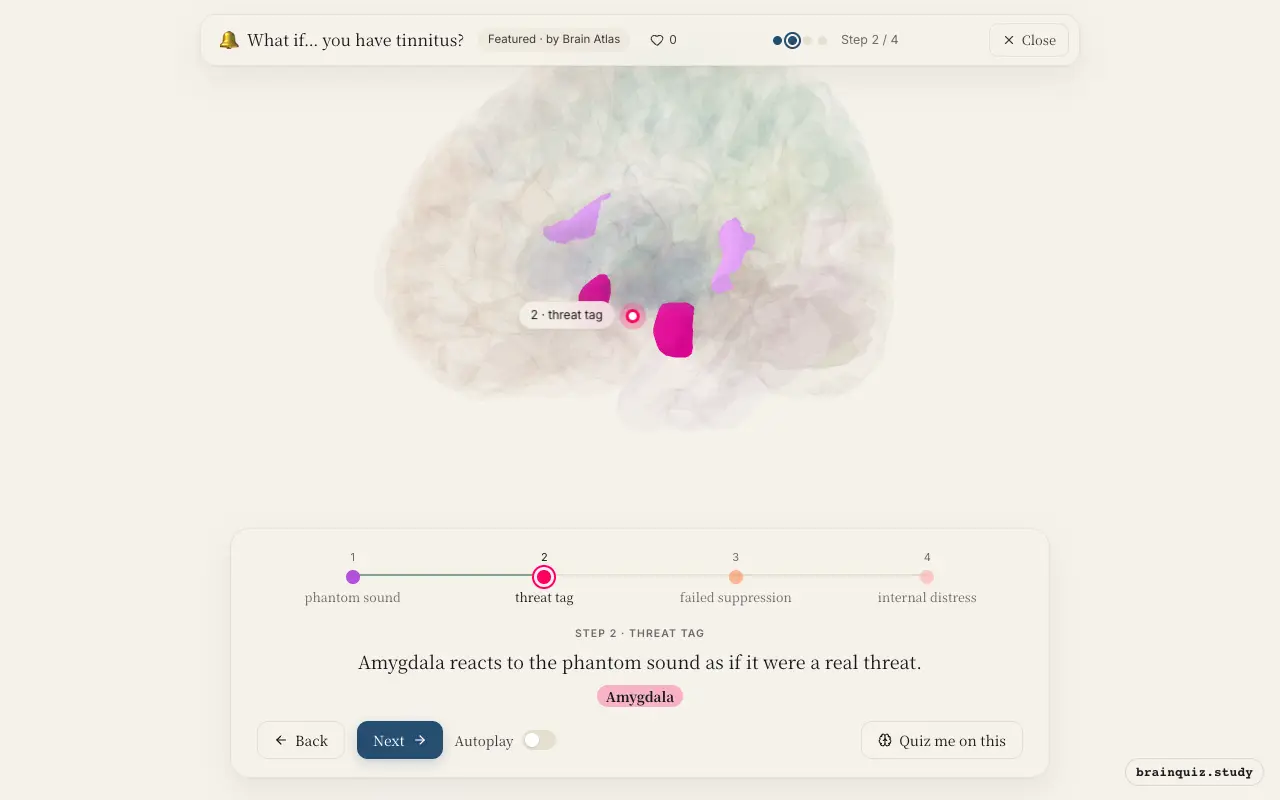
The amygdala evaluates the sound's emotional significance and often labels it as alarming. This limbic tagging makes the tinnitus more intrusive and stressful. Over time, the amygdala's response can become exaggerated, reinforcing the perception of distress.
3. Prefrontal Cortex: failed suppression
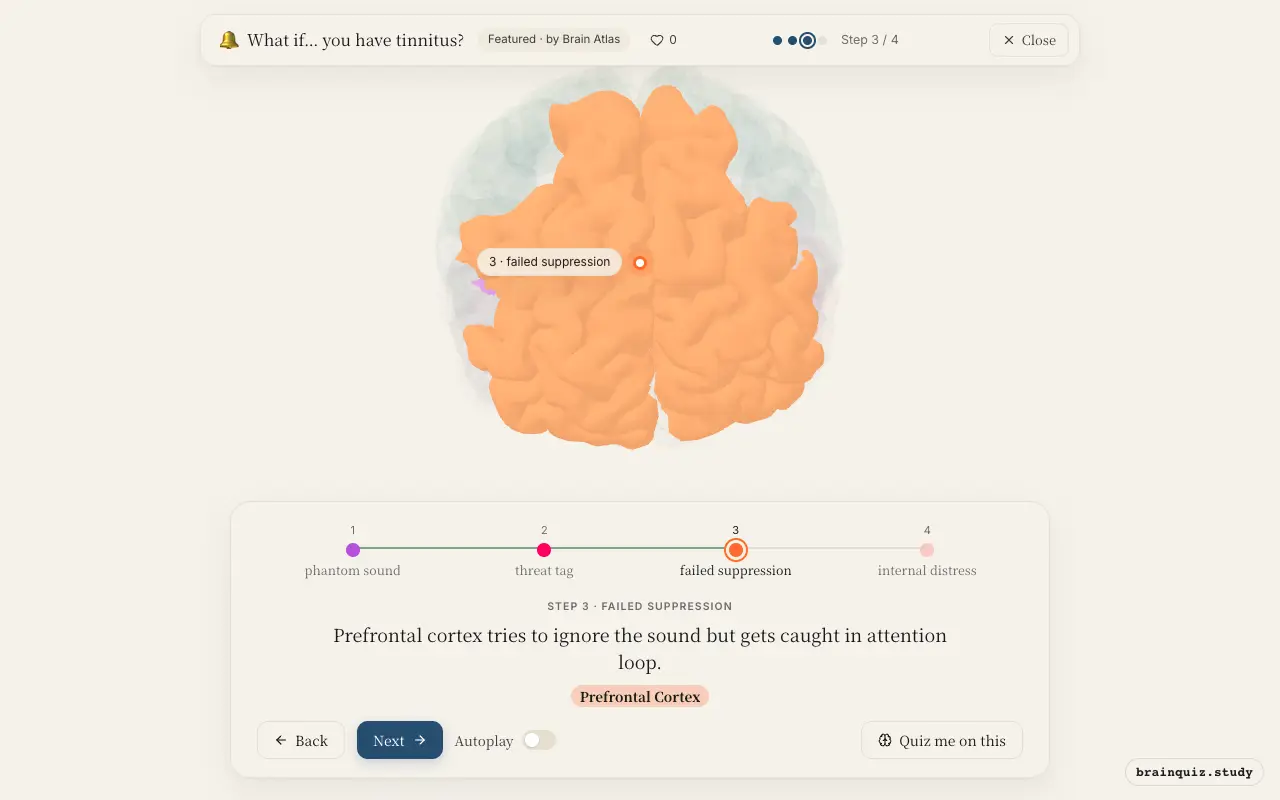
The prefrontal cortex attempts to suppress the phantom sound, but its efforts are often unsuccessful. This failure leads to frustration and the tinnitus becomes a constant distraction. The prefrontal cortex's role is in attentional control, and its inability to disengage maintains the perception.
4. Insula: internal distress
The insula monitors internal bodily states and signals the discomfort of living with tinnitus. It integrates the emotional and physiological arousal, contributing to the conscious experience of suffering. The insula's activation correlates with the severity of tinnitus distress.
Good to know
- Tinnitus is associated with reduced inhibition in the central auditory system, leading to hyperactivity.
- Many people with tinnitus have measurable hearing loss, even if they are not aware of it.
- The limbic system's involvement explains why tinnitus can cause anxiety and depression.
Tinnitus vs. Real Sound
When you hear a real sound, the auditory cortex processes input from the ear. In tinnitus, the auditory cortex is active without any external stimulus, driven by internal neural noise. This difference is crucial: the brain is generating a percept that has no basis in the outside world.
Test yourself
Which brain region is primarily responsible for generating the phantom sound in tinnitus?
What is the role of the amygdala in tinnitus?
How does the prefrontal cortex contribute to the annoyance of tinnitus?
0 of 3 answered · 0 correct
Simplified: many regions work together at once, and this shows the main players in the order they act. For learning only, not medical advice.