What happens in your brain when you learn from a mistake?
Updated
The anterior cingulate cortex detects the mistake, the orbitofrontal cortex evaluates its significance, the amygdala attaches an emotional tag, the hippocampus forms a memory, and the prefrontal cortex updates your behavioural strategy.
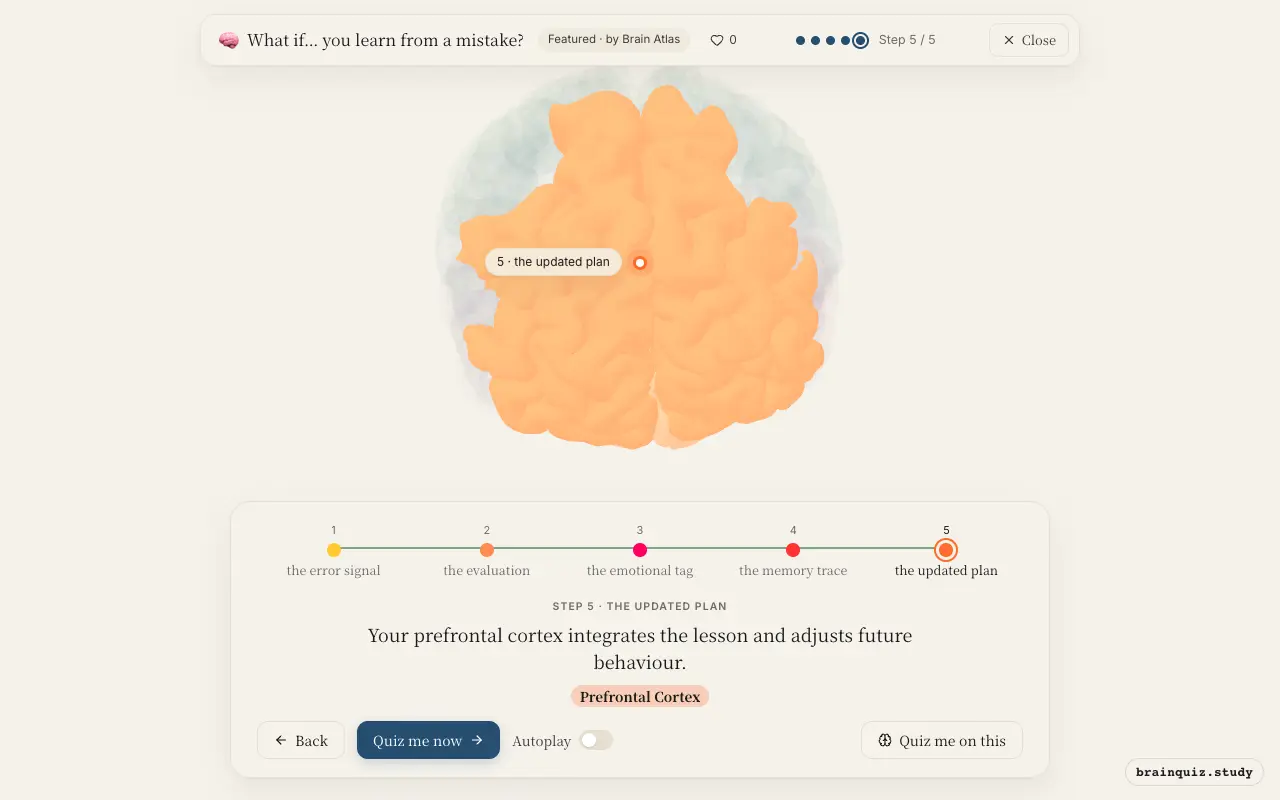
Watch it light up on the 3D brain
Brain regions that light up
| Order | Region | What it does here |
|---|---|---|
| 1 | Anterior Cingulate Cortex | Your anterior cingulate cortex fires when you realise you’ve made a mistake. |
| 2 | Orbitofrontal Cortex | The orbitofrontal cortex assesses how bad the mistake was. |
| 3 | Amygdala | Your amygdala attaches a feeling of aversion to the mistake. |
| 4 | Hippocampus | The hippocampus encodes the context and details of the error. |
| 5 | Prefrontal Cortex | Your prefrontal cortex integrates the lesson and adjusts future behaviour. |
1. Anterior Cingulate Cortex: the error signal
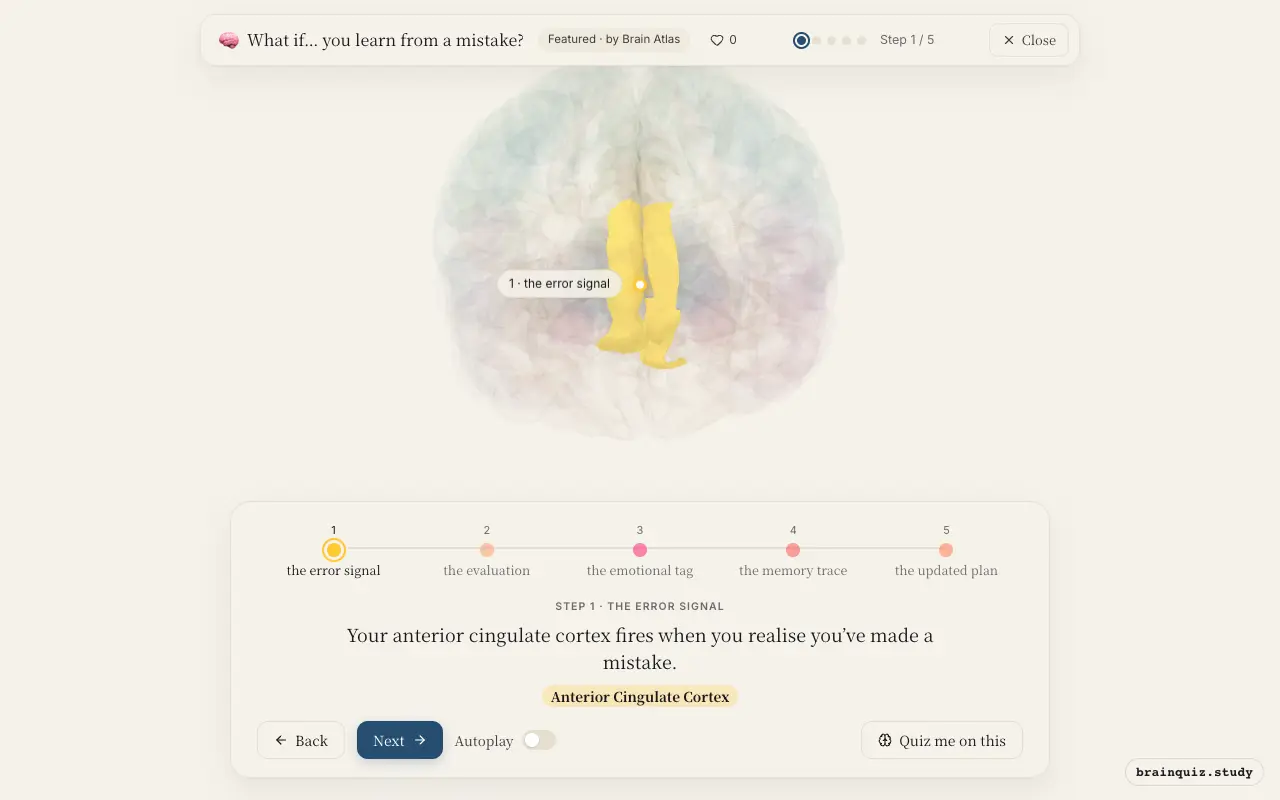
The ACC acts as an error detector, comparing your action’s expected outcome with the actual result. It generates a signal known as the error-related negativity, alerting other regions that something went wrong and adjustments are needed.
2. Orbitofrontal Cortex: the evaluation
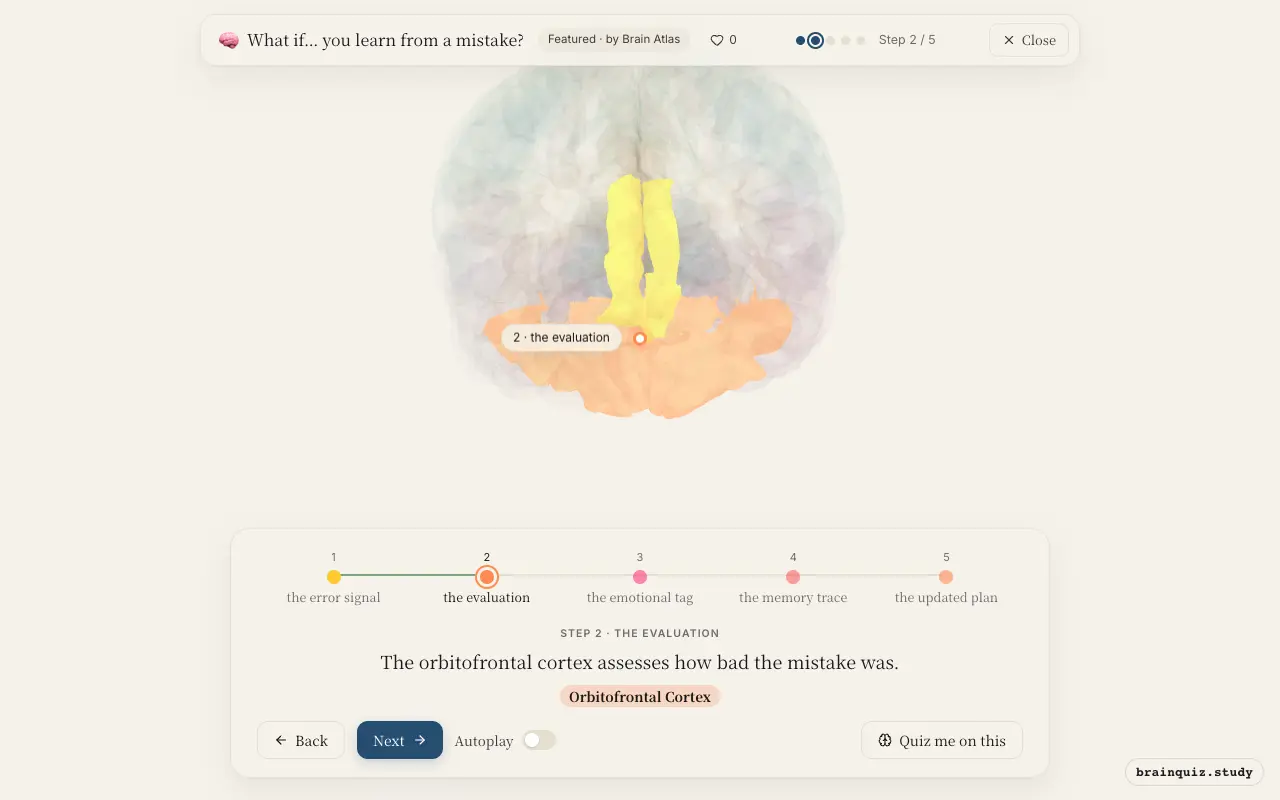
The OFC processes the negative value of the outcome and updates the expected reward of the chosen action. It helps compute a prediction error, signalling that the action was less rewarding than anticipated.
3. Amygdala: the emotional tag
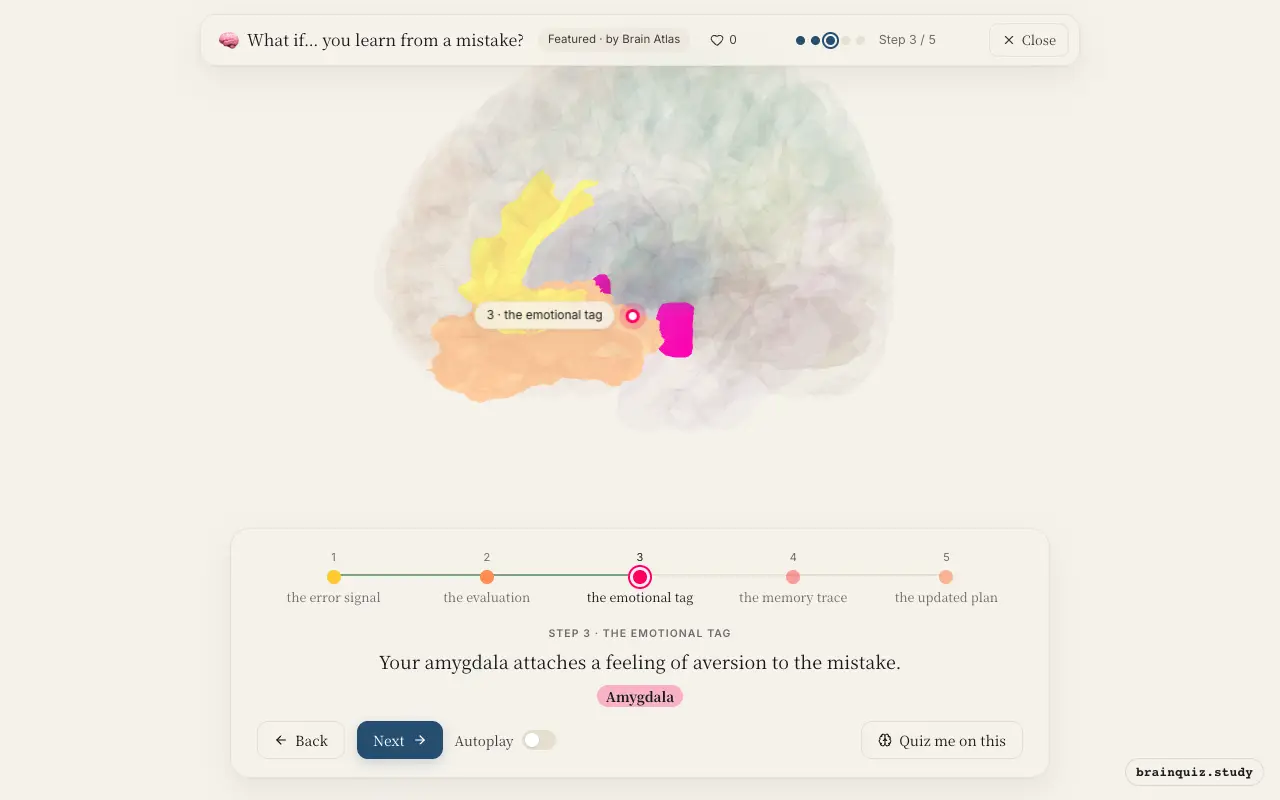
The amygdala adds an emotional charge to the error, making the experience salient and unpleasant. This emotional tagging strengthens the memory and motivates you to avoid repeating the same action in the future.
4. Hippocampus: the memory trace
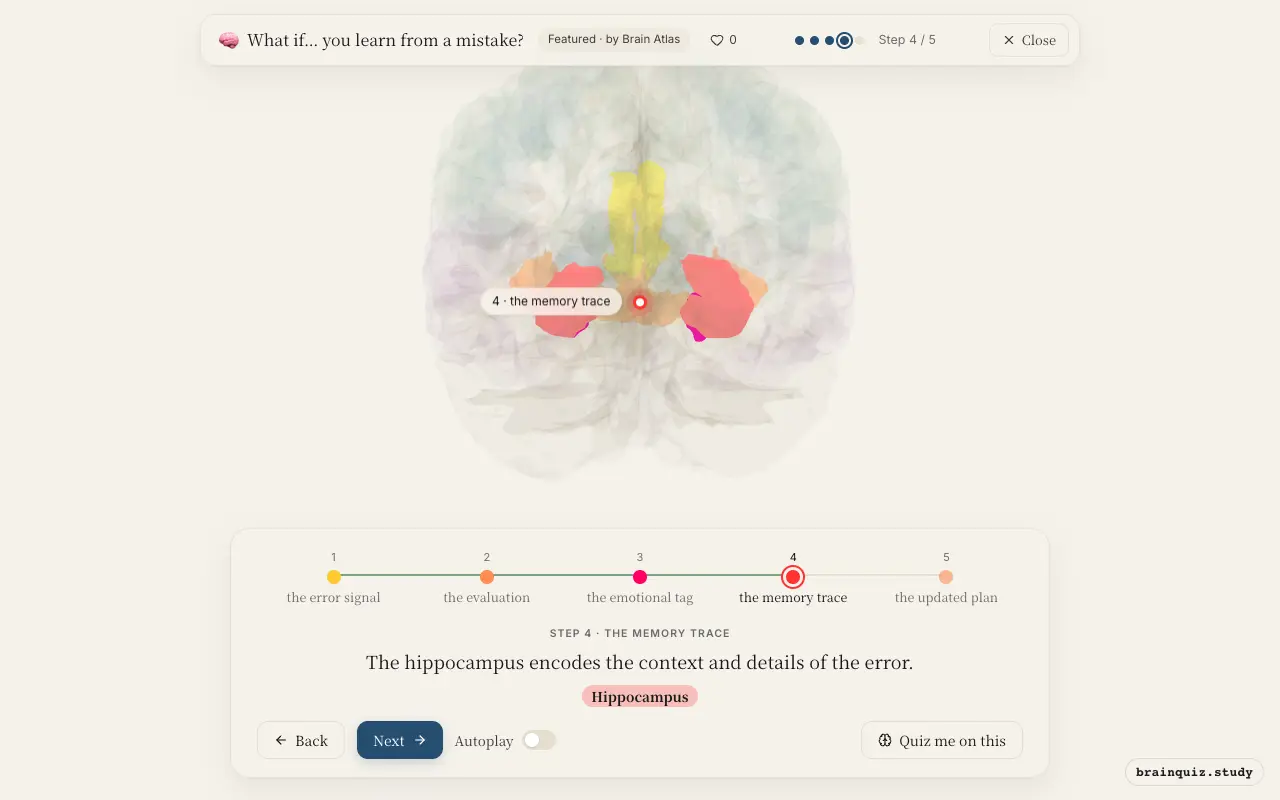
The hippocampus binds together the sensory, spatial, and temporal elements of the mistake into an episodic memory. This rapid encoding allows you to recall the specific situation later, helping you recognise similar circumstances.
5. Prefrontal Cortex: the updated plan
The dorsolateral prefrontal cortex updates working memory and cognitive strategies based on the error signal. It suppresses the incorrect response and biases decision-making towards more successful alternatives the next time the situation arises.
Good to know
- Dopamine neurons in the ventral tegmental area briefly reduce their firing when an outcome is worse than expected, a negative reward prediction error.
- The error-related negativity (ERN), an event-related potential linked to ACC activity, occurs within about 100 milliseconds after making an error.
Negative feedback vs. positive reinforcement
When you make a mistake, the ACC and OFC signal a negative prediction error and dopamine dips. In contrast, reward-based learning involves a dopamine surge and activation of the nucleus accumbens and caudate, with less ACC involvement for the initial error detection.
Test yourself
Which brain region is primarily responsible for detecting errors?
What happens to dopamine levels when you learn from a mistake?
Which region encodes the episodic memory of the mistake?
0 of 3 answered · 0 correct
Simplified: many regions work together at once, and this shows the main players in the order they act.