What happens in your brain when you look at a beautiful painting?
Updated
Your visual cortex processes the painting's lines and colors; the occipital cortex integrates form and motion; the orbitofrontal cortex evaluates its beauty and reward; the amygdala adds emotional salience, making the experience feel moving.
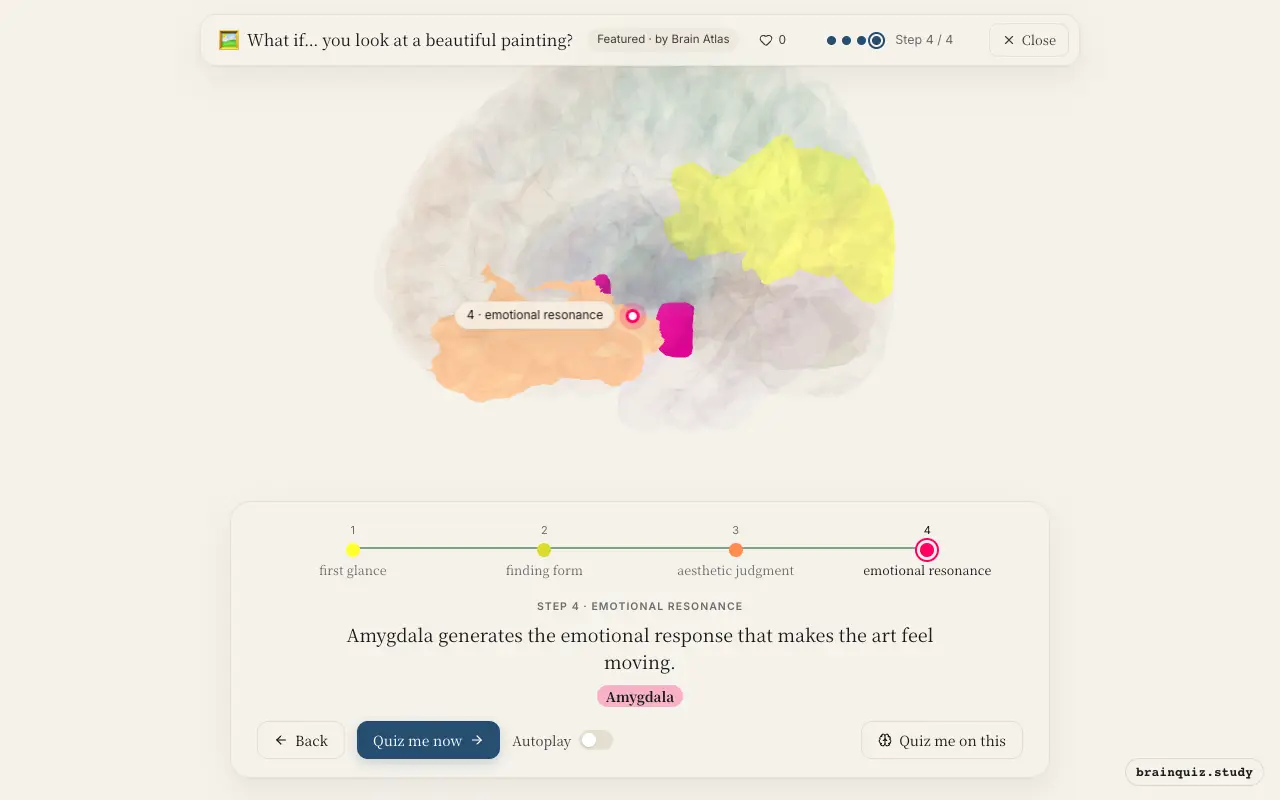
Watch it light up on the 3D brain
Brain regions that light up
| Order | Region | What it does here |
|---|---|---|
| 1 | Visual Cortex | Primary visual cortex decodes edges, colors, and shapes into a raw image. |
| 2 | Occipital Cortex | Higher visual areas integrate features into objects, scenes, and composition. |
| 3 | Orbitofrontal Cortex | Orbitofrontal cortex evaluates the painting as beautiful and rewarding. |
| 4 | Amygdala | Amygdala generates the emotional response that makes the art feel moving. |
1. Visual Cortex: first glance
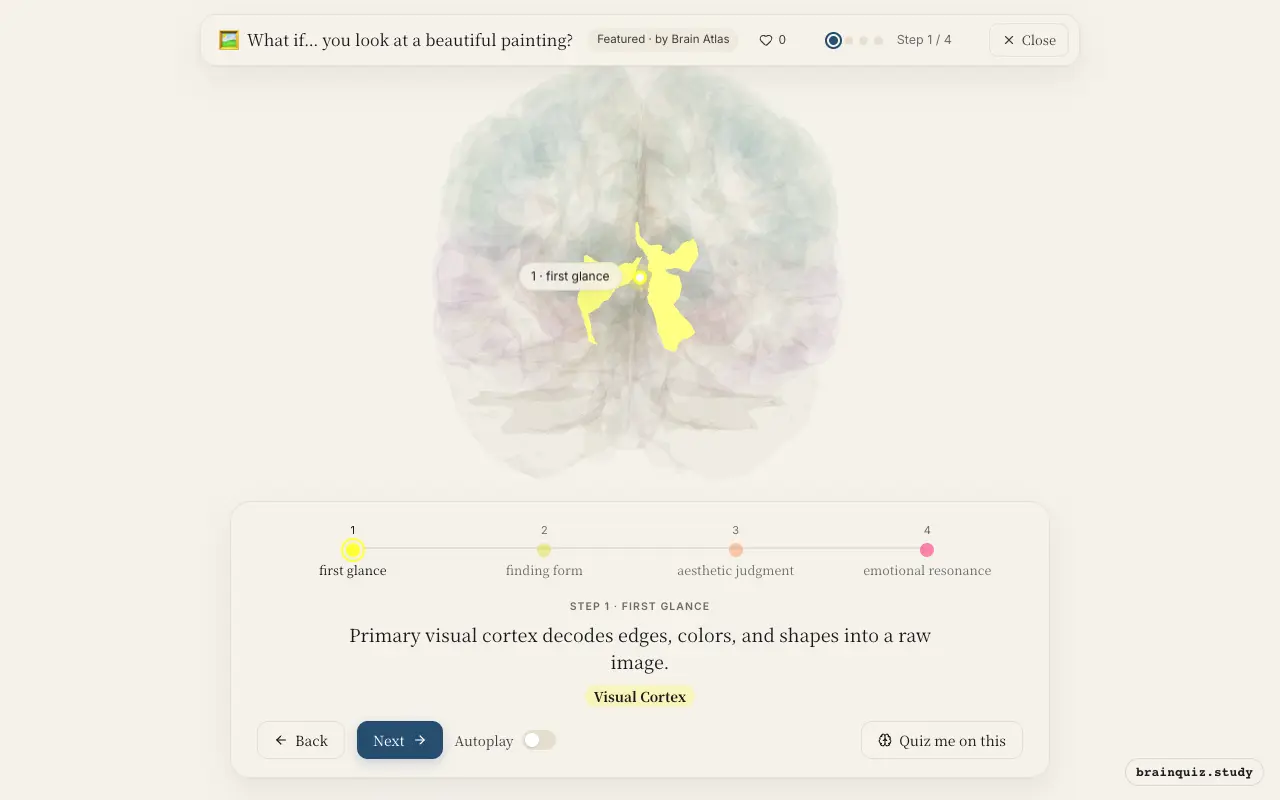
The visual cortex (V1) is the first cortical stage of visual processing. Neurons here respond to basic features like orientation, contrast, and color. This raw representation is sent forward for higher-level analysis, forming the building blocks of what you see.
2. Occipital Cortex: finding form
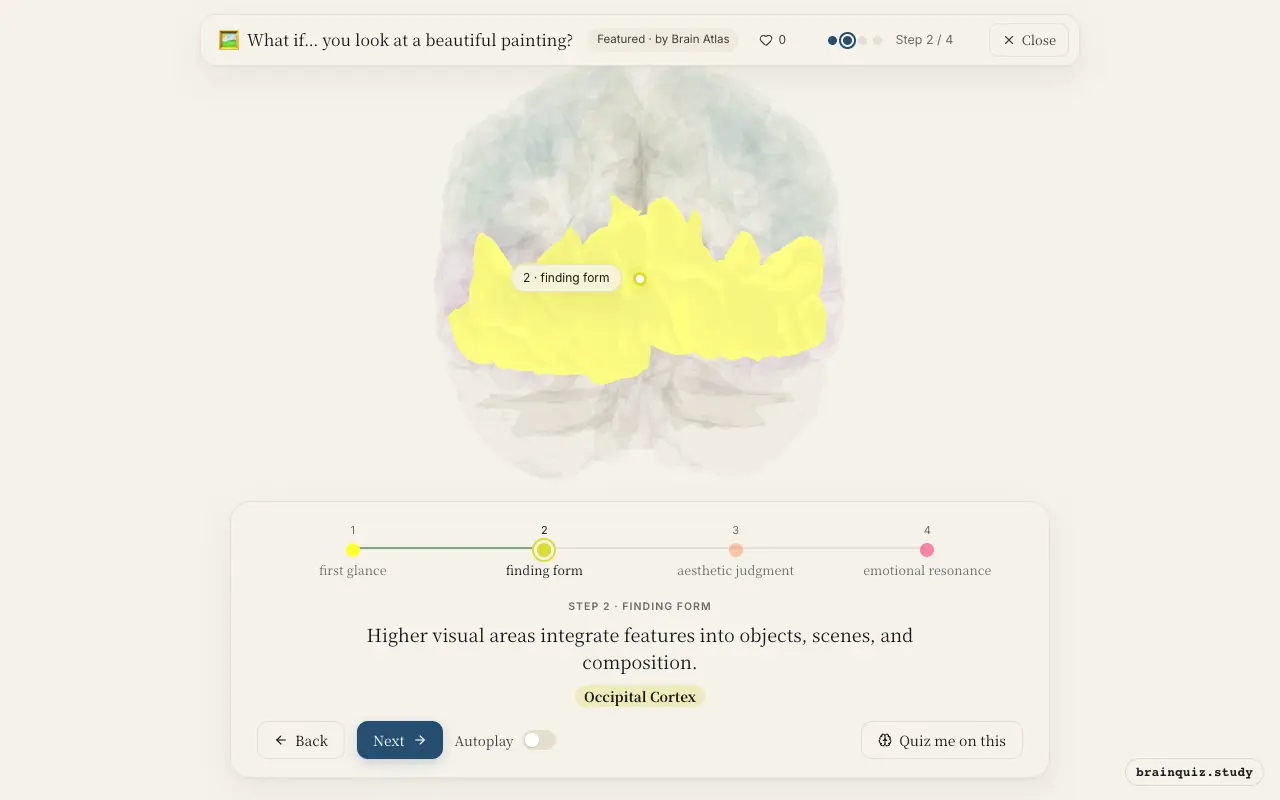
The occipital cortex beyond V1 includes areas like V2, V4, and the lateral occipital complex. These regions extract more complex properties such as shape, symmetry, and spatial organization. This processing underlies your ability to perceive the painting's overall structure and visual harmony.
3. Orbitofrontal Cortex: aesthetic judgment
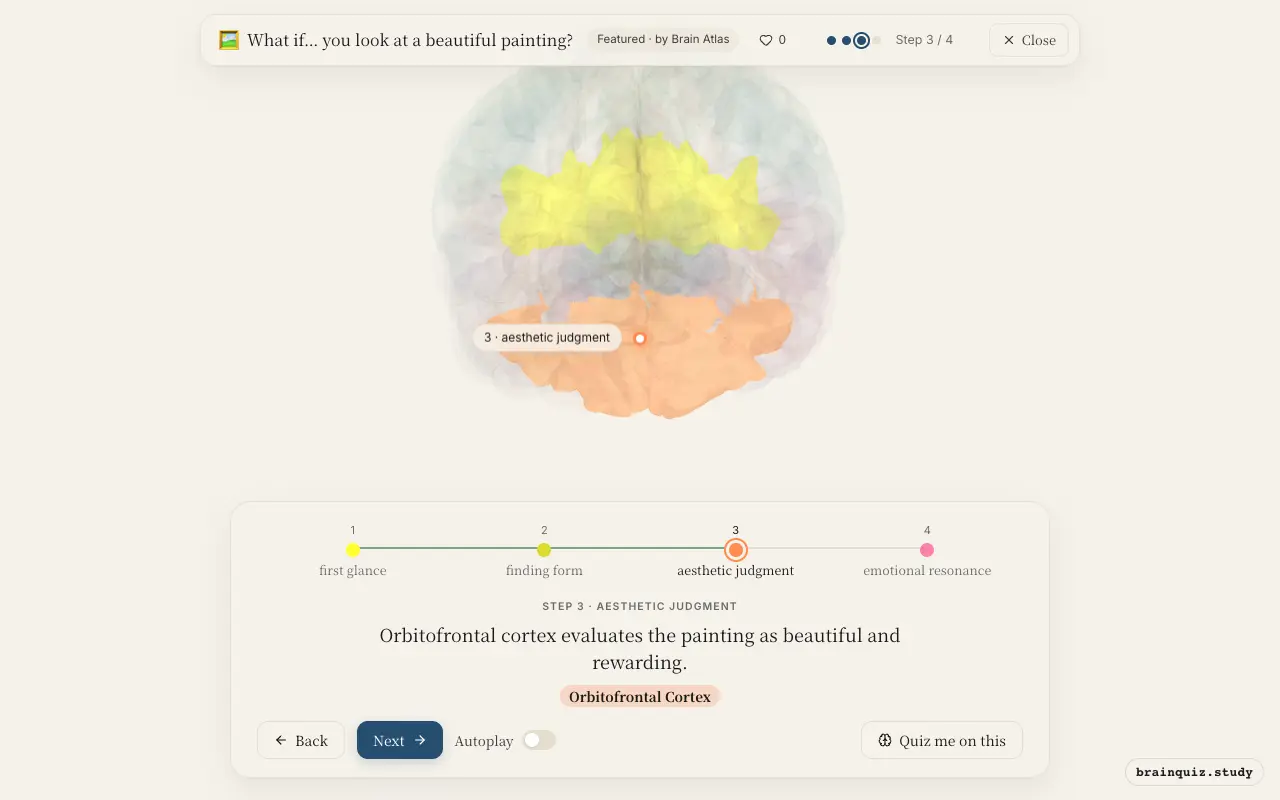
The orbitofrontal cortex receives input from sensory areas and links it to value. Neuroimaging studies show that activity here correlates with subjective ratings of beauty. This region computes the hedonic value of the artwork, signaling that it is pleasing.
4. Amygdala: emotional resonance
The amygdala processes emotional salience and can tag the visual experience as emotionally significant. This may enhance memory for the painting and produce visceral feelings. Its activation is thought to contribute to the 'chills' or awe some people report.
Good to know
- Studies suggest that the orbitofrontal cortex responds to both visual and musical beauty, pointing to a common aesthetic network.
- The amygdala is known to enhance memory for emotionally arousing events, which may explain why powerful artworks are remembered.
- Aesthetic experiences engage a distributed network including sensory, reward, and default-mode regions, not a single 'art center'.
Painting vs Pattern
Looking at a random pattern activates early visual areas but fails to engage the orbitofrontal cortex's reward response as strongly. Recognizable or harmonious art recruits additional object and scene processing, producing a richer emotional and aesthetic experience.
Test yourself
Which brain region first processes the basic visual features of the painting, such as edges and colors?
Activity in which region is most closely linked to judging the painting as beautiful?
Damage to which region would most likely reduce the emotional impact of viewing the painting?
0 of 3 answered · 0 correct
Simplified: many regions work together at once, and this shows the main players in the order they act.