What happens in your brain when you oversleep?
Updated
Oversleeping disrupts the hypothalamus's circadian clock, reduces brainstem arousal signals, and leaves the thalamus and prefrontal cortex sluggish, causing grogginess and impaired cognition.
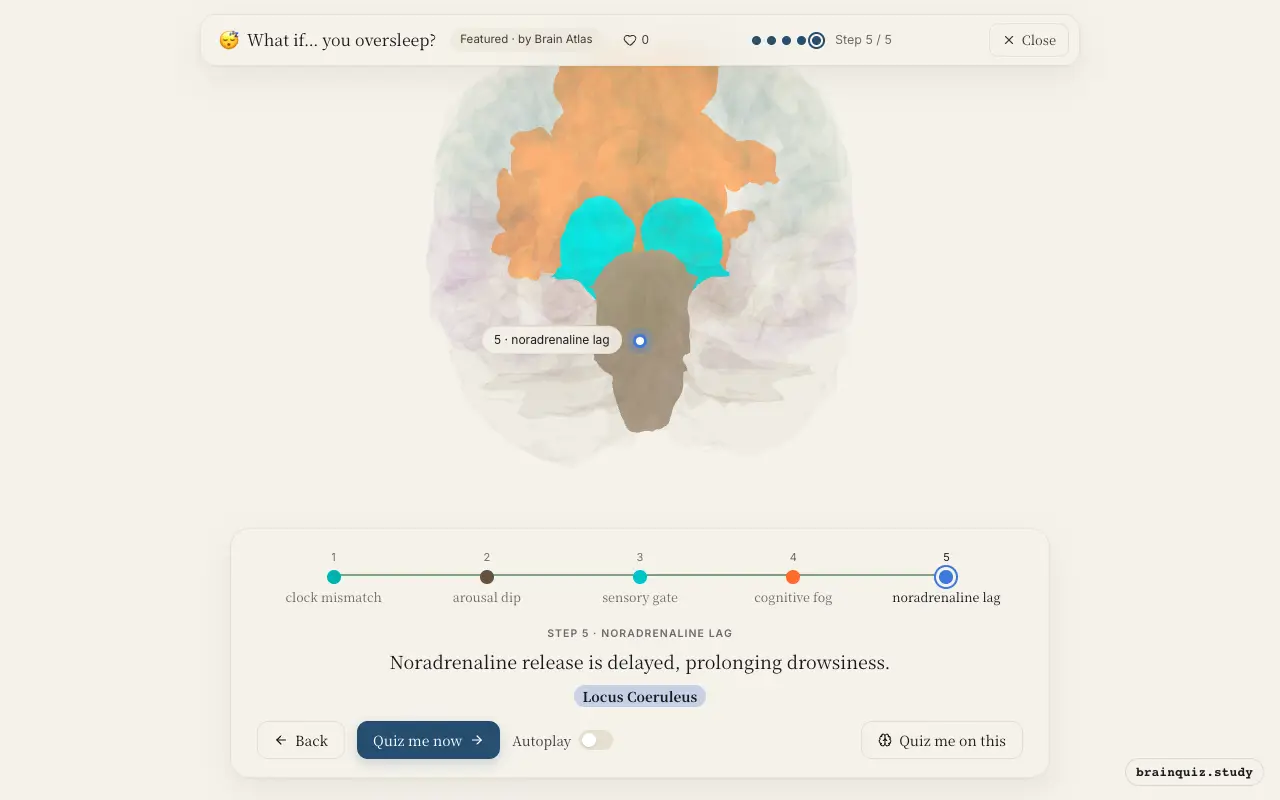
Watch it light up on the 3D brain
Brain regions that light up
| Order | Region | What it does here |
|---|---|---|
| 1 | Hypothalamus | Your internal clock signals it's time to wake, but you keep sleeping. |
| 2 | Brainstem | Arousal systems stay dampened, keeping you in a sleep-like state. |
| 3 | Thalamus | The thalamus lets fewer signals through, blurring the transition to wake. |
| 4 | Prefrontal Cortex | Executive functions are slow to reboot, causing grogginess and poor decisions. |
| 5 | Locus Coeruleus | Noradrenaline release is delayed, prolonging drowsiness. |
1. Hypothalamus: clock mismatch
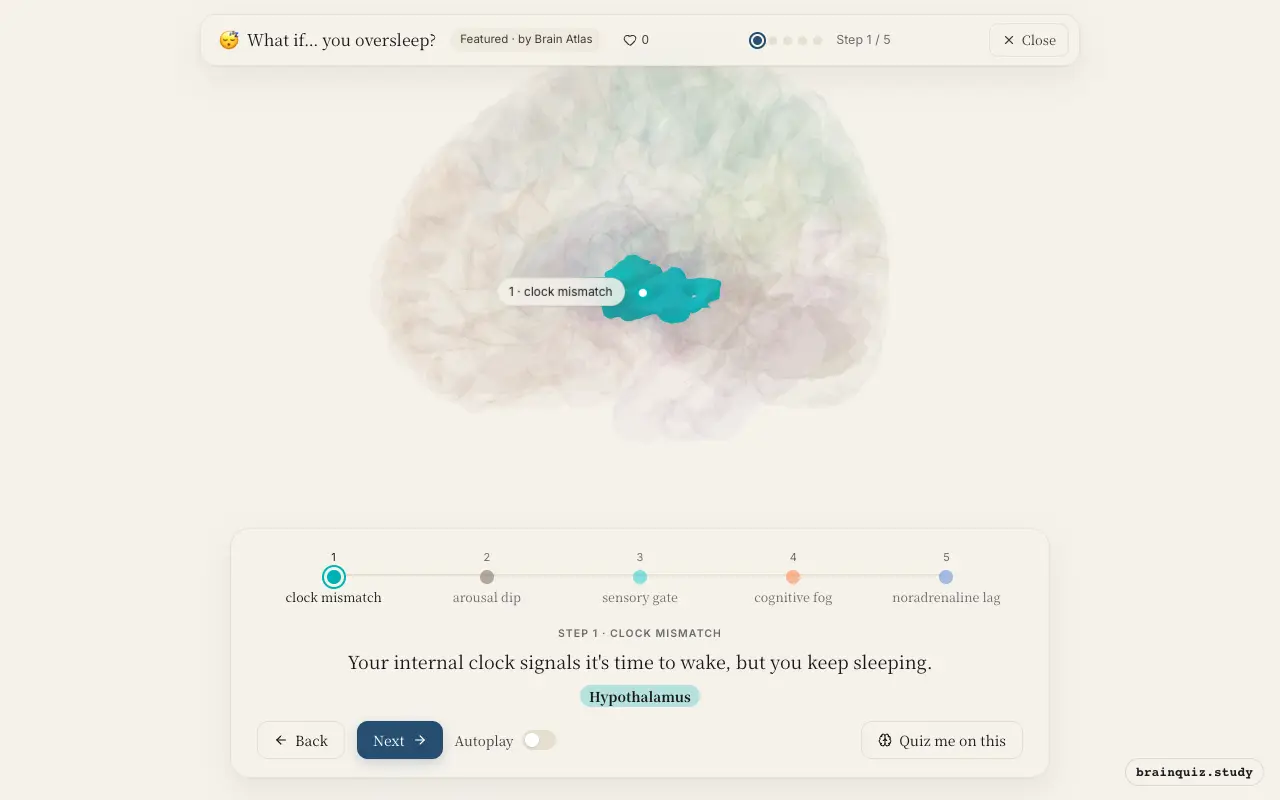
The suprachiasmatic nucleus in the hypothalamus normally aligns sleep-wake cycles with daylight. Oversleeping delays exposure to morning light cues, shifting the circadian rhythm and confusing the brain's sense of time.
2. Brainstem: arousal dip
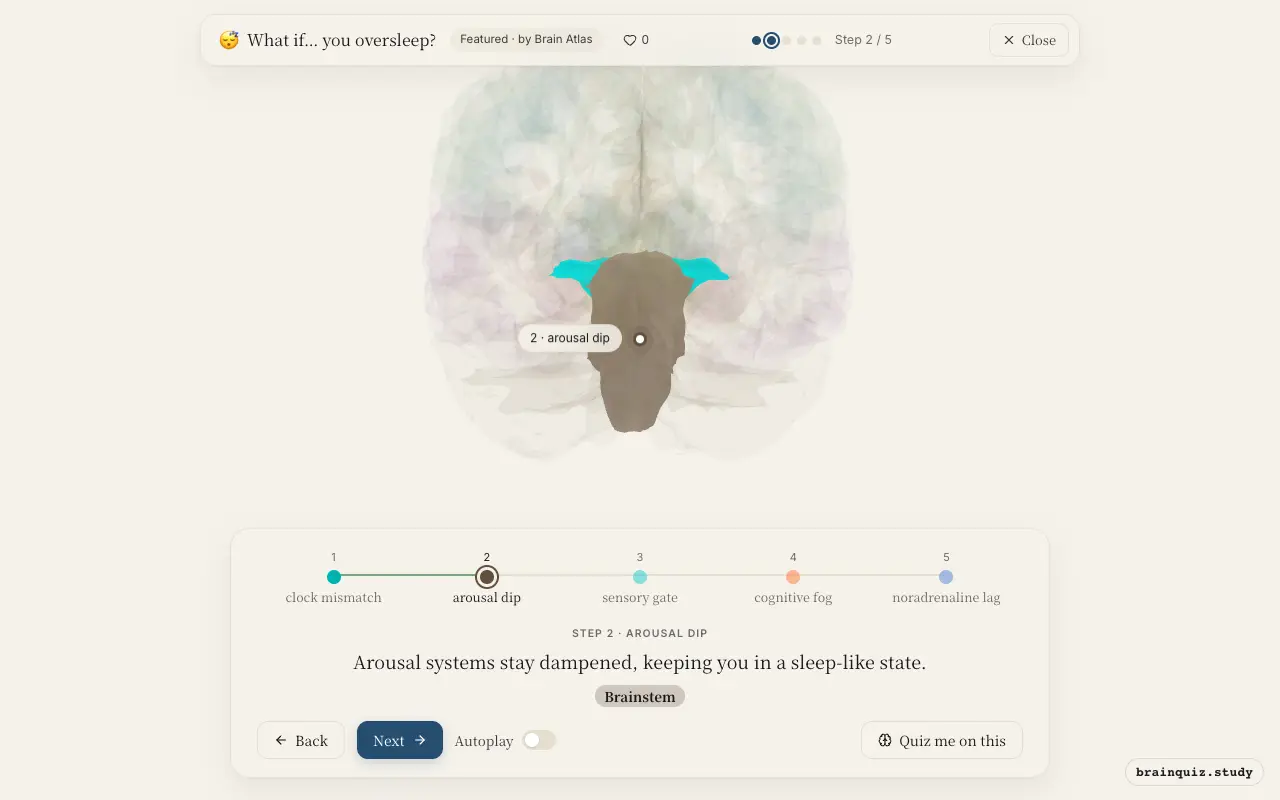
The reticular activating system in the brainstem, which promotes wakefulness, may remain less active after prolonged sleep. This reduces cortical alertness and makes it harder to fully wake up.
3. Thalamus: sensory gate
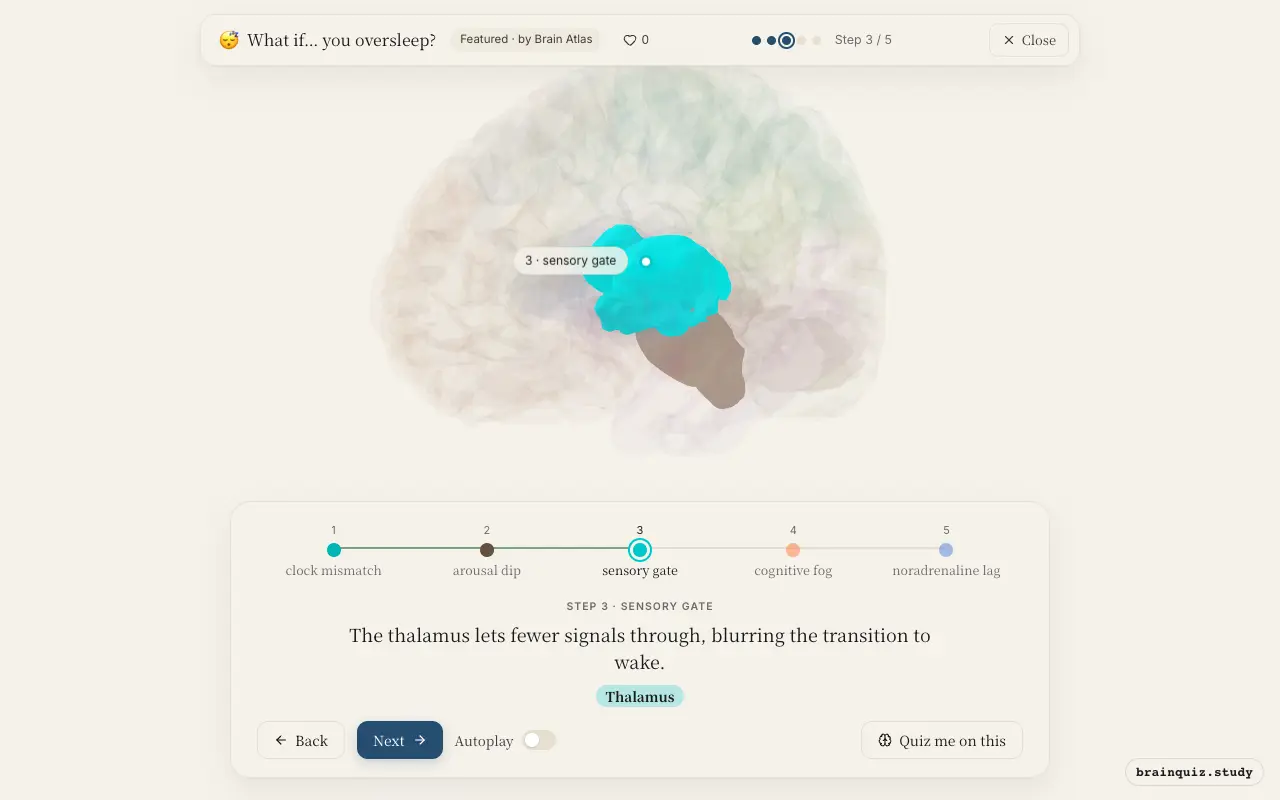
The thalamus normally relays sensory information to the cortex and helps maintain consciousness. After oversleeping, its activity may be sluggish, so external stimuli may be poorly processed, leaving you feeling disconnected.
4. Prefrontal Cortex: cognitive fog
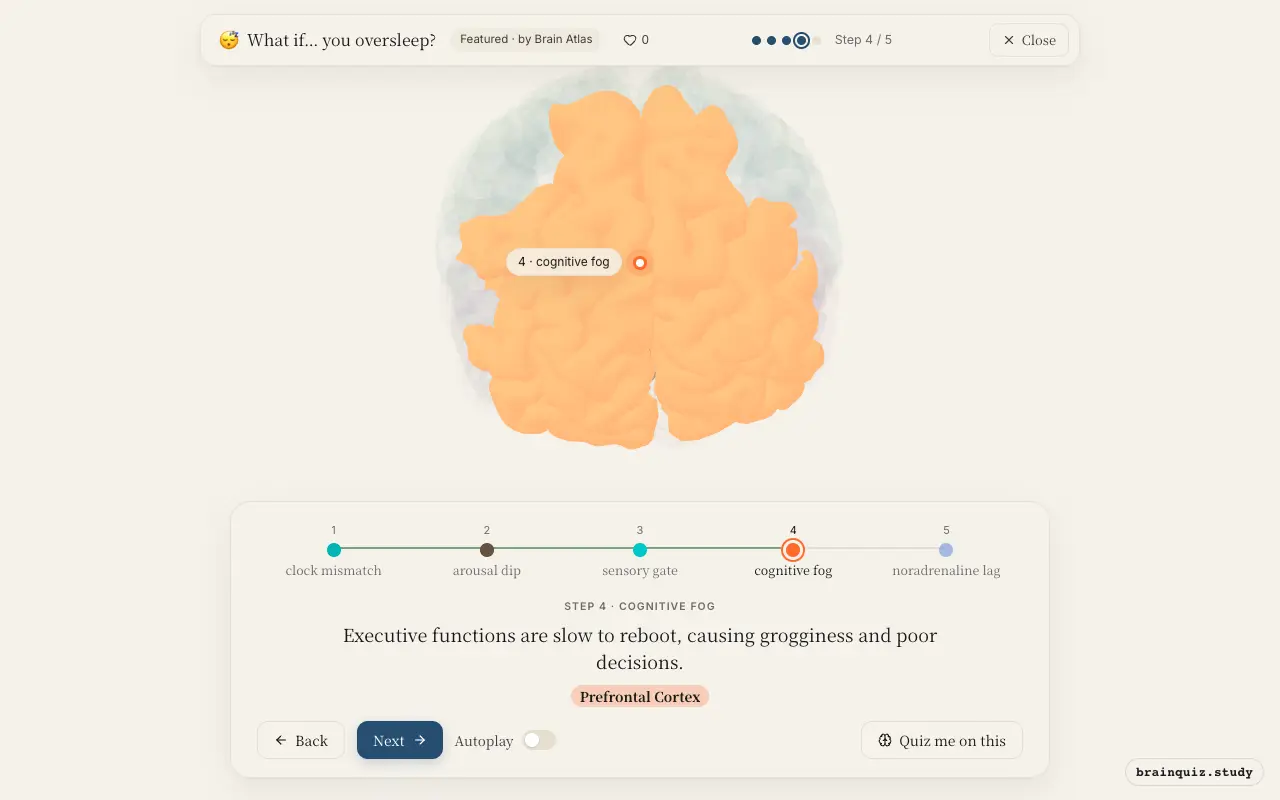
The prefrontal cortex, responsible for planning, attention, and working memory, may take longer to reactivate after extended sleep. This underlies the 'sleep inertia' that makes thinking feel slow and effortful.
5. Locus Coeruleus: noradrenaline lag
The locus coeruleus, the brain's main source of noradrenaline, usually fires to promote arousal. Oversleeping may delay its activation, so alertness-promoting signals may remain low, contributing to the foggy feeling.
Good to know
- Sleep inertia is strongest when waking from deep slow-wave sleep, and may be worse after sleeping longer than usual.
- The circadian clock in the hypothalamus is reset primarily by morning light, so oversleeping delays that cue.
Oversleep vs. well-rested wake
After normal sleep, the brainstem and thalamus reactivate quickly, and the prefrontal cortex comes online within minutes. Oversleeping delays these processes, causing prolonged sleep inertia. In contrast, sleep deprivation triggers excessive adenosine and compensatory arousal, leading to a different kind of cognitive impairment.
Test yourself
Which brain region is primarily responsible for maintaining the circadian rhythm that gets disrupted by oversleeping?
What causes the grogginess known as sleep inertia after oversleeping?
Which neurochemical system is slow to activate after oversleeping, prolonging drowsiness?
0 of 3 answered · 0 correct
Simplified: many regions work together at once, and this shows the main players in the order they act.