What happens in your brain when you remember your first day at school?
Updated
Your prefrontal cortex initiates the memory search, the hippocampus reactivates the stored episode, the posterior cingulate integrates it with your sense of self, the amygdala adds the emotional tone, and the visual cortex replays the scene.
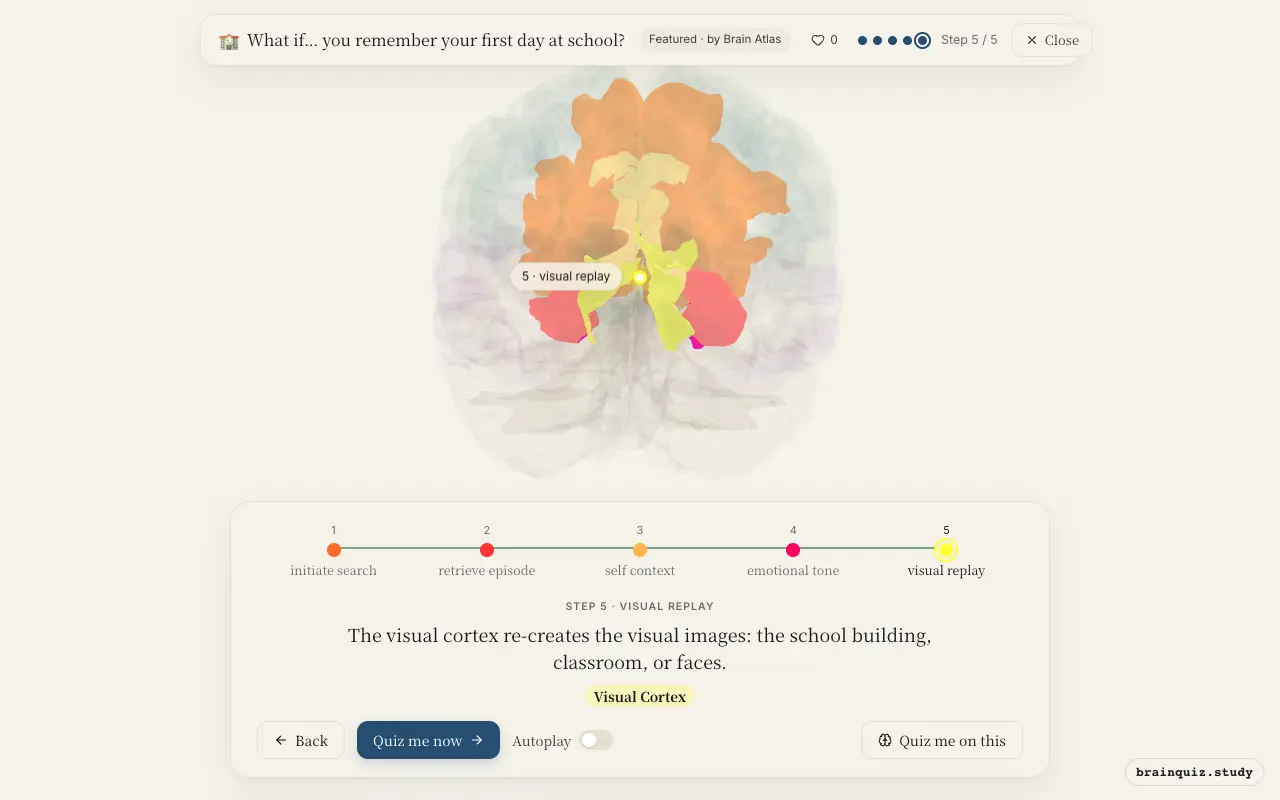
Watch it light up on the 3D brain
Brain regions that light up
| Order | Region | What it does here |
|---|---|---|
| 1 | Prefrontal Cortex | Your prefrontal cortex starts the memory search using the cue of 'first day at school.' |
| 2 | Hippocampus | The hippocampus reactivates the stored pattern of the event, bringing scattered details together. |
| 3 | Posterior Cingulate Cortex | The posterior cingulate integrates the memory into your life story and sense of self. |
| 4 | Amygdala | The amygdala adds the emotional coloring—like anxiety or excitement—to the memory. |
| 5 | Visual Cortex | The visual cortex re-creates the visual images: the school building, classroom, or faces. |
1. Prefrontal Cortex: initiate search
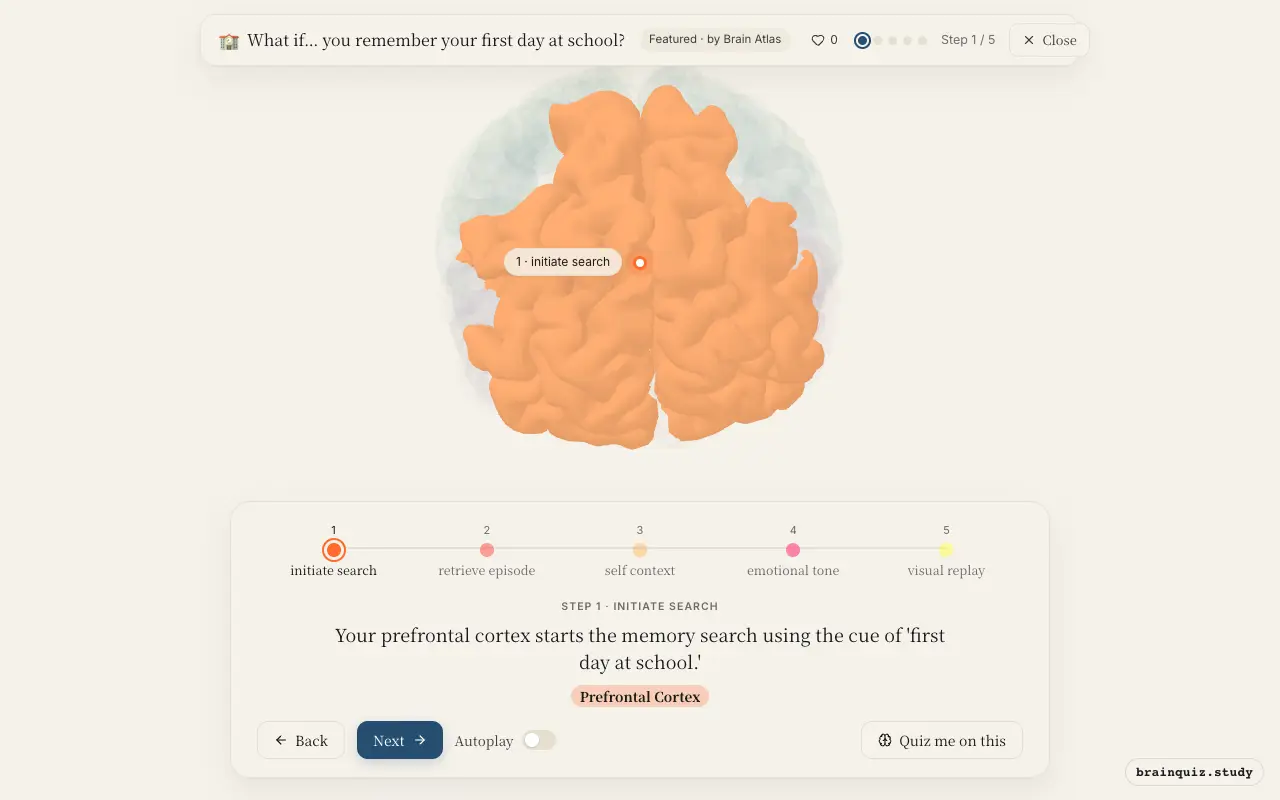
The prefrontal cortex directs attention to the retrieval goal and holds the cue in working memory while searching for relevant associations. This top-down control is essential for initiating effortful recall and for monitoring the products of memory retrieval, ensuring that the remembered episodes match the current goal.
2. Hippocampus: retrieve episode
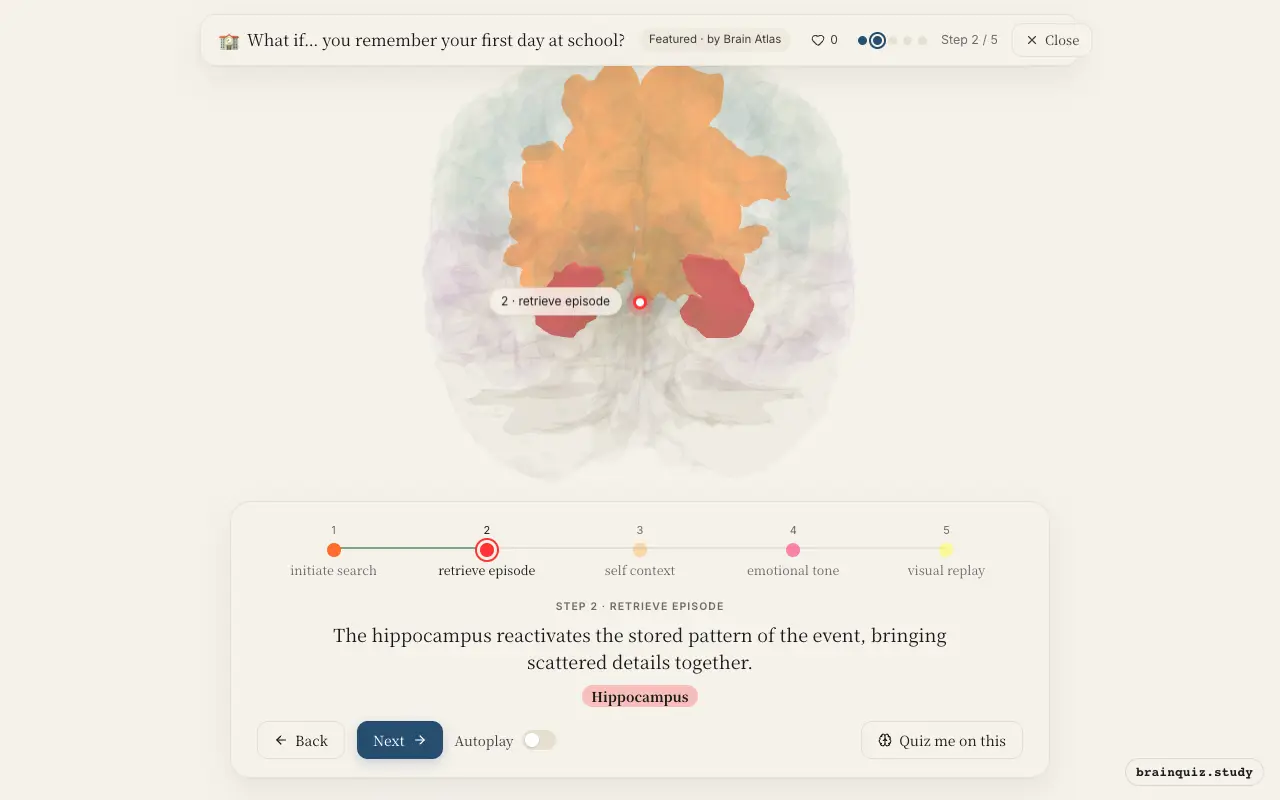
The hippocampus performs pattern completion to reconstruct the episode from partial cues, reactivating the distributed cortical representations that were active during the original event. This process is central to retrieving specific episodes and is thought to be mediated by the CA3 recurrent network. Successful retrieval depends on the strength of these reinstated patterns.
3. Posterior Cingulate Cortex: self context
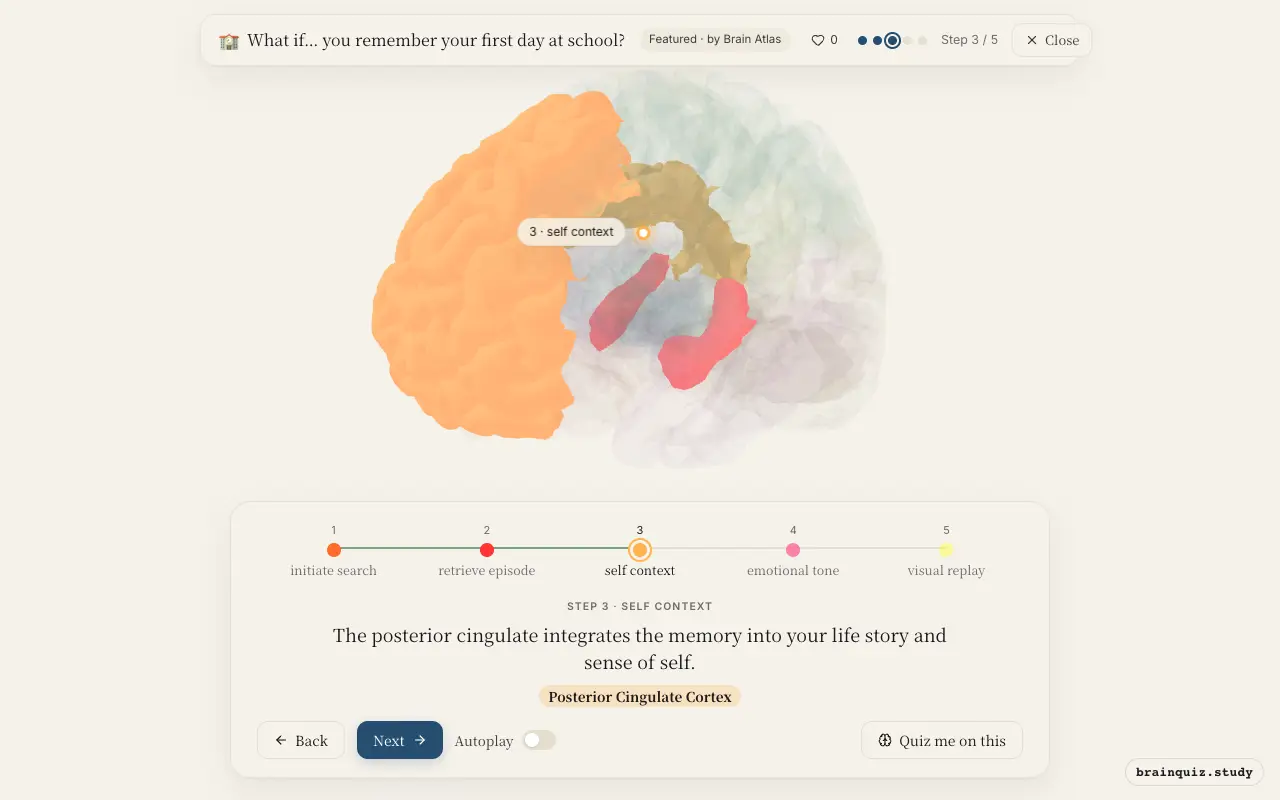
As part of the default mode network, the posterior cingulate is active during autobiographical recollection. It links the remembered event to personal significance and self-referential processing, making the memory feel like a part of your own life narrative rather than an isolated fact. It also helps integrate spatial and temporal context.
4. Amygdala: emotional tone
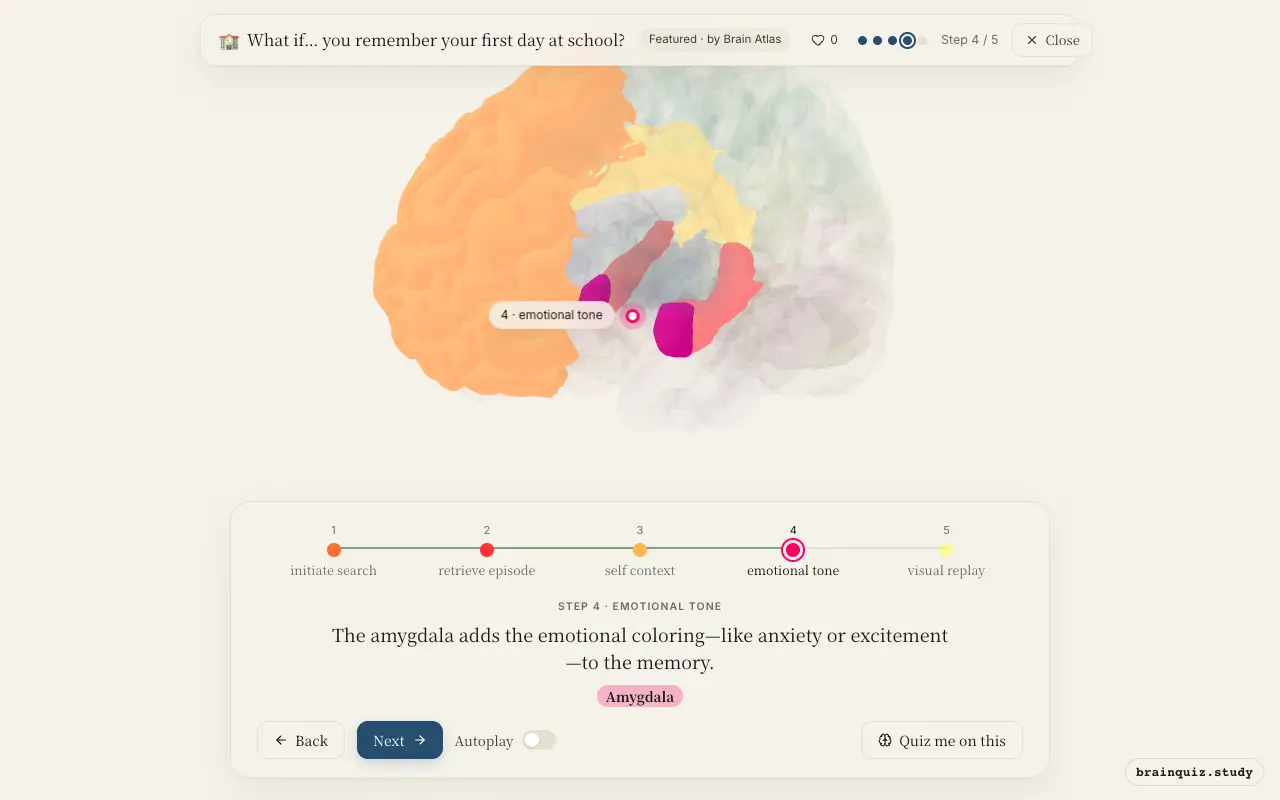
The amygdala modulates memory consolidation and retrieval of emotionally arousing events. It strengthens the memory trace and influences how vividly the emotional aspects are re-experienced. For a first day of school, feelings of nervousness or joy are common and are amplified by this region.
5. Visual Cortex: visual replay
Early visual areas are reactivated during vivid recall, supporting mental imagery. This reinstatement of sensory details makes the memory feel like reliving the scene. The degree of visual cortex activation correlates with memory vividness, so a clear mental picture means strong visual reactivation.
Good to know
- Episodic memories are not stored permanently in the hippocampus; they are thought to consolidate in the neocortex over time, with the hippocampus acting as an index.
- Emotional arousal during an event enhances memory consolidation via amygdala modulation of the hippocampus, making such memories more vivid and lasting.
- Retrieval is a reconstructive process; each time you recall the first day, the memory trace is slightly modified and re-consolidated.
Episodic vs. semantic memory
When you recall that the capital of France is Paris, you use semantic memory, which relies more on the lateral temporal cortex. Remembering your first day at school is episodic, engaging the hippocampus, posterior cingulate, and visual cortex to reconstruct a specific personal event.
Test yourself
Which brain region is primarily responsible for the initial memory search when you try to recall your first day at school?
What role does the amygdala play in retrieving an emotional memory like your first day at school?
Which network is most active during autobiographical recollection of a personal event?
0 of 3 answered · 0 correct
Simplified: many regions work together at once, and this shows the main players in the order they act.