What happens in your brain when you sleepwalk?
Updated
During sleepwalking, the brainstem triggers partial arousal from deep sleep, the basal ganglia and motor cortex generate movements, and the cerebellum coordinates them—all while the prefrontal cortex stays offline, leaving no conscious awareness.
Watch it light up on the 3D brain
Brain regions that light up
| Order | Region | What it does here |
|---|---|---|
| 1 | Brainstem | The brainstem triggers a partial wake-up from deep non-REM sleep. |
| 2 | Basal Ganglia | The basal ganglia select learned motor sequences without conscious control. |
| 3 | Motor Cortex | The motor cortex sends commands to muscles, producing coordinated actions. |
| 4 | Cerebellum | The cerebellum fine-tunes movements to maintain balance and smooth execution. |
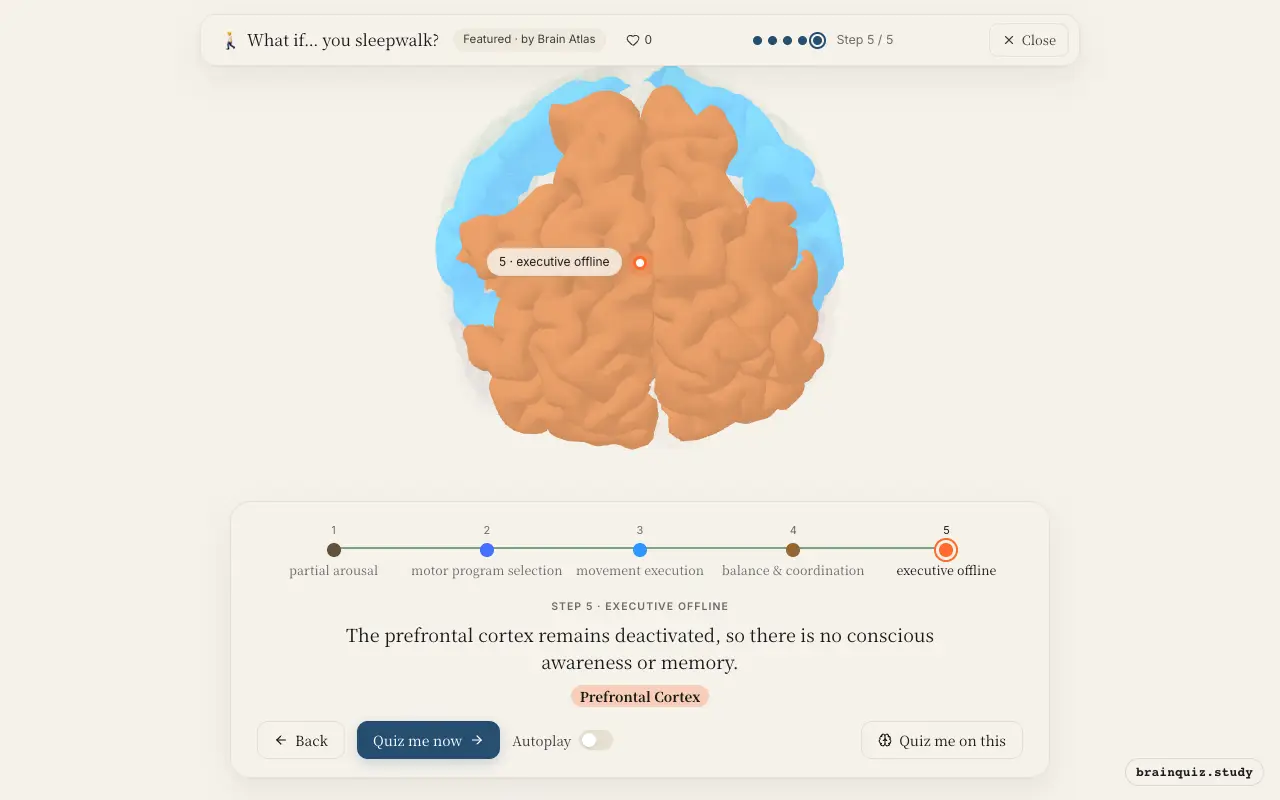
| 5 | Prefrontal Cortex | The prefrontal cortex remains deactivated, so there is no conscious awareness or memory. |
1. Brainstem: partial arousal

During stage N3 sleep, the brainstem can generate a partial arousal that does not fully wake the cortex. This allows subcortical motor circuits to become active while higher cortical areas remain in sleep, setting the stage for sleepwalking.
2. Basal Ganglia: motor program selection
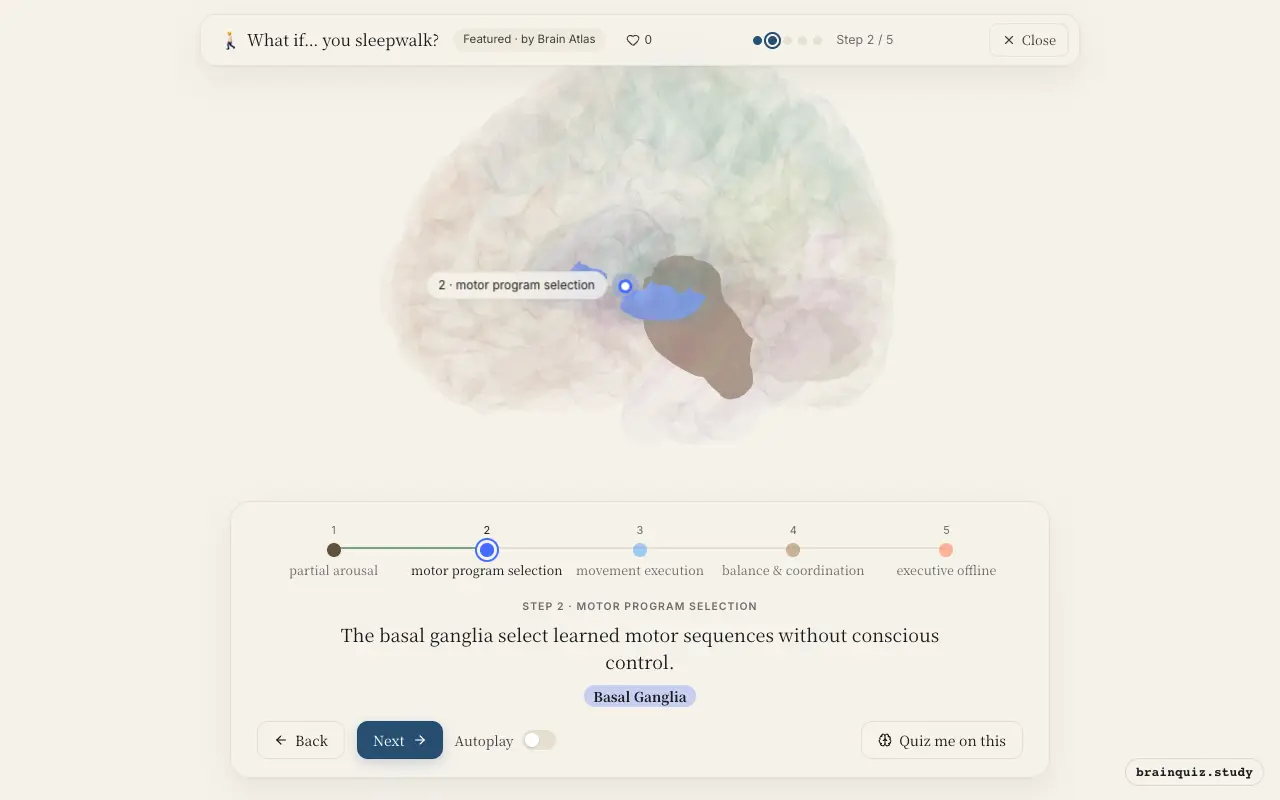
The basal ganglia can initiate habitual behaviors through their role in action selection. During sleepwalking, these circuits may drive complex movements such as walking or even manipulating objects, using stored motor programs that do not require executive oversight.
3. Motor Cortex: movement execution
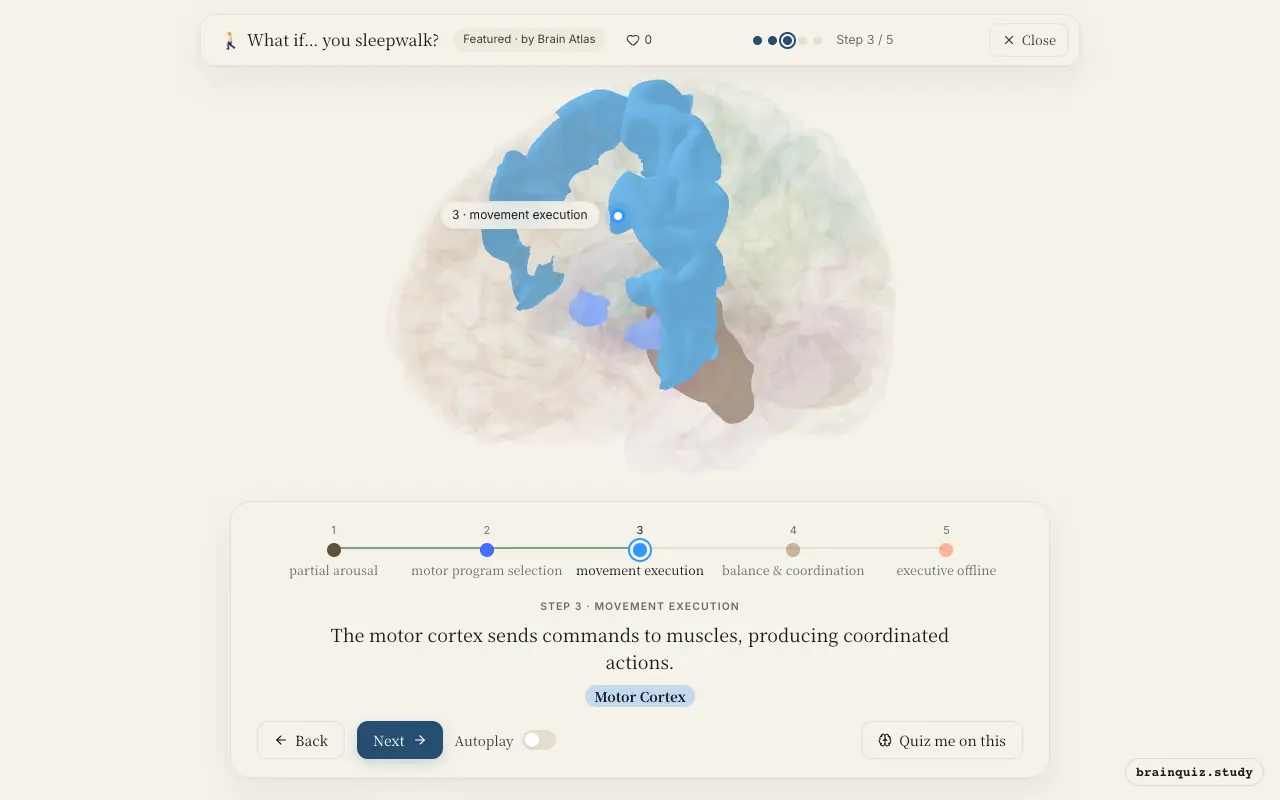
The motor cortex, particularly the primary motor area, is thought to be active during sleepwalking episodes. It generates the neural signals that travel down the corticospinal tract to move the body, enabling the person to walk, open doors, or perform other motor tasks while asleep.
4. Cerebellum: balance & coordination
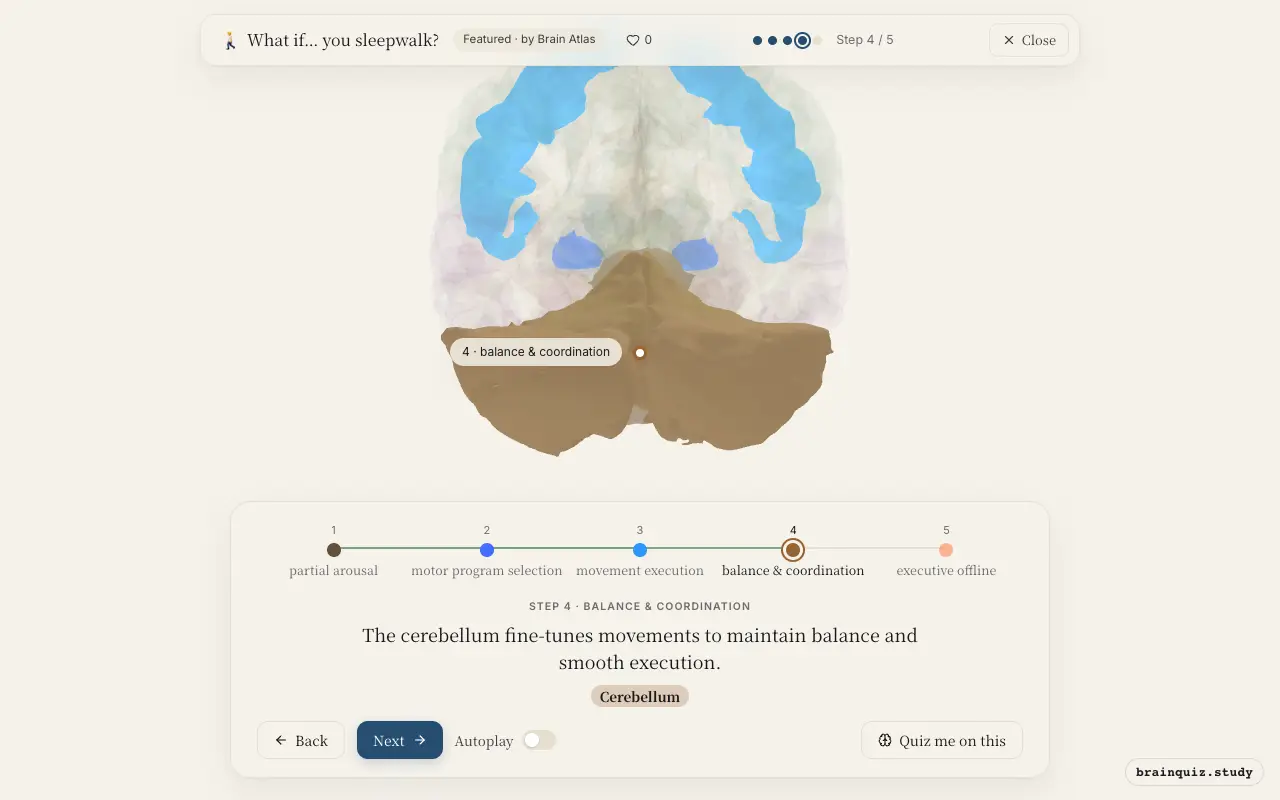
The cerebellum receives sensory feedback and adjusts motor commands in real time, ensuring that the sleepwalker does not fall and that movements are fluid. It coordinates posture, gait, and the timing of muscle activations during the episode.
5. Prefrontal Cortex: executive offline
The prefrontal cortex, which normally provides self-monitoring, judgment, and episodic memory encoding, shows reduced activity during sleepwalking. This explains why sleepwalkers typically have no recollection of the event and may behave in ways that ignore social norms or safety.
Good to know
- Sleepwalking is most common in children and tends to decrease with age, though it can persist into adulthood.
- Episodes typically occur during the first third of the night, when slow-wave sleep is most abundant.
- Unlike REM sleep behavior disorder, sleepwalking is not associated with vivid dreaming; people are not acting out a dream.
Sleepwalking vs REM Sleep Behavior Disorder
Sleepwalking arises from partial arousal in deep non-REM sleep, with motor areas active but prefrontal cortex asleep. In RBD, the brainstem fails to paralyze muscles during REM sleep, so people physically act out vivid, often violent dreams with full emotional content.
Test yourself
Which sleep stage does sleepwalking typically occur in?
Which brain region is relatively deactivated during sleepwalking, explaining lack of awareness?
What role does the basal ganglia play in sleepwalking?
0 of 3 answered · 0 correct
Simplified: many regions work together at once, and this shows the main players in the order they act.