What happens in your brain when you take a sleeping pill?
Updated
A sleeping pill boosts GABA-A inhibition: the brainstem's arousal system quiets, the thalamus reduces relaying sensory signals, the prefrontal cortex slows executive processing, and the hippocampus reduces encoding, inducing sleep and amnesia.
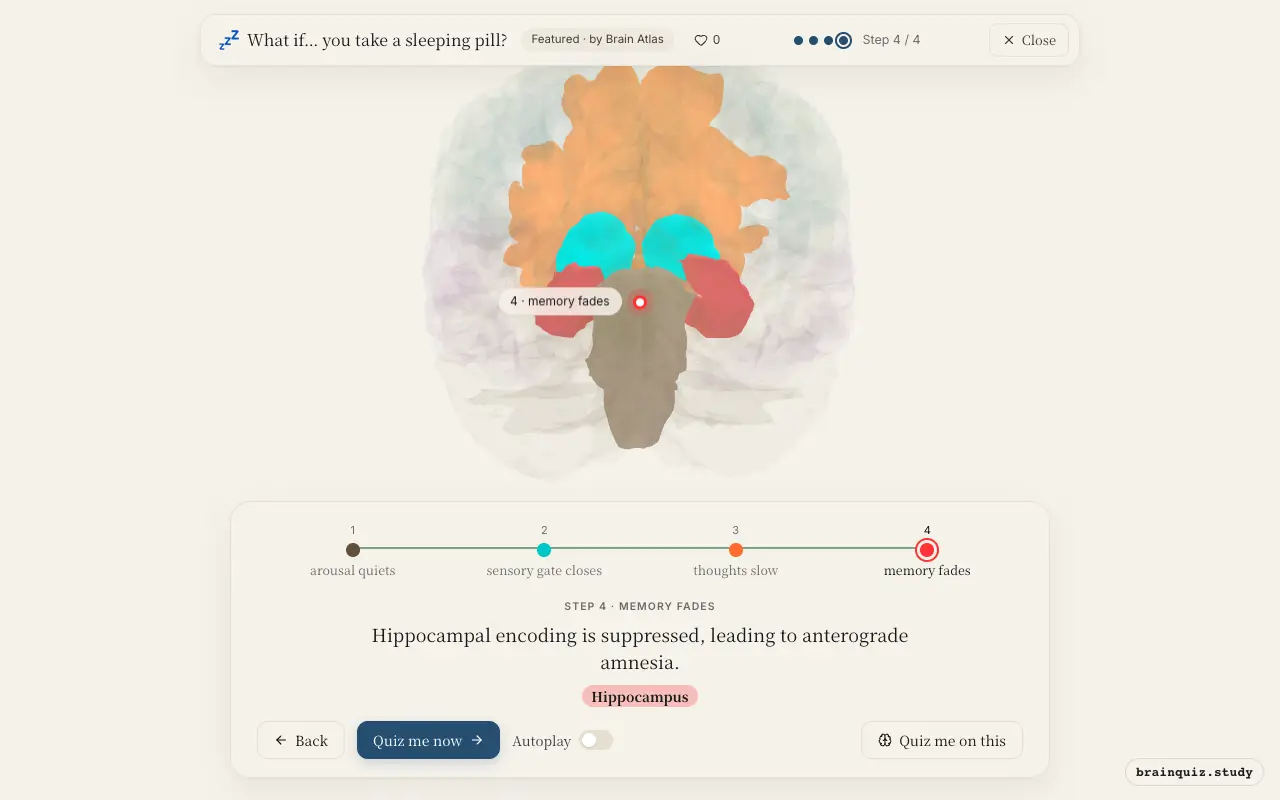
Watch it light up on the 3D brain
Brain regions that light up
| Order | Region | What it does here |
|---|---|---|
| 1 | Brainstem | The brainstem's wake-promoting neurons are inhibited by enhanced GABA-A signaling. |
| 2 | Thalamus | The thalamus reduces relay of external sensory information to the cortex. |
| 3 | Prefrontal Cortex | Prefrontal cortex activity decreases, reducing executive functions and conscious awareness. |
| 4 | Hippocampus | Hippocampal encoding is suppressed, leading to anterograde amnesia. |
1. Brainstem: arousal quiets
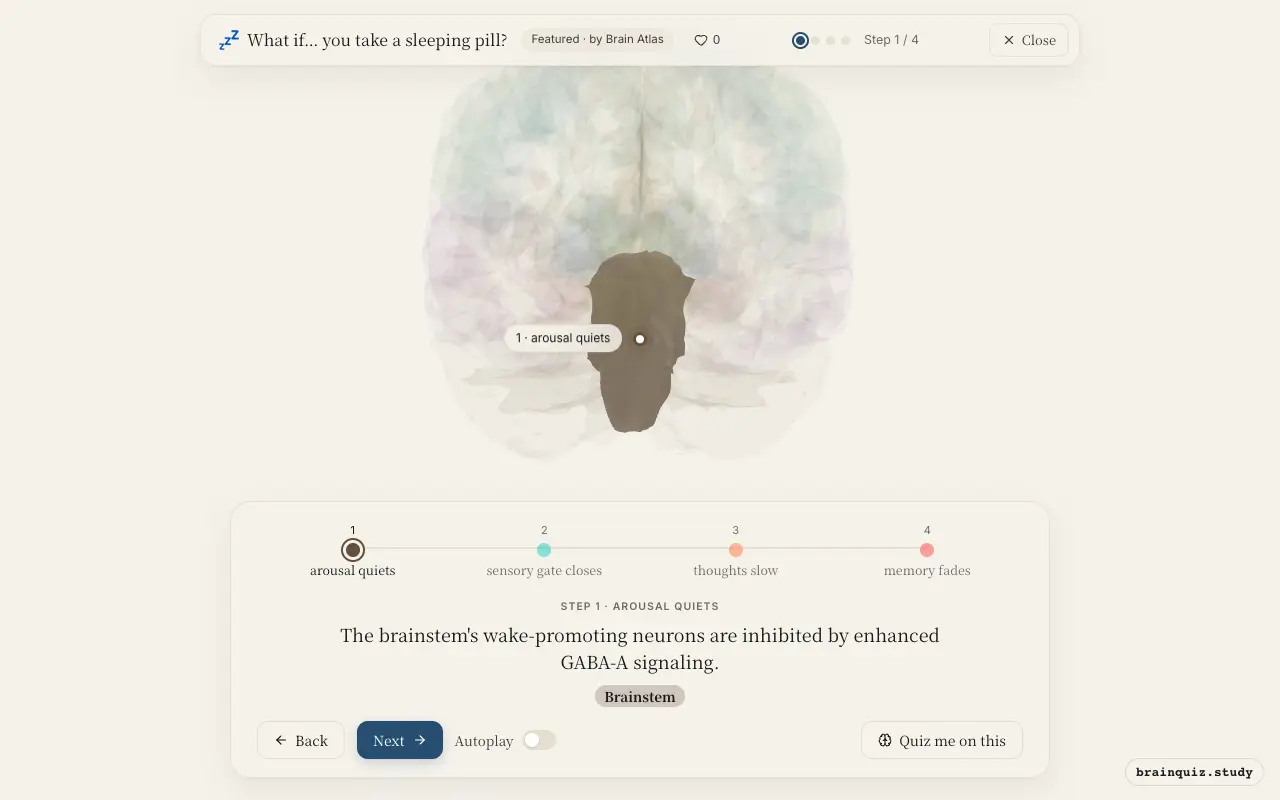
The pill binds to GABA-A receptors, increasing chloride influx and hyperpolarizing neurons in the reticular activating system. This reduces the ascending arousal drive, making it easier to fall asleep. The brainstem's control over heart rate and breathing remains active but less excitable.
2. Thalamus: sensory gate closes
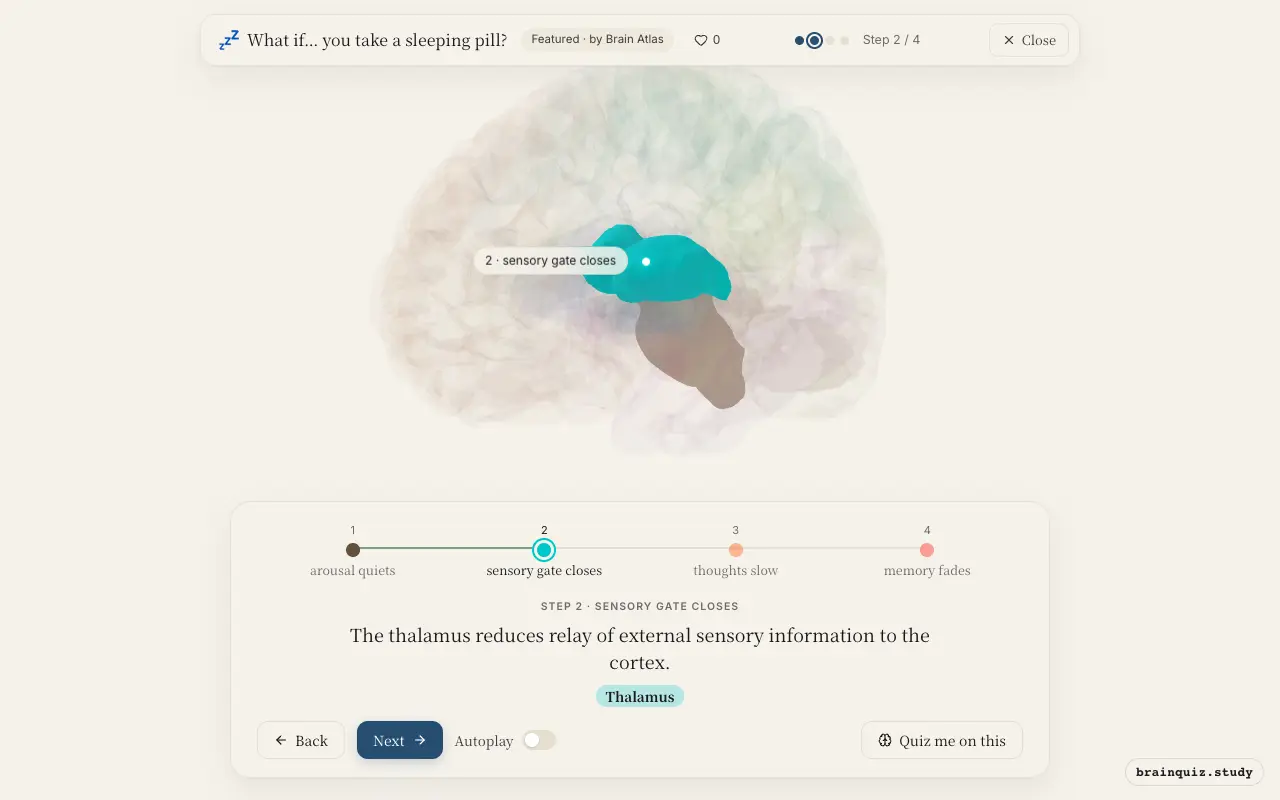
Enhanced GABA-A inhibition in thalamic relay nuclei decreases their firing rate. This dampens the flow of sounds, light, and touch to the cerebral cortex, promoting a state of sensory disconnection. Sleep spindles, generated by the thalamus, may increase, reflecting lighter NREM sleep.
3. Prefrontal Cortex: thoughts slow
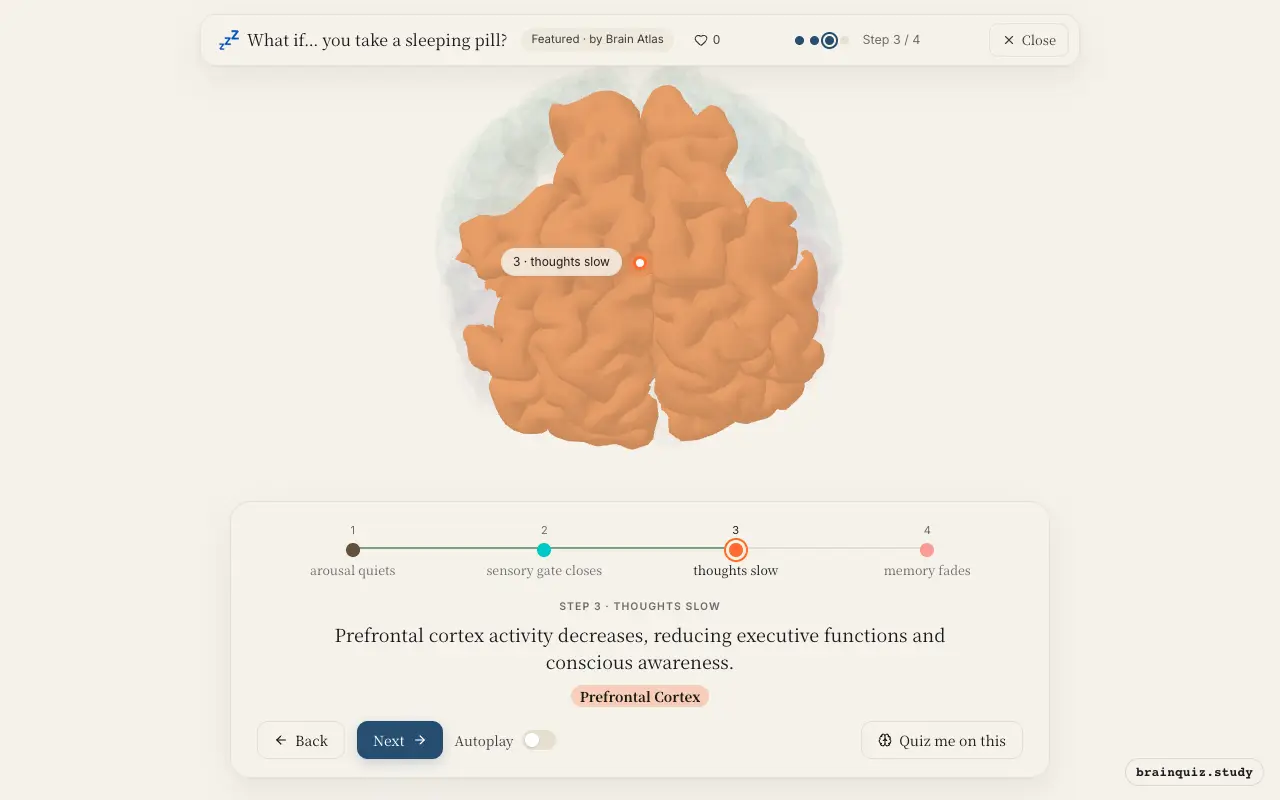
With less excitatory input, the prefrontal cortex lowers its metabolic rate and neural firing. This impairs working memory, decision-making, and self-monitoring, contributing to the hypnotic effect. The user feels drowsy and unfocused as higher cognition winds down.
4. Hippocampus: memory fades
GABAergic enhancement in the hippocampus inhibits long-term potentiation. New experiences are not consolidated into memory, so events during the drug's action may be forgotten. This explains why users often have no recollection of falling asleep.
Good to know
- Benzodiazepines and Z-drugs are positive allosteric modulators of the GABA-A receptor, not direct agonists.
- Sleeping pills reduce sleep latency and increase total sleep time but may decrease time in slow-wave and REM sleep.
- Tolerance can develop within days to weeks, leading to reduced effectiveness over time.
Sleeping pill vs. alcohol before bed
Both enhance GABA-A inhibition, but alcohol also blocks NMDA glutamate receptors and disrupts sleep architecture more severely. A sleeping pill primarily targets sleep-regulating circuits, while alcohol fragments sleep and suppresses REM earlier, causing rebound effects later in the night.
Test yourself
Which neurotransmitter system is primarily enhanced by most prescription sleeping pills?
Which brain region's reduced activity explains why you might not remember falling asleep?
What is the role of the thalamus during sleeping pill-induced sedation?
0 of 3 answered · 0 correct
Simplified: many regions work together at once, and this shows the main players in the order they act. For learning only, not medical advice.