What happens in your brain when you teach someone else?
Updated
Teaching recruits the hippocampus for memory retrieval, the prefrontal cortex to organize the explanation, Broca's area for speech, the anterior cingulate to monitor the learner, and the orbitofrontal cortex for social reward.
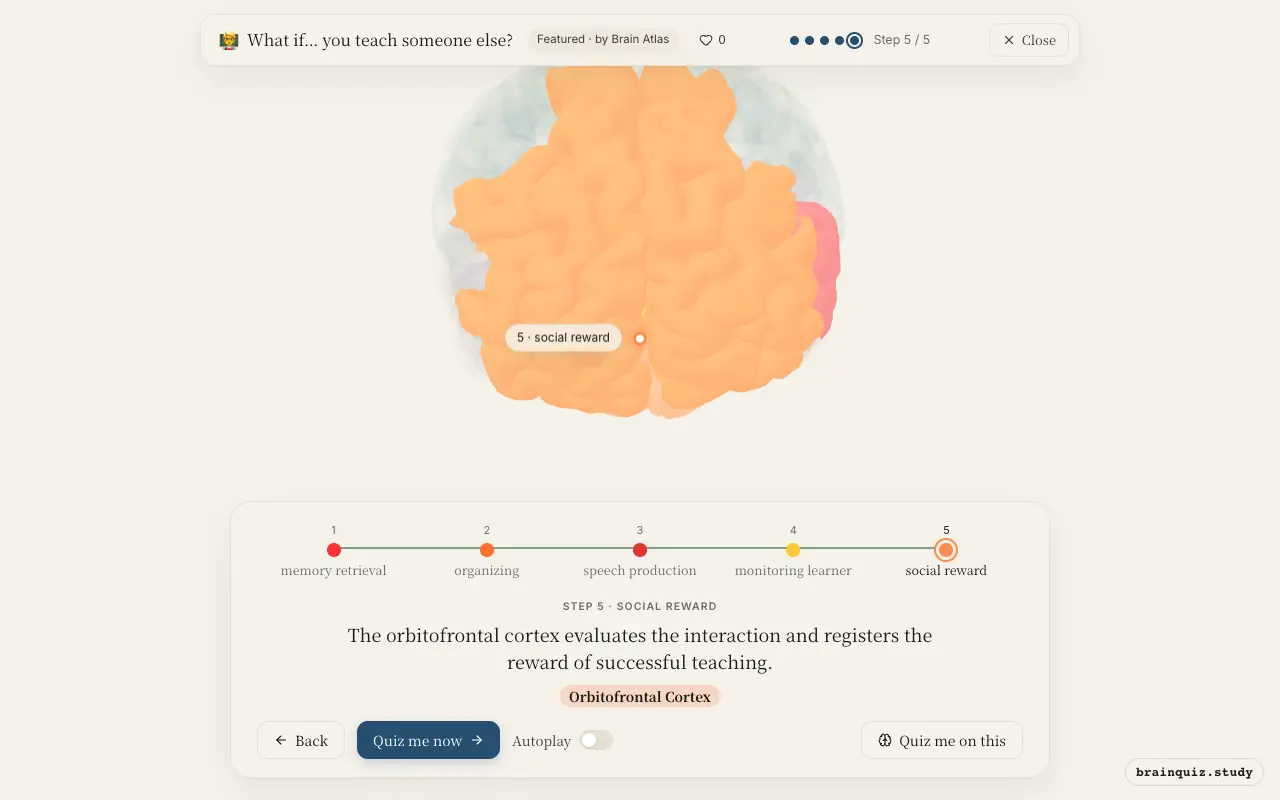
Watch it light up on the 3D brain
Brain regions that light up
| Order | Region | What it does here |
|---|---|---|
| 1 | Hippocampus | The hippocampus retrieves facts and concepts you need to teach. |
| 2 | Prefrontal Cortex | The prefrontal cortex organizes retrieved information into a coherent explanation. |
| 3 | Broca's Area | Broca's area translates the planned message into spoken words. |
| 4 | Anterior Cingulate Cortex | The anterior cingulate detects errors or confusion in the learner's feedback. |
| 5 | Orbitofrontal Cortex | The orbitofrontal cortex evaluates the interaction and registers the reward of successful teaching. |
1. Hippocampus: memory retrieval
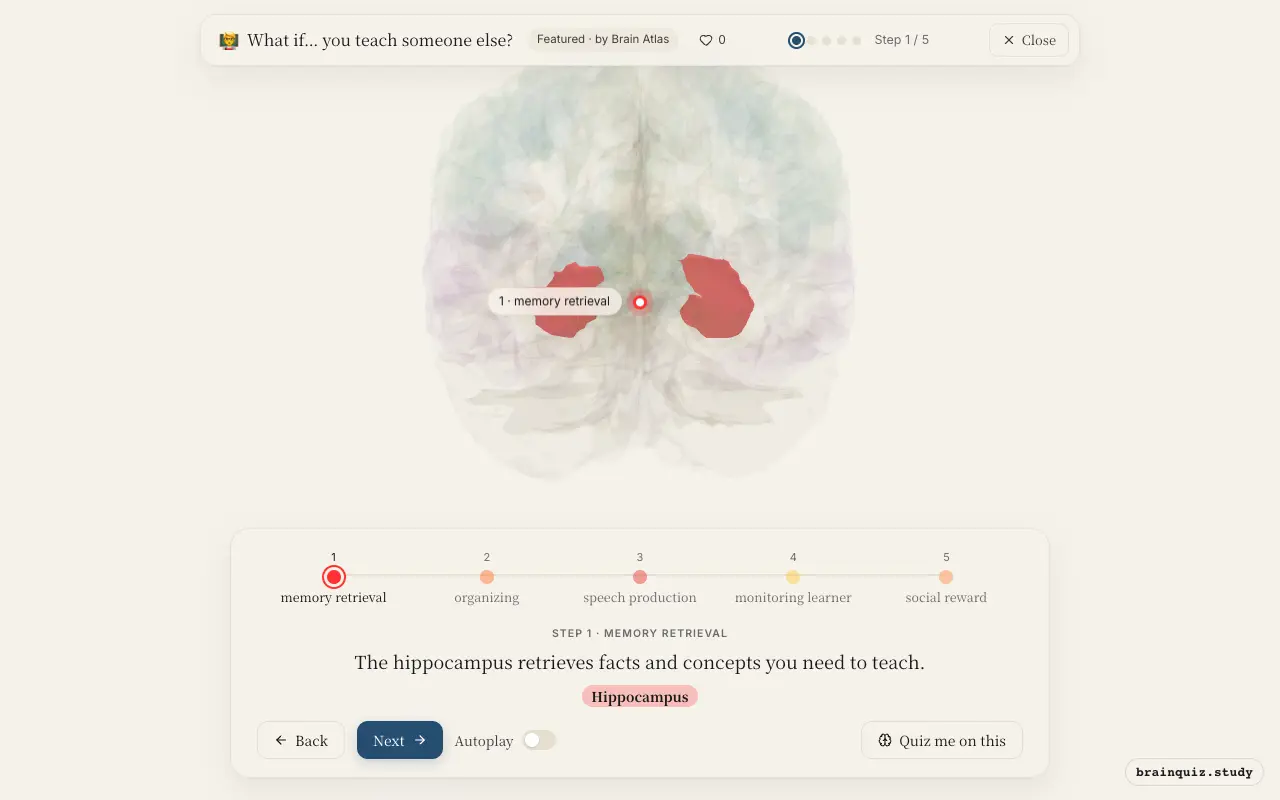
The hippocampus is essential for recalling explicit memories. When you decide to teach, it activates stored knowledge networks, bringing relevant information into working memory. This retrieval is context-dependent and can be strengthened by the intention to teach.
2. Prefrontal Cortex: organizing
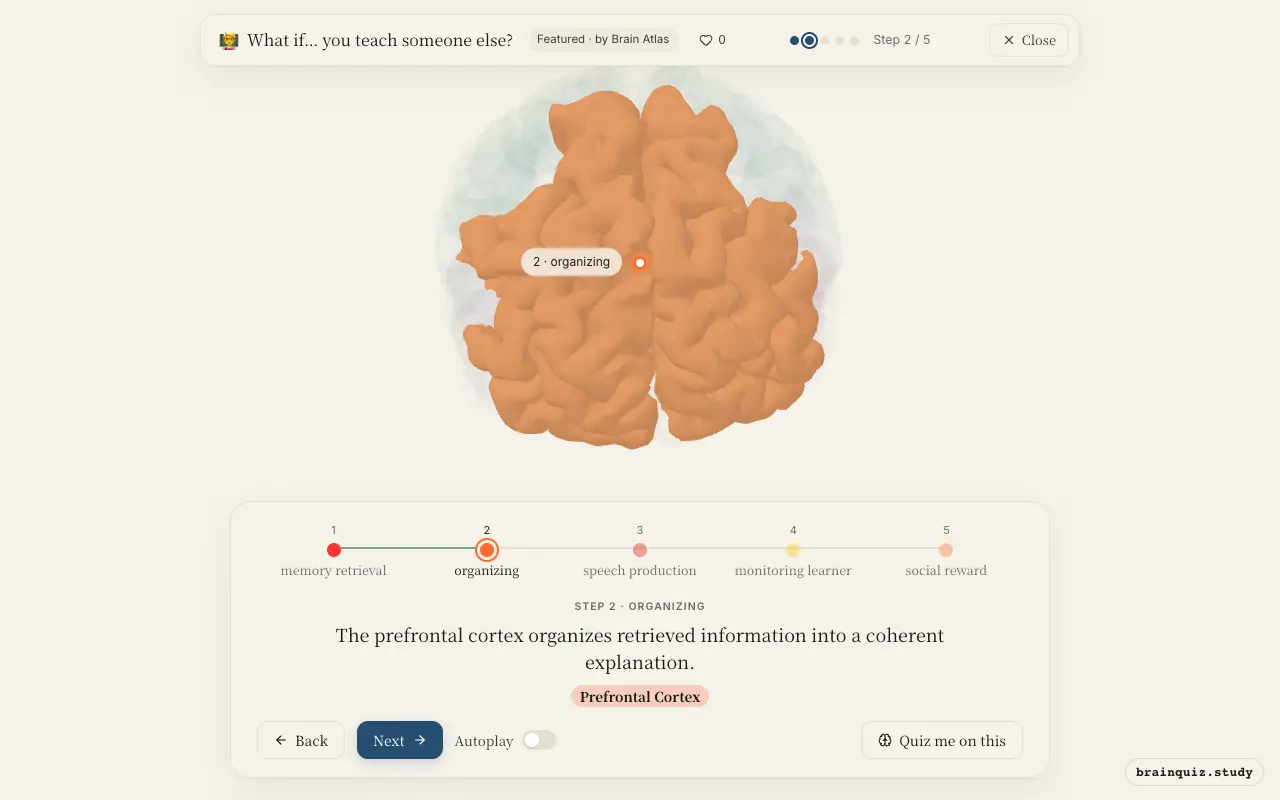
The prefrontal cortex manages working memory and executive functions. It sequences concepts, selects key points, and suppresses irrelevant details. This region also monitors your own understanding, a process known as metacognition, to adjust the explanation for the learner.
3. Broca's Area: speech production
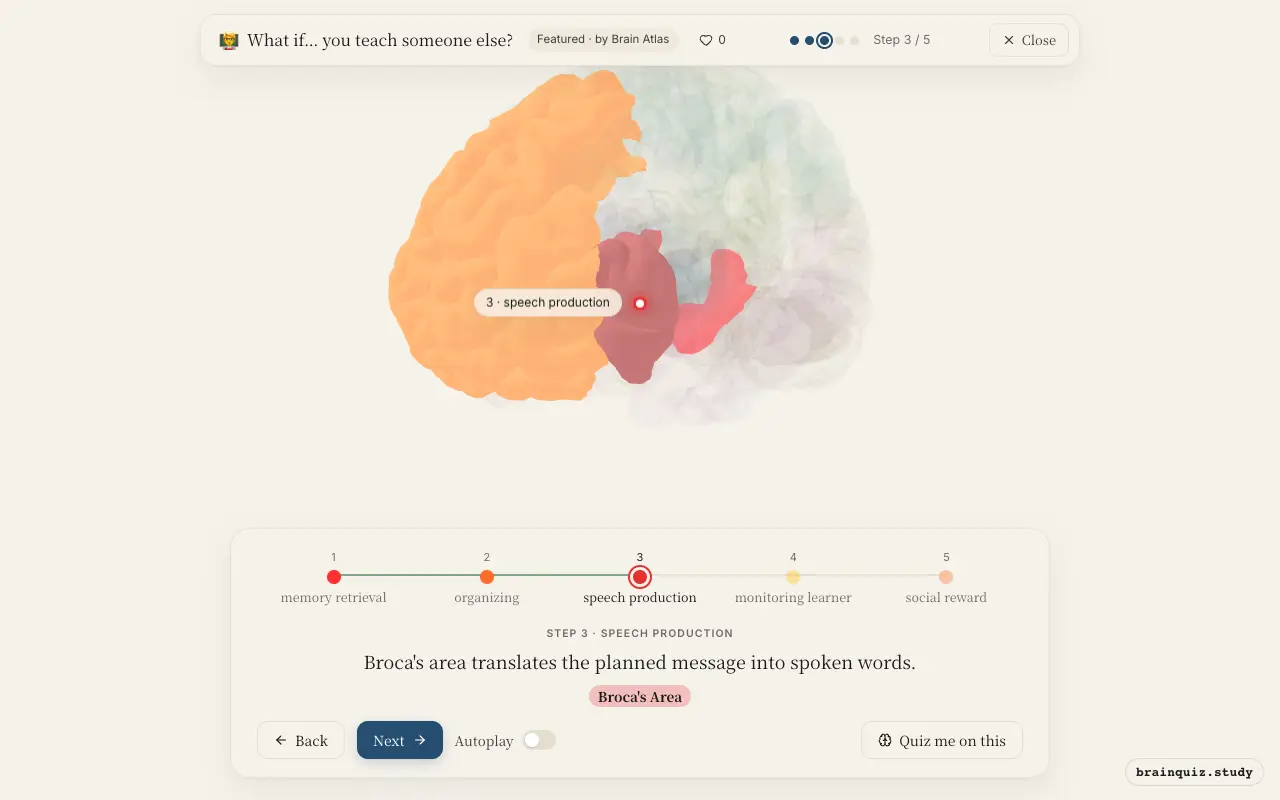
Broca's area is critical for language production. It coordinates the motor programs for articulation by sending signals to the motor cortex, which controls the muscles of speech. It also processes grammatical structure, ensuring sentences are fluent.
4. Anterior Cingulate Cortex: monitoring learner
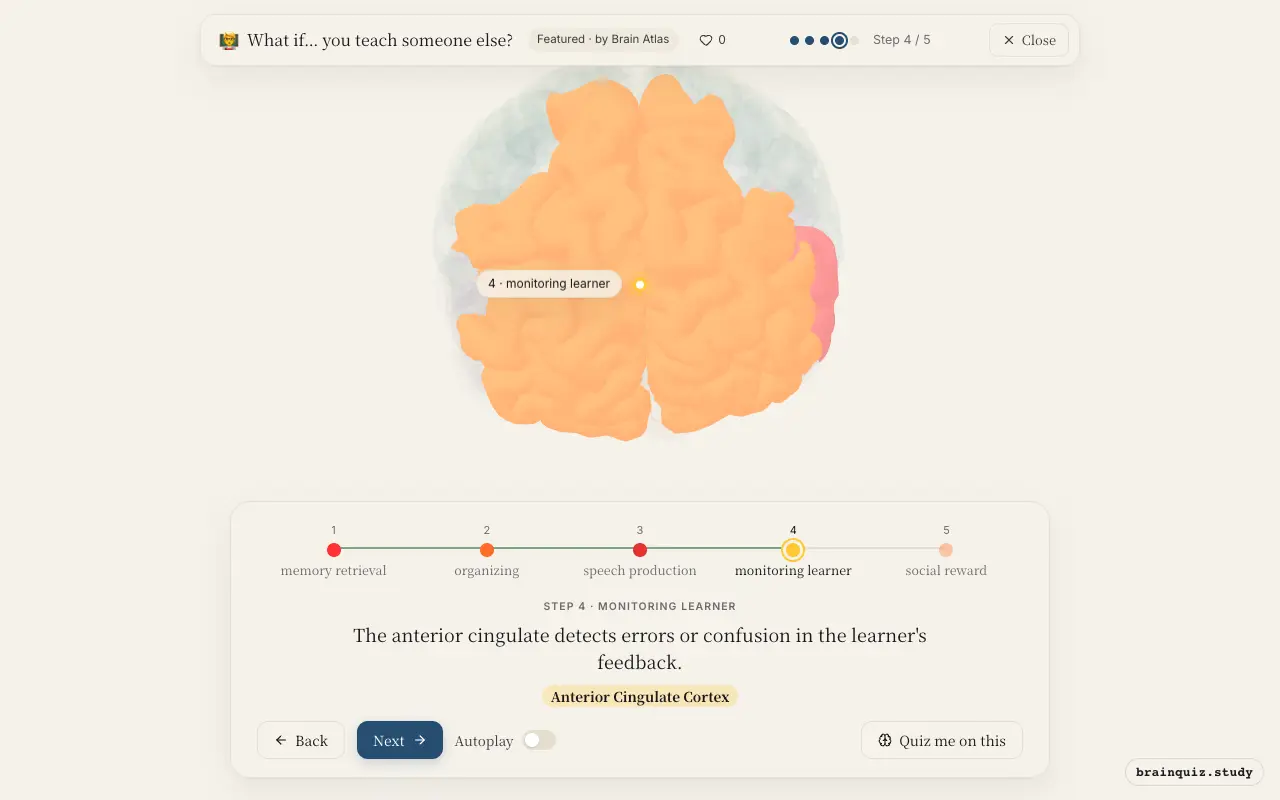
The anterior cingulate cortex is involved in error detection and conflict monitoring. While teaching, it processes social cues like puzzled expressions or questions, signaling when the learner does not understand. This triggers adjustments in the explanation, such as rephrasing or adding examples.
5. Orbitofrontal Cortex: social reward
The orbitofrontal cortex integrates reward value and social feedback. When the learner shows comprehension, it generates a positive emotional response, reinforcing the teaching behavior. This reward signal may motivate future teaching and contribute to the satisfaction of helping others learn.
Good to know
- The 'protégé effect' describes improved memory and understanding in teachers after they explain material to others.
- Teaching activates brain networks involved in social cognition, including theory of mind regions that infer the learner's mental state.
- Dopamine release in reward pathways may reinforce teaching when the learner succeeds, making the interaction intrinsically rewarding.
Teaching vs passive studying
Teaching engages additional prefrontal, language, and social monitoring regions to adapt to another person. Passive studying relies more on hippocampal encoding and visual attention, without the need for real-time error detection and speech production. The social reward circuitry is uniquely active during teaching.
Test yourself
Which brain region is primarily responsible for retrieving stored knowledge during teaching?
What role does the anterior cingulate cortex play when you teach someone?
Why is the orbitofrontal cortex active during successful teaching?
0 of 3 answered · 0 correct
Simplified: many regions work together at once, and this shows the main players in the order they act.