What happens in your brain when you wake up groggy?
Updated
The brainstem and hypothalamus initiate arousal, the thalamus begins relaying signals, but the prefrontal cortex lags behind, leaving you with mental fog and slow thinking.
Watch it light up on the 3D brain
Brain regions that light up
| Order | Region | What it does here |
|---|---|---|
| 1 | Brainstem | During non-REM sleep, brainstem neurons dampen arousal signals, keeping you unconscious. |
| 2 | Hypothalamus | The hypothalamus senses morning and triggers the switch from sleep to wake. |
| 3 | Locus Coeruleus | The locus coeruleus releases noradrenaline to rouse the cortex. |
| 4 | Thalamus | The thalamus begins relaying sensory and internal signals to the cortex. |
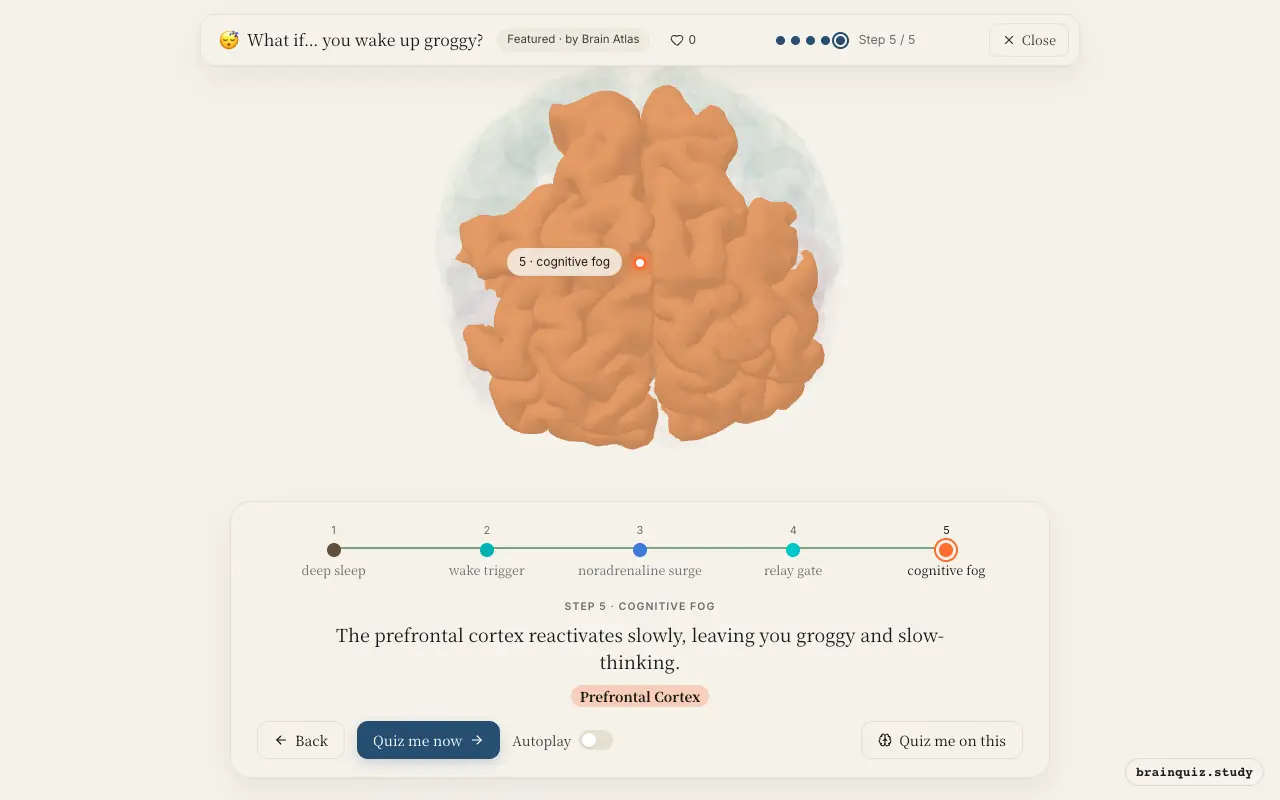
| 5 | Prefrontal Cortex | The prefrontal cortex reactivates slowly, leaving you groggy and slow-thinking. |
1. Brainstem: deep sleep
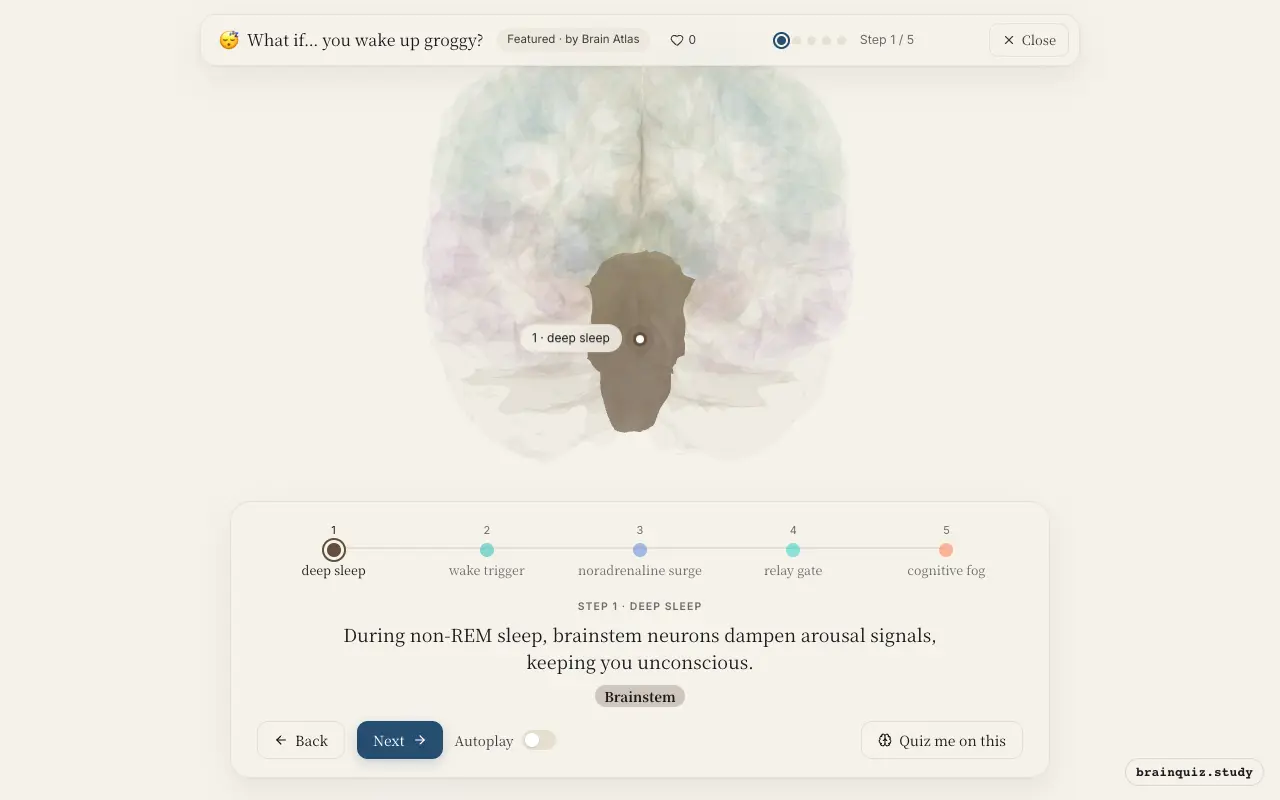
The brainstem's reticular formation reduces excitatory drive to the cortex, keeping you in a stable sleep state. During slow-wave sleep, this inhibition is strongest. Upon waking, the reticular system does not instantly resume full activity, so a low-arousal baseline lingers and contributes to grogginess.
2. Hypothalamus: wake trigger
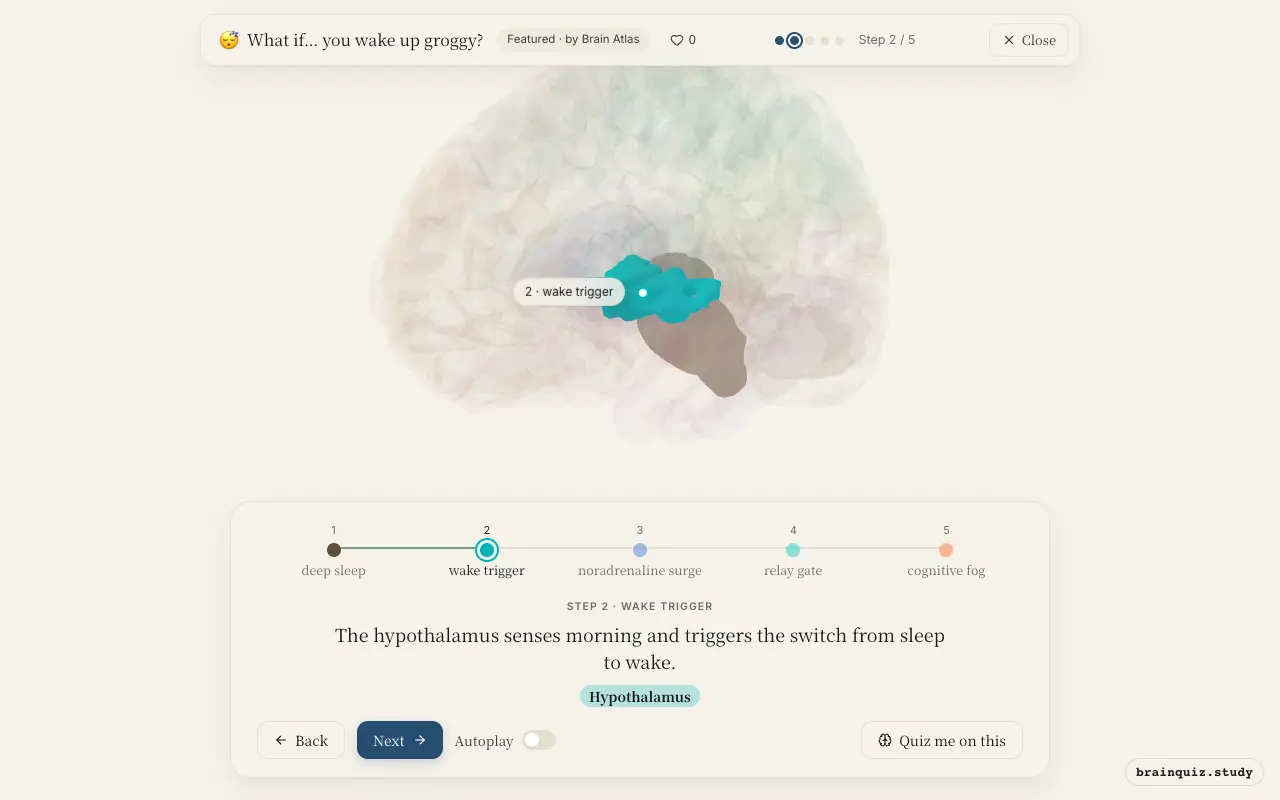
The suprachiasmatic nucleus detects morning light and shifts circadian output to wake mode. Hypothalamic orexin neurons become active, stabilizing the waking state and exciting the brainstem arousal system. This transition must overcome sleep-promoting systems like the ventrolateral preoptic area, which can lag, leaving you half-asleep.
3. Locus Coeruleus: noradrenaline surge
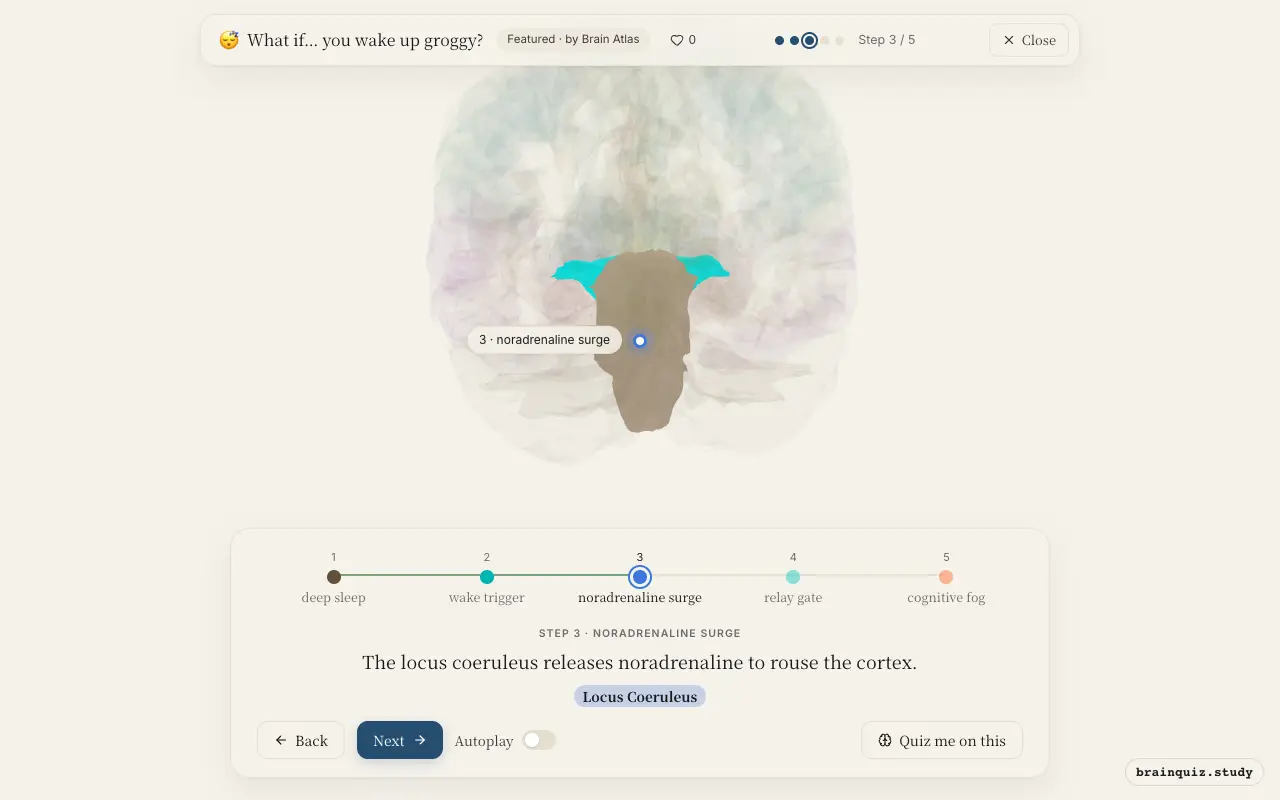
The locus coeruleus is a small pontine nucleus that releases noradrenaline throughout the cortex during wakefulness. This neurotransmitter boosts neuronal responsiveness and improves signal-to-noise ratio, aiding alert attention. Early waking levels may be insufficient fully to activate executive networks, so cortical activation remains muted and grogginess persists.
4. Thalamus: relay gate
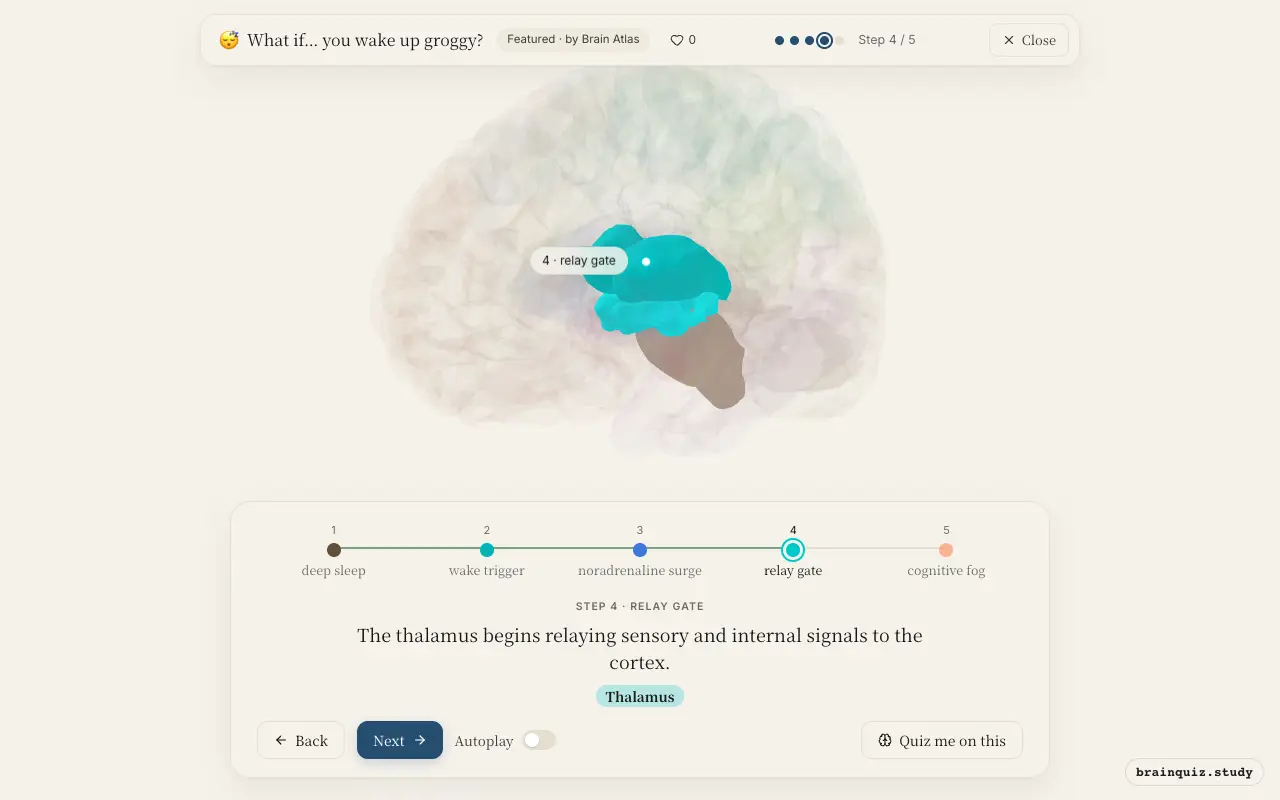
The thalamus acts as a gate for sensory and cortical information, filtering what reaches the cortex. During sleep, its relay cells are inhibited by GABAergic inputs. On waking, this inhibition lifts gradually, so the thalamus is still sluggish at transmitting signals, slowing perception and thought.
5. Prefrontal Cortex: cognitive fog
The prefrontal cortex governs working memory, attention, and decision-making. After waking, its metabolic activity and connectivity with subcortical arousal centers recover more slowly than primary sensory areas. This lag produces the classic heavy-headed feeling and poor executive function known as sleep inertia.
Good to know
- Sleep inertia is most severe after waking from slow-wave sleep, the deepest non-REM stage.
- Caffeine can temporarily reduce grogginess by blocking adenosine receptors that promote sleep pressure.
- Reaction times can be impaired for up to 30 minutes after waking, comparable to moderate sleep deprivation.
Groggy wake vs. alert wake
In an alert wake, the prefrontal cortex reactivates quickly and the thalamus shifts to a fully alert relay mode. In sleep inertia, these transitions lag, especially after deep sleep, leaving you sluggish longer. Overall, grogginess reflects a mismatch between subcortical arousal and cortical readiness.
Test yourself
Which brain region shows delayed reactivation during sleep inertia?
Which neurotransmitter from the locus coeruleus promotes arousal?
Sleep inertia is worst after waking from which stage?
0 of 3 answered · 0 correct
Simplified: many regions work together at once, and this shows the main players in the order they act.