What happens in your brain when you work a night shift?
Updated
Your brain fights its circadian clock: the hypothalamus pushes for sleep, the brainstem struggles to keep you alert, and the prefrontal cortex and thalamus falter, impairing focus and perception.
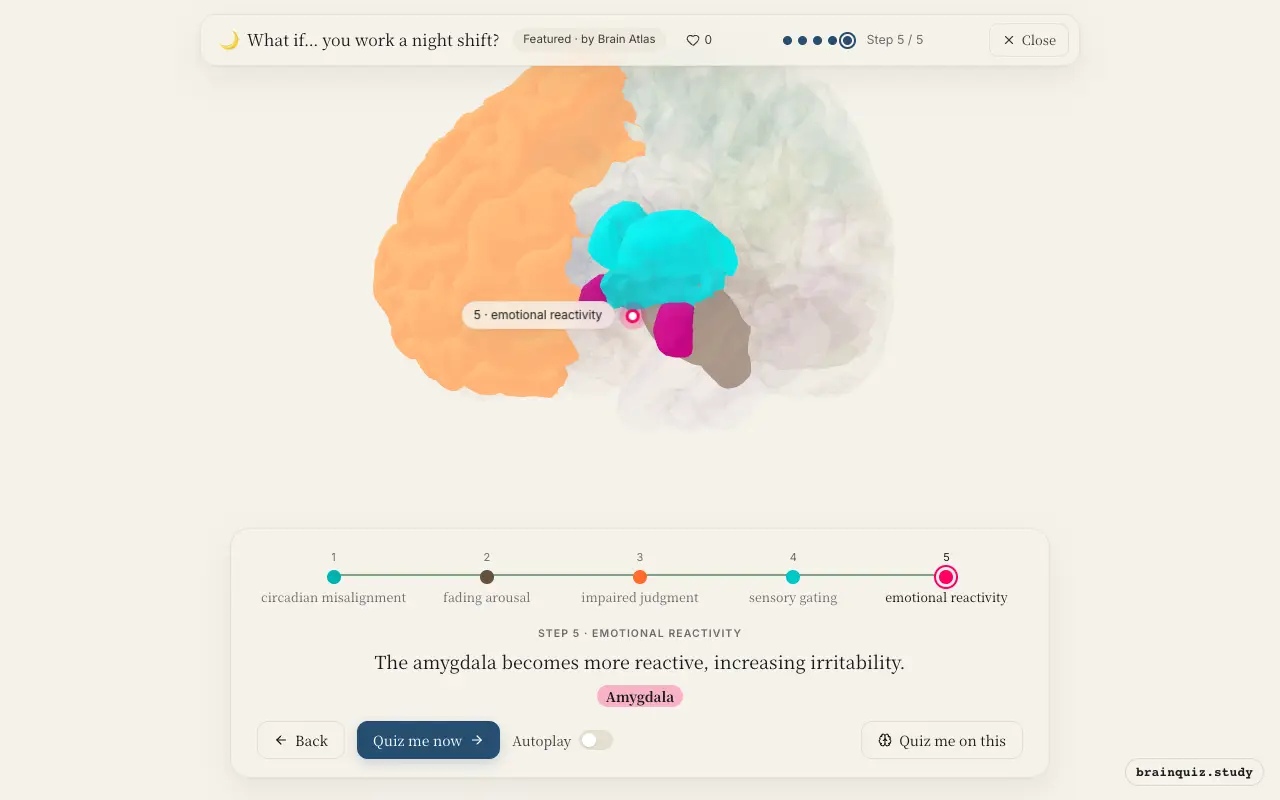
Watch it light up on the 3D brain
Brain regions that light up
| Order | Region | What it does here |
|---|---|---|
| 1 | Hypothalamus | The hypothalamus's clock signals sleep when you need to be awake. |
| 2 | Brainstem | Brainstem arousal systems struggle to maintain wakefulness. |
| 3 | Prefrontal Cortex | The prefrontal cortex slows down, reducing focus and decision-making. |
| 4 | Thalamus | The thalamus relays sensory information less efficiently. |
| 5 | Amygdala | The amygdala becomes more reactive, increasing irritability. |
1. Hypothalamus: circadian misalignment
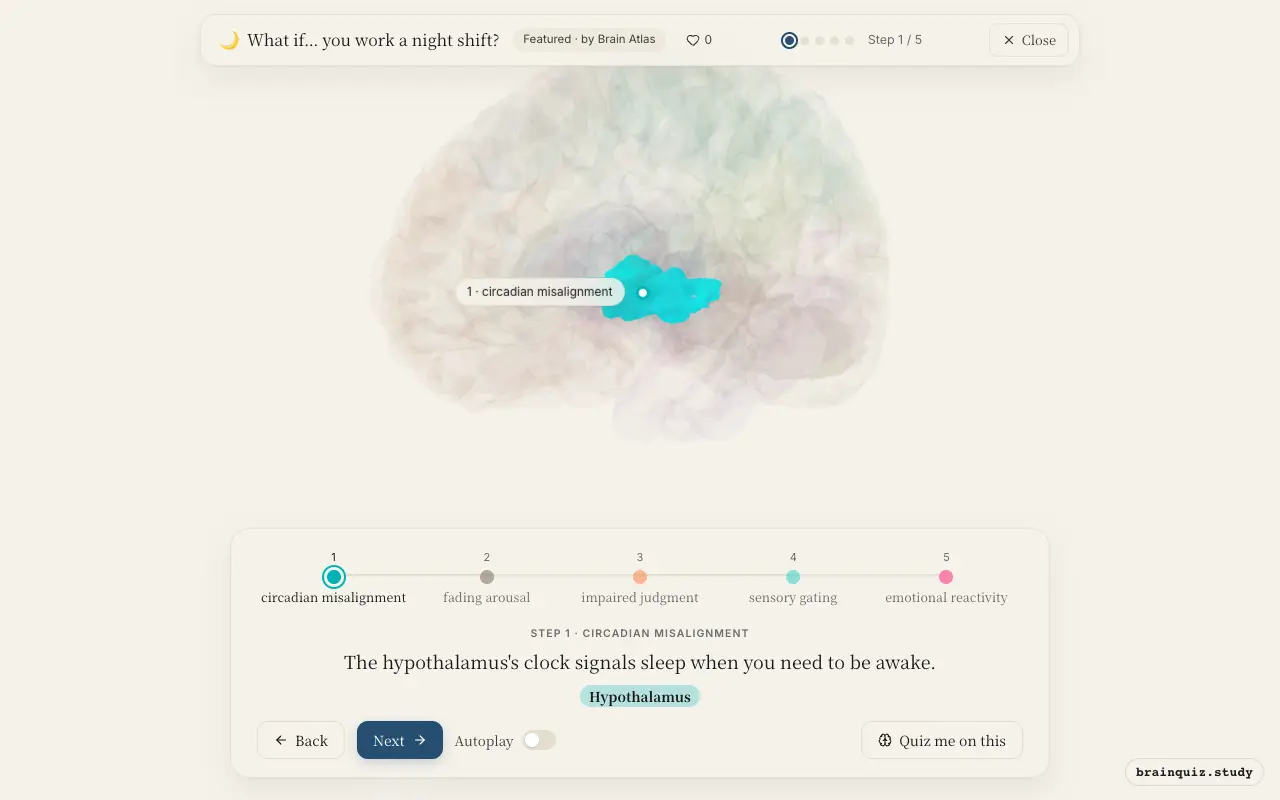
The suprachiasmatic nucleus in the hypothalamus keeps your circadian rhythm, promoting sleepiness at night. Working against this clock means the body is primed for rest while you must stay active. This mismatch is the root of night shift struggles.
2. Brainstem: fading arousal
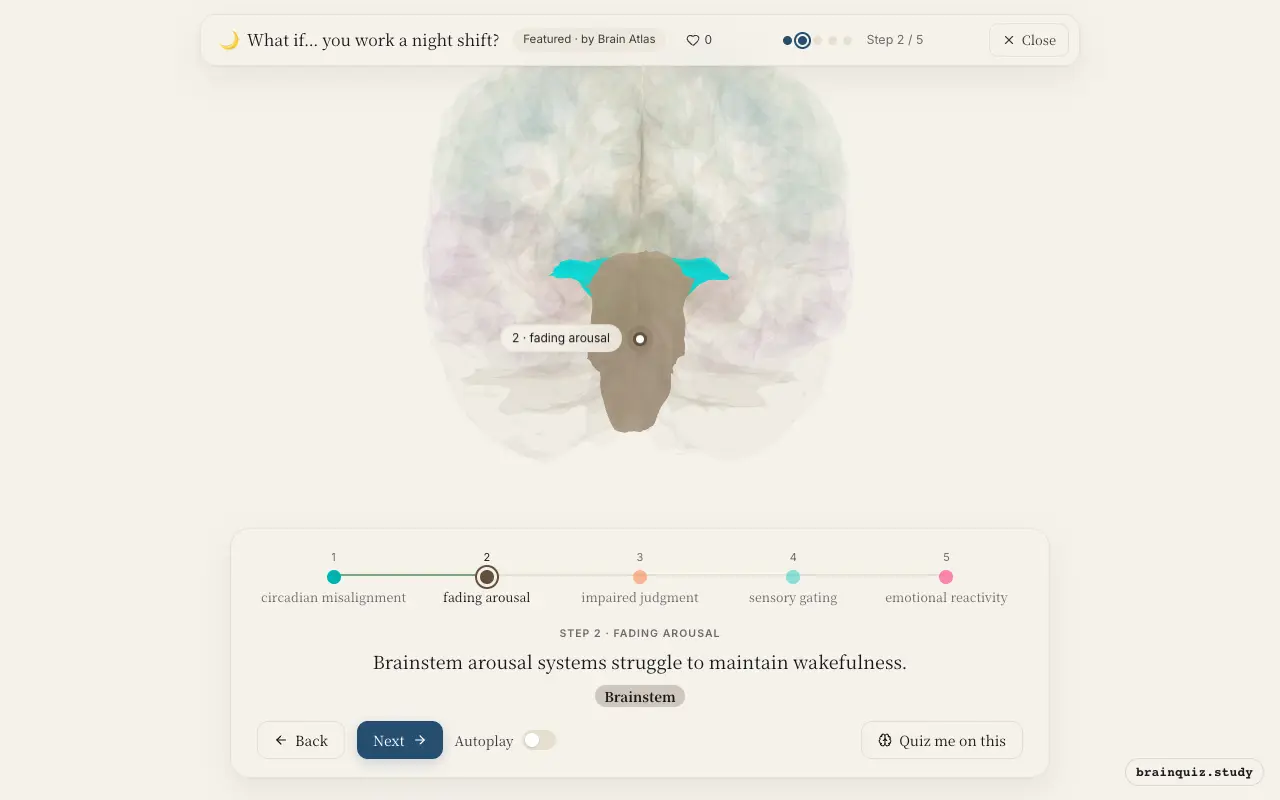
The brainstem's reticular activating system normally keeps you alert, but during a night shift its drive weakens. With circadian pressure for sleep rising, these arousal pathways cannot fully counteract the urge to sleep, leading to drowsiness.
3. Prefrontal Cortex: impaired judgment
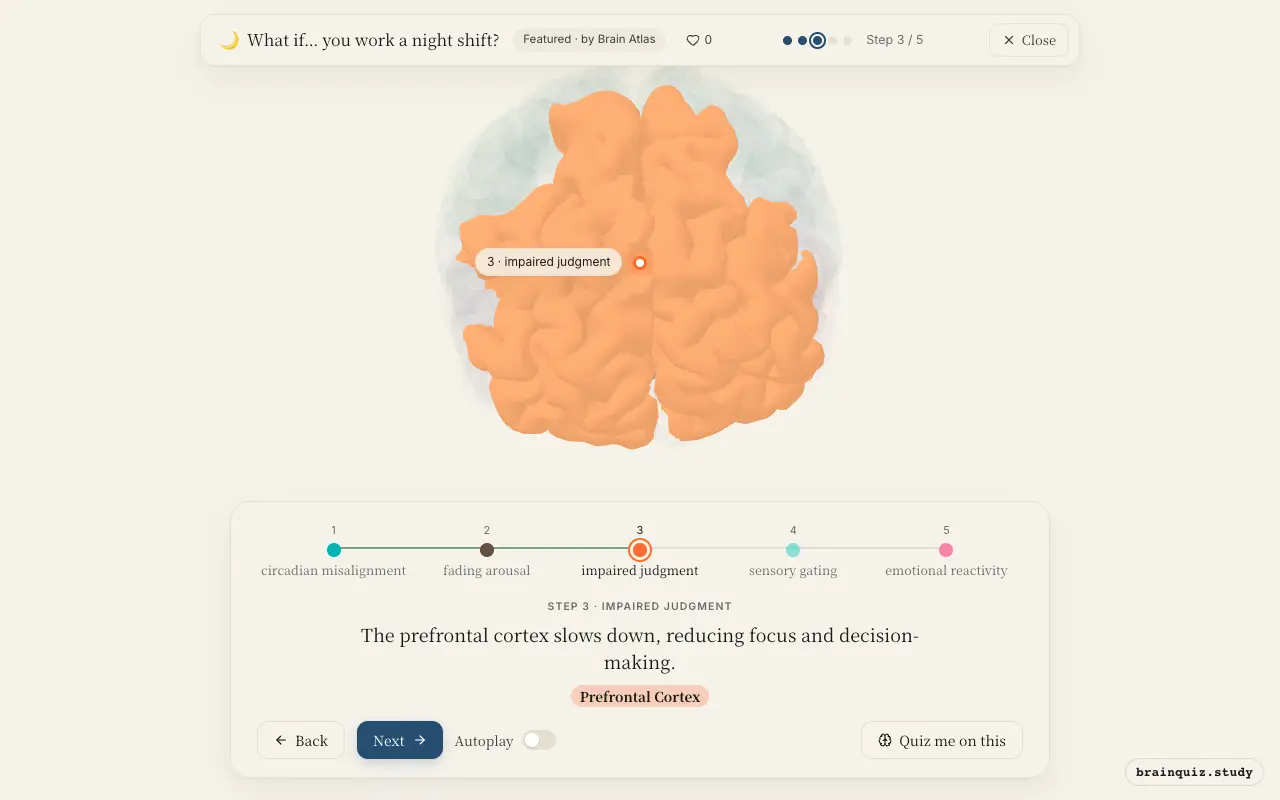
Sleep deprivation reduces metabolic activity in the prefrontal cortex, which handles executive functions like working memory and judgment. This makes it harder to concentrate, solve problems, and avoid mistakes during a night shift.
4. Thalamus: sensory gating
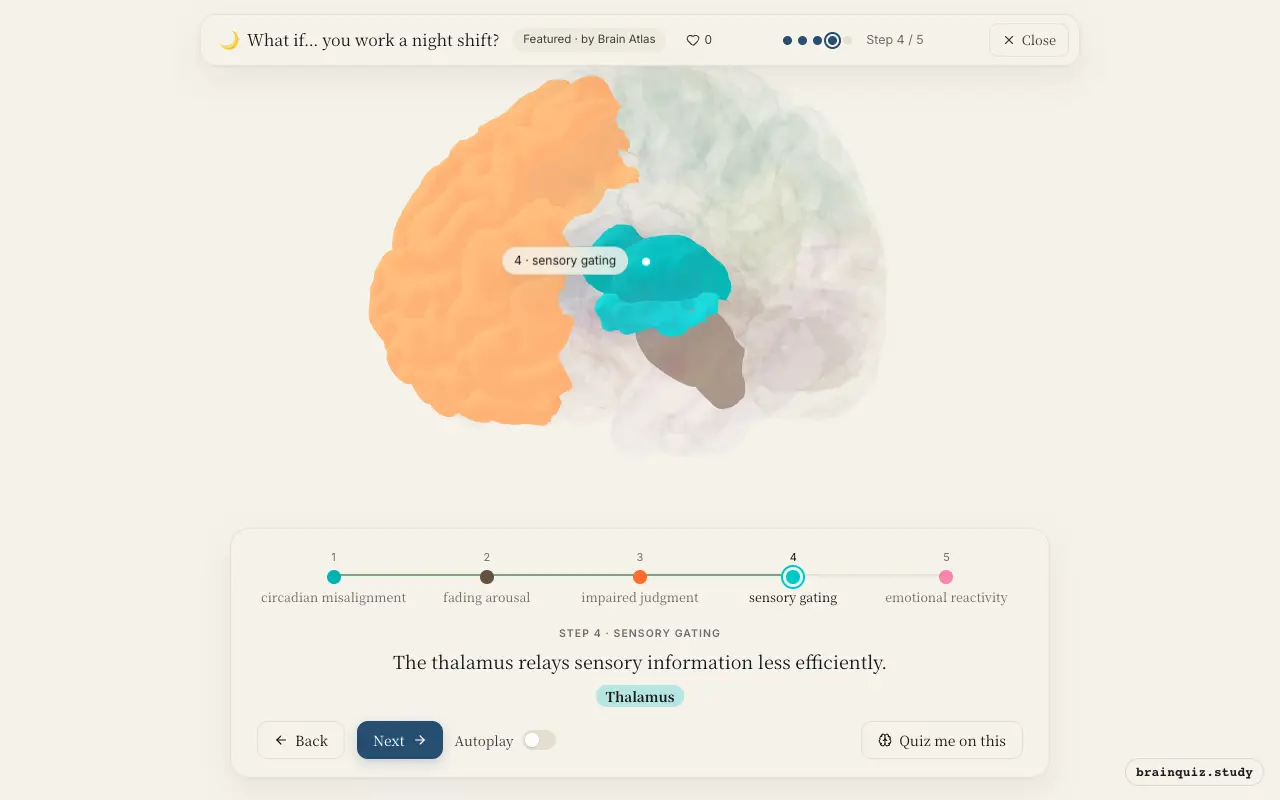
The thalamus normally filters and relays sensory input to the cortex. With sleep pressure high, its gating function degrades, making you less responsive to important stimuli and more prone to lapses in attention.
5. Amygdala: emotional reactivity
Without adequate sleep, the amygdala's response to negative stimuli is heightened while its connection to the prefrontal cortex weakens. This can make you more emotional, stressed, or short-tempered during a night shift.
Good to know
- Melatonin, secreted by the pineal gland under hypothalamic control, rises at night and promotes sleep, making night shift work physiologically difficult.
- Even after a night shift, daytime sleep is often shorter and less restorative than nighttime sleep because the circadian clock still promotes wakefulness during daylight.
- Chronic night shift work is associated with long-term health risks, including cardiovascular and metabolic disorders.
Night shift vs jet lag
Night shift keeps your circadian clock misaligned for days or weeks, while jet lag is a temporary mismatch that resolves as you adjust to the new time zone. In jet lag, light exposure resets the hypothalamus faster; in night shift, you often fight the clock constantly.
Test yourself
Which brain region is primarily responsible for the circadian rhythm that makes night shift work hard?
What happens to the prefrontal cortex during a night shift due to sleep deprivation?
Why does the amygdala cause increased irritability on a night shift?
0 of 3 answered · 0 correct
Simplified: many regions work together at once, and this shows the main players in the order they act.