What happens in your brain when you feel bored?
Updated
Boredom arises when the orbitofrontal cortex evaluates the environment as unrewarding, the anterior cingulate flags a mismatch, the prefrontal cortex struggles to re-engage attention, the posterior cingulate is active during mind-wandering, and the insula contributes to the felt restlessness.
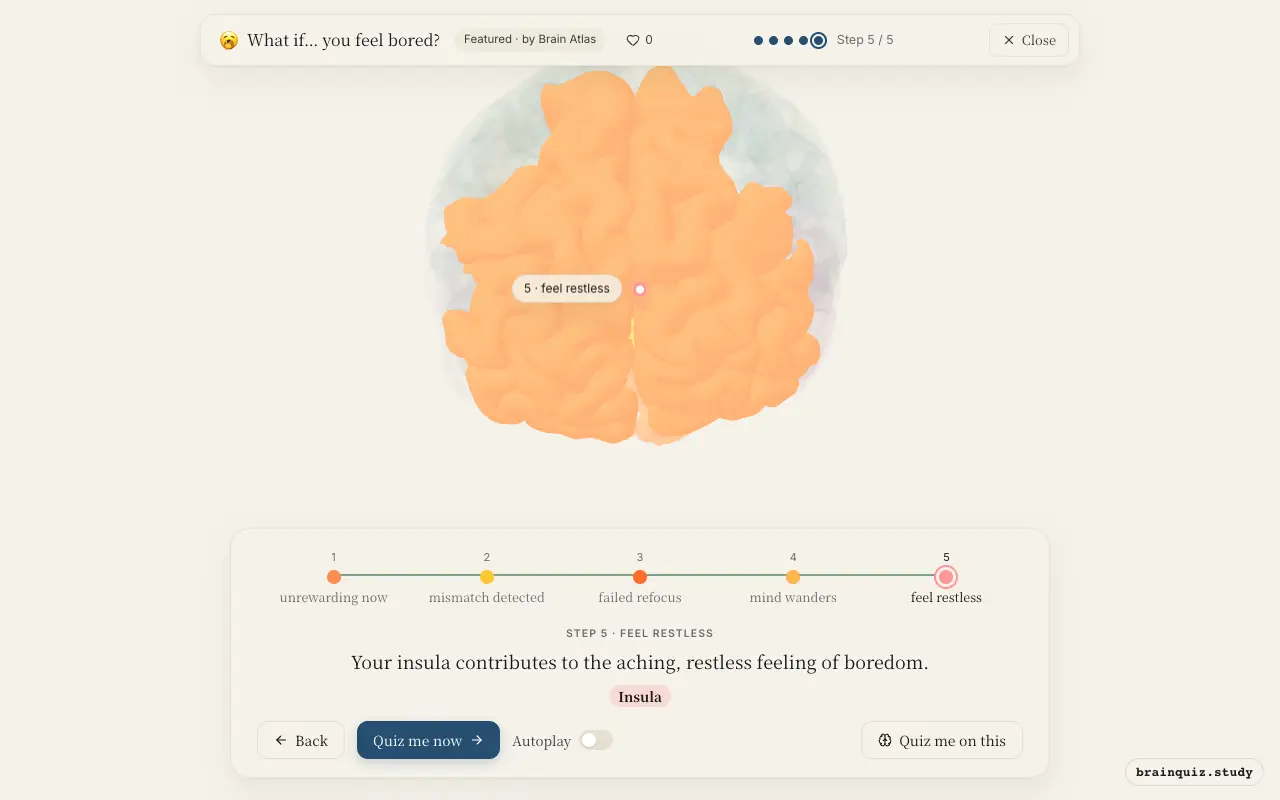
Watch it light up on the 3D brain
Brain regions that light up
| Order | Region | What it does here |
|---|---|---|
| 1 | Orbitofrontal Cortex | Your orbitofrontal cortex evaluates the situation and finds little value or reward. |
| 2 | Anterior Cingulate Cortex | Your anterior cingulate cortex spots the gap between desired and actual stimulation. |
| 3 | Prefrontal Cortex | Your prefrontal cortex tries to redirect attention but struggles to find interest. |
| 4 | Posterior Cingulate Cortex | Your posterior cingulate cortex activates, pulling you into spontaneous thoughts. |
| 5 | Insula | Your insula contributes to the aching, restless feeling of boredom. |
1. Orbitofrontal Cortex: unrewarding now
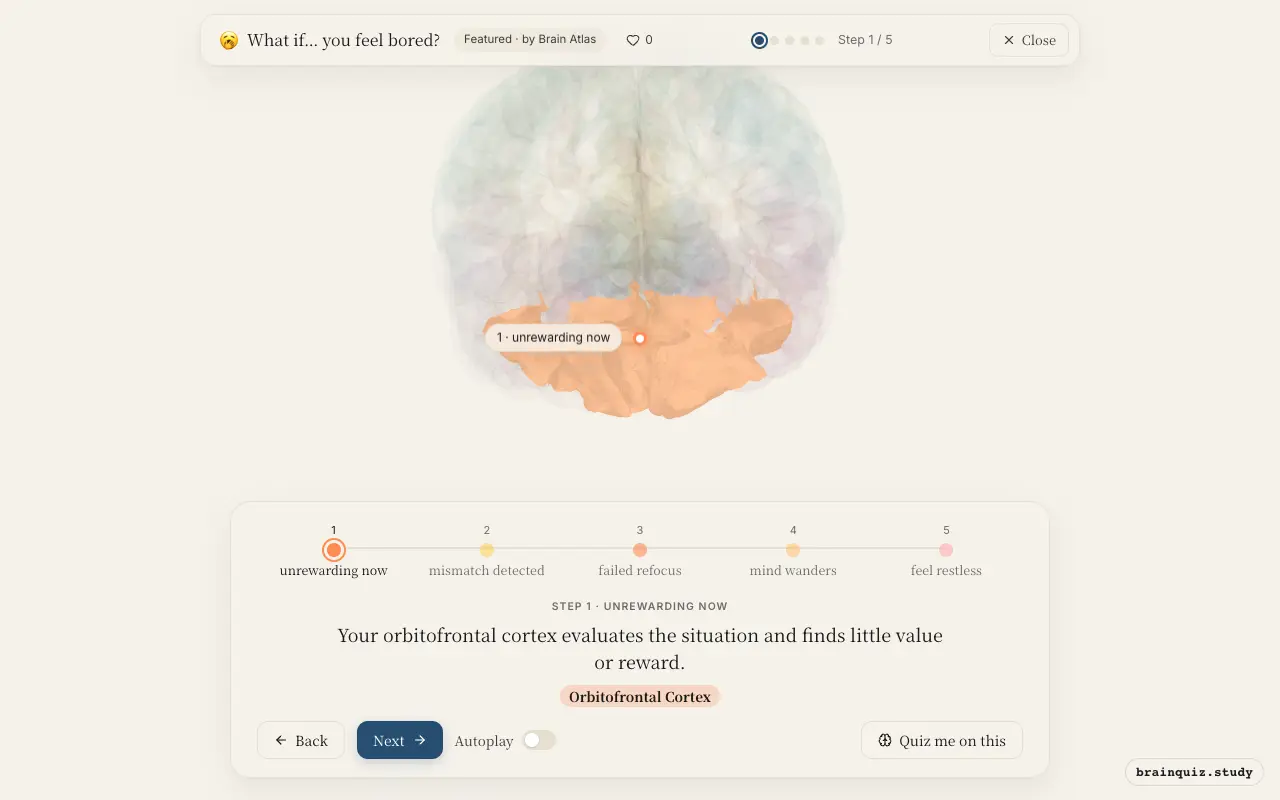
The orbitofrontal cortex is a key hub for evaluating rewards and assigning value to the current situation. When the environment offers little that is novel or engaging, its activity decreases, sending a signal to other brain regions that no rewarding outcomes are available. This drop in value representation is thought to be an early neural marker of boredom.
2. Anterior Cingulate Cortex: mismatch detected
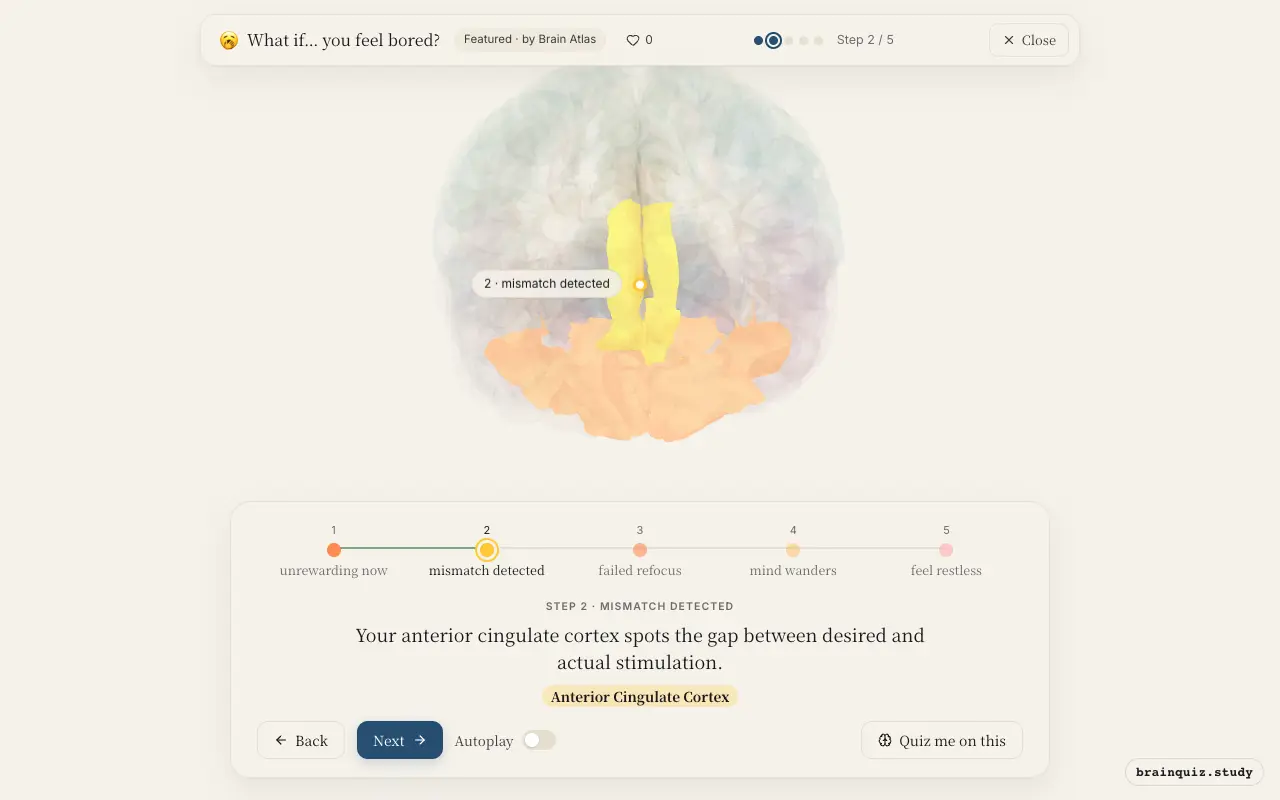
The anterior cingulate cortex monitors for conflicts between expected and actual states. It detects that your current level of stimulation falls short of what you desire, creating a motivational signal to seek change. This mismatch error is thought to drive the urge to escape boredom.
3. Prefrontal Cortex: failed refocus
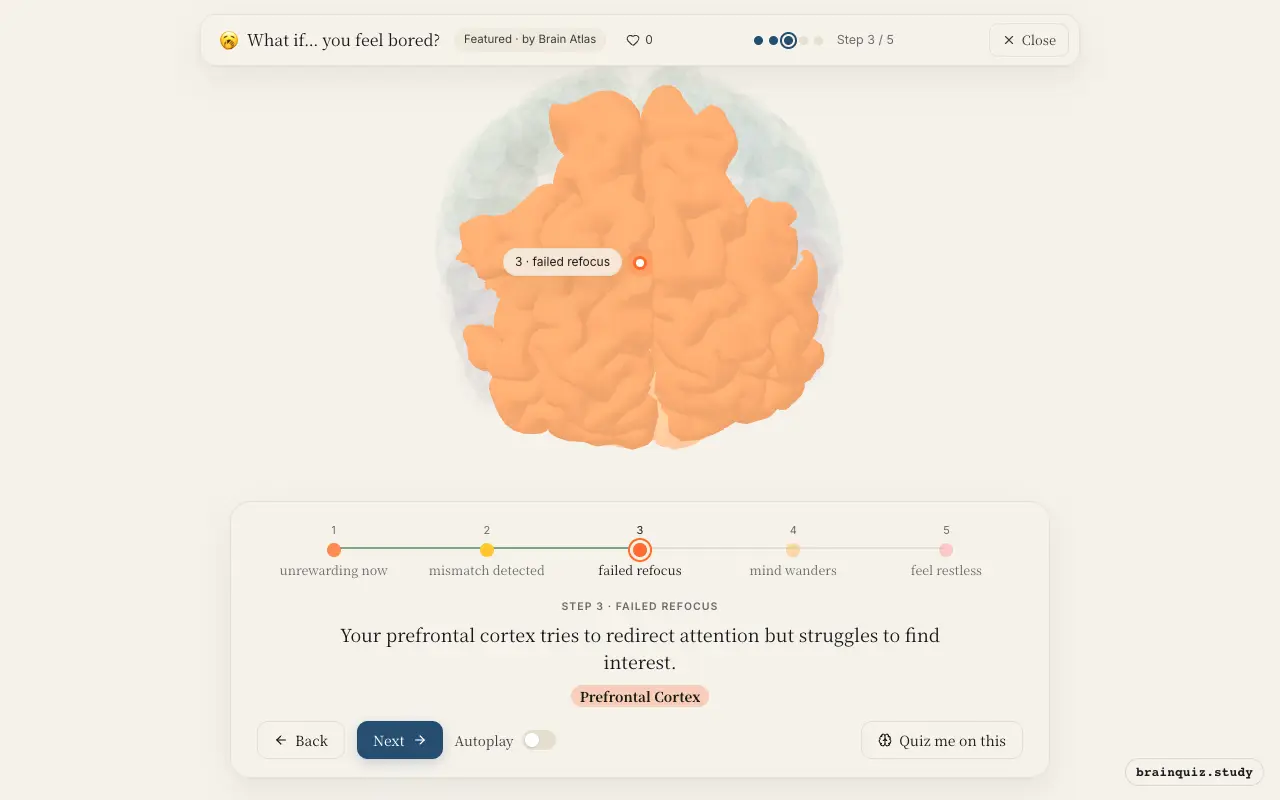
The prefrontal cortex is responsible for executive control and sustained attention. It attempts to re-engage with the task or environment, but when nothing is sufficiently interesting, its efforts fail. This failure is a core component of the bored state, as top-down control cannot overcome the lack of bottom-up stimulation.
4. Posterior Cingulate Cortex: mind wanders
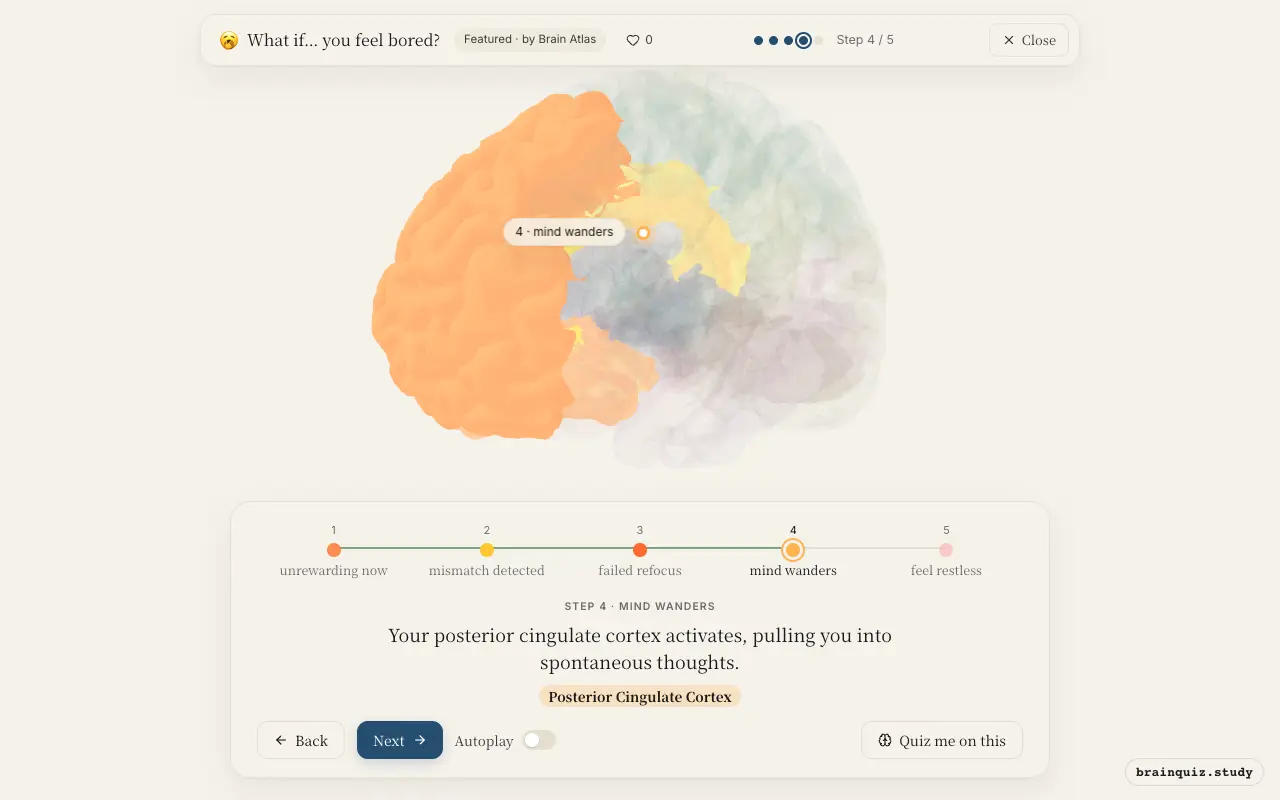
The posterior cingulate cortex is a central node of the default mode network, which becomes active during rest and self-referential thought. As external attention wanes, this region engages, leading to mind-wandering and daydreaming. This shift to internally focused thought often accompanies boredom.
5. Insula: feel restless
The insula integrates interoceptive signals from the body, making you consciously aware of internal states. During boredom, it is involved in the familiar feeling of restlessness or unease, often described as a gnawing sensation. This bodily awareness motivates you to seek new stimulation and resolve the mismatch.
Good to know
- Boredom is associated with increased activity in the default mode network, which includes the posterior cingulate cortex and medial prefrontal regions.
- Studies suggest that boredom can enhance creativity by encouraging mind-wandering, as the brain explores new internal associations.
- The neurotransmitter dopamine plays a role in motivation, and its levels in reward circuits may drop during boredom, but findings are still debated.
Boredom vs Engagement
When you are engaged in a rewarding task, the prefrontal cortex and reward regions like the orbitofrontal cortex show sustained activity. In contrast, boredom shifts activity toward the default mode network and insula, and the anterior cingulate signals a lack of stimulation.
Test yourself
Which brain region is primarily responsible for detecting the mismatch between desired and actual stimulation during boredom?
What role does the posterior cingulate cortex play in boredom?
Which region creates the conscious feeling of restlessness that makes you want to escape boredom?
0 of 3 answered · 0 correct
Simplified: many regions work together at once, and this shows the main players in the order they act.