What happens in your brain when you learn a skateboard trick?
Updated
Your prefrontal cortex focuses and plans; premotor cortex sequences movements; motor cortex executes them; cerebellum corrects balance and timing; basal ganglia and cerebellum store the skill.
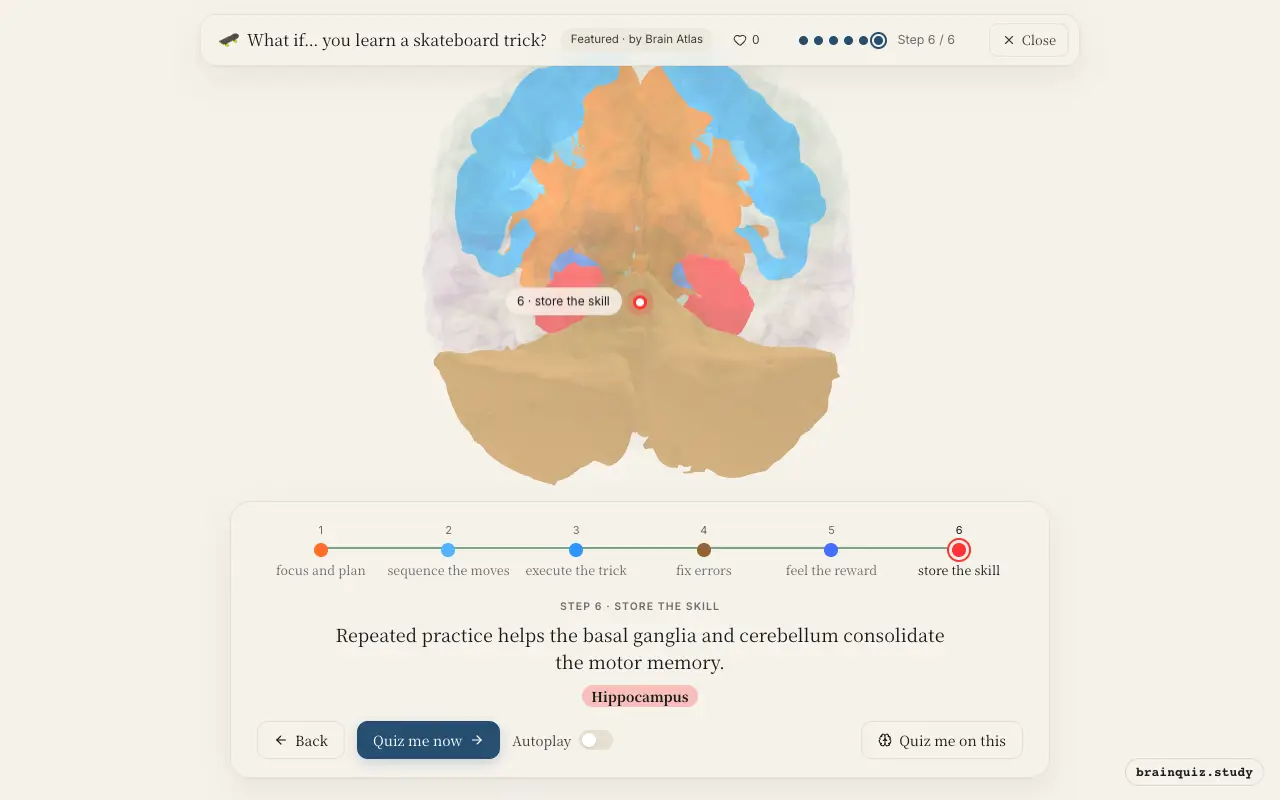
Watch it light up on the 3D brain
Brain regions that light up
| Order | Region | What it does here |
|---|---|---|
| 1 | Prefrontal Cortex | You watch the trick and plan your approach. |
| 2 | Premotor Cortex | Your brain prepares the specific sequence of movements. |
| 3 | Motor Cortex | Motor cortex sends commands to your muscles to perform the trick. |
| 4 | Cerebellum | Your cerebellum compares intended and actual movement and corrects mistakes. |
| 5 | Basal Ganglia | When you land even part of the trick, dopamine rewards the attempt. |
| 6 | Hippocampus | Repeated practice helps the basal ganglia and cerebellum consolidate the motor memory. |
1. Prefrontal Cortex: focus and plan
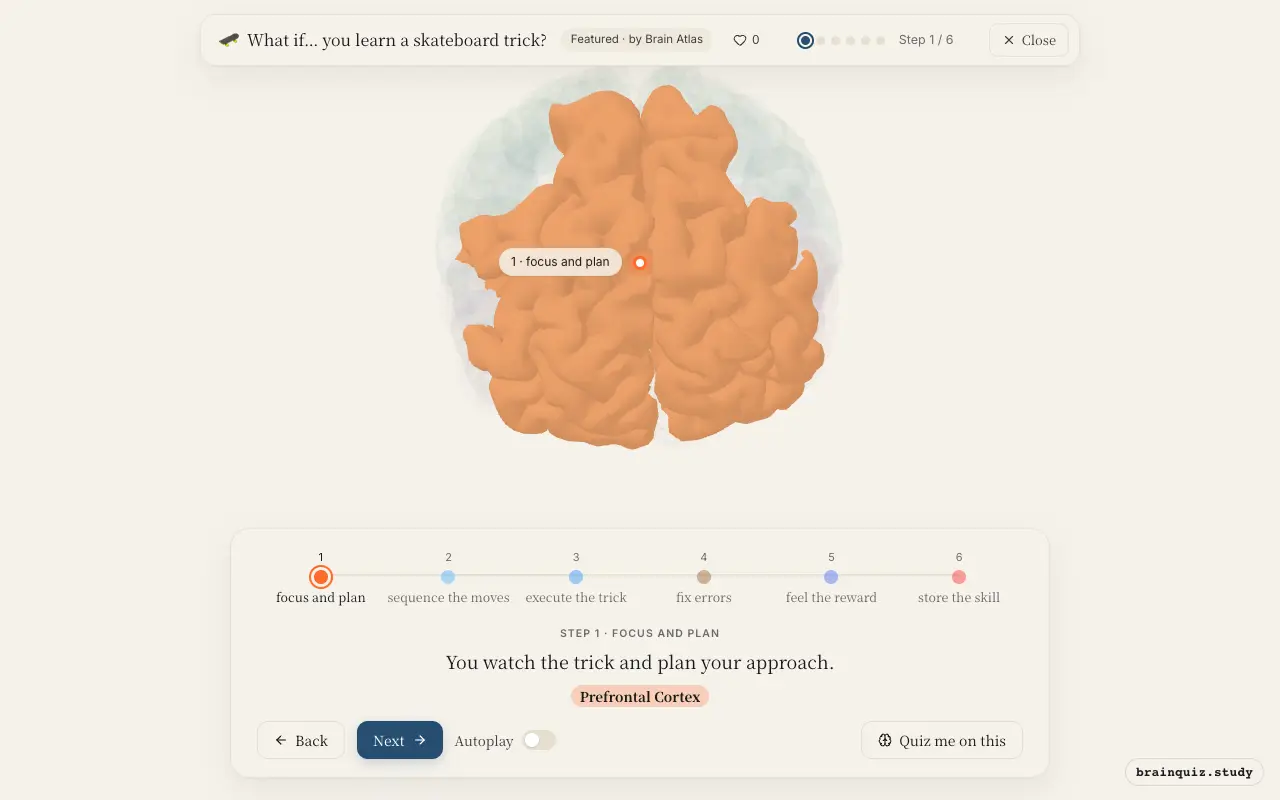
The prefrontal cortex is the brain's executive center. During learning, it maintains your goal, filters out distractions, and plans the sequence of actions. It also works with working memory to hold the trick's steps in mind while you attempt them.
2. Premotor Cortex: sequence the moves
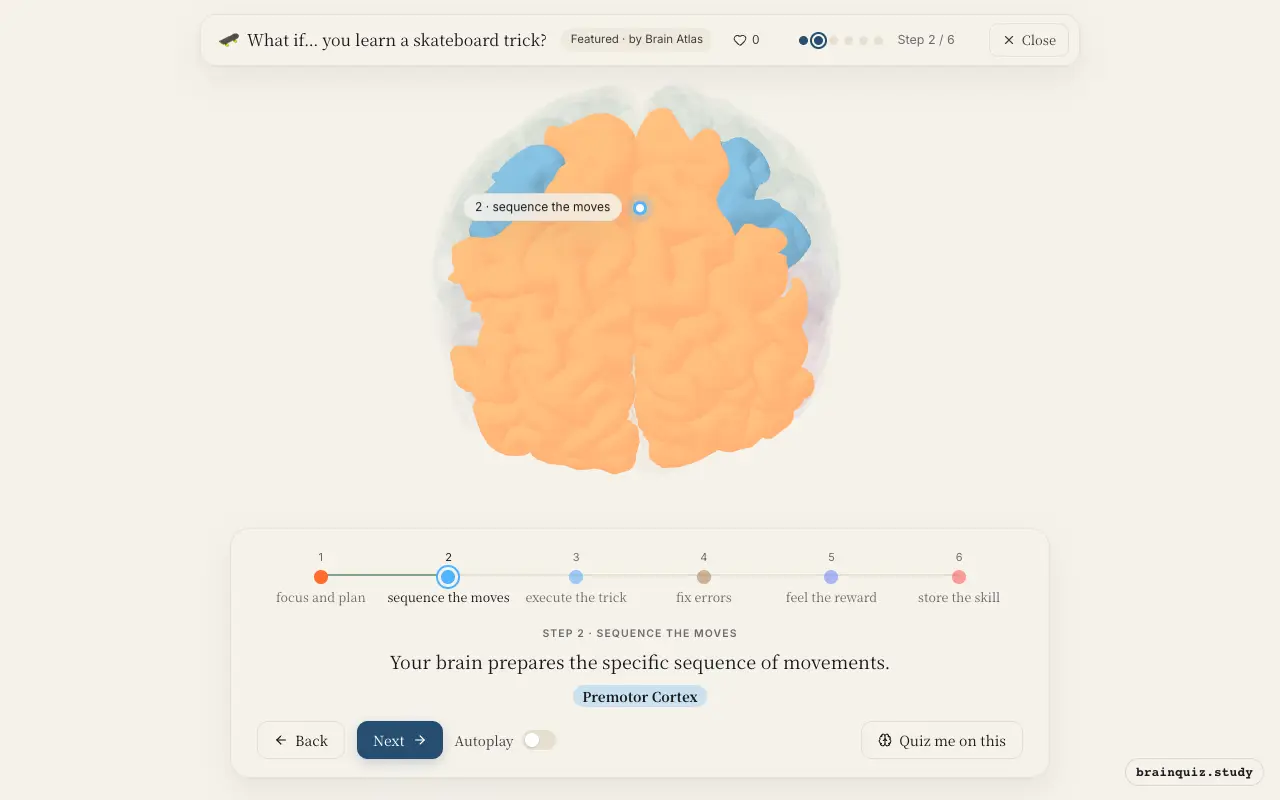
The premotor cortex lies just anterior to the motor cortex. It is essential for preparing complex, sequential movements like a skateboard trick. It organizes the order and timing of muscle activations, often by mentally rehearsing the movement before you actually do it.
3. Motor Cortex: execute the trick
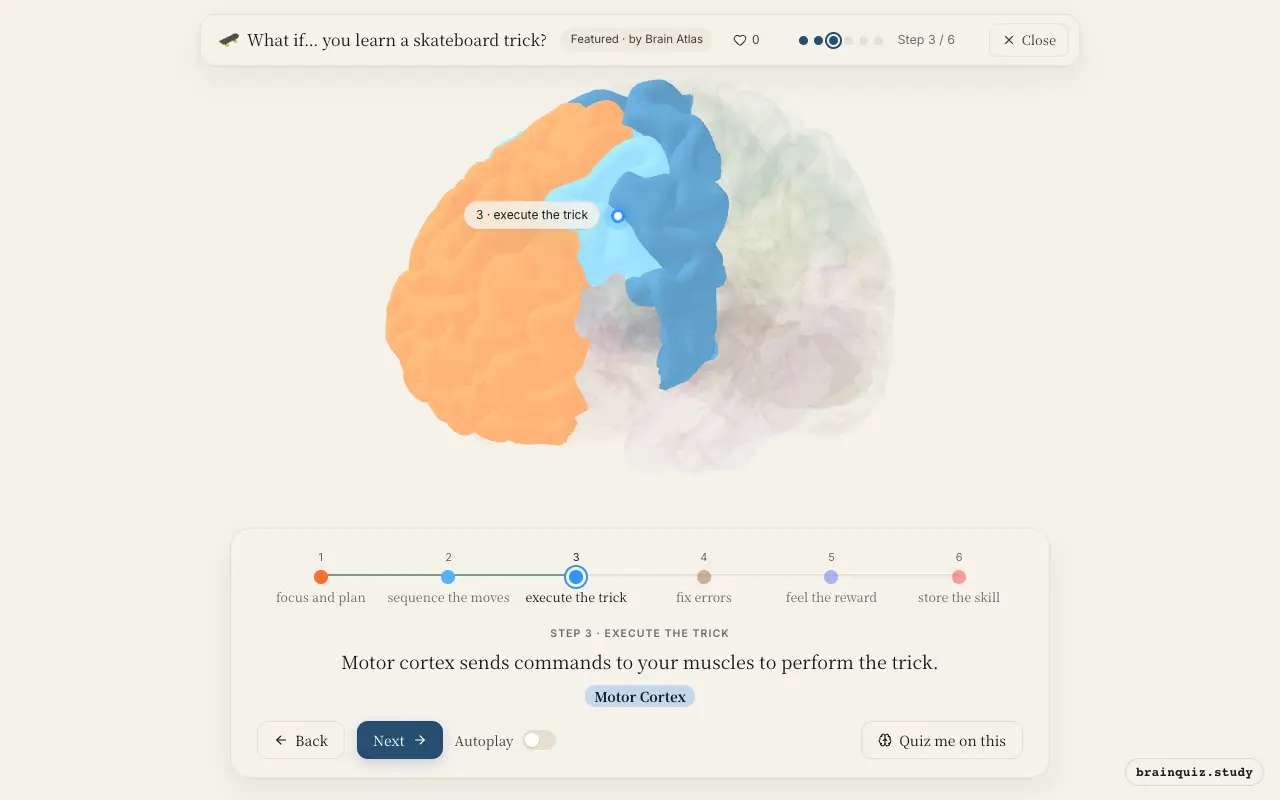
The primary motor cortex executes voluntary movements by sending signals down the corticospinal tract to lower motor neurons in the spinal cord. During early learning, its activity is broad and unrefined, producing clumsy attempts. With practice, the neural commands become more precise and efficient.
4. Cerebellum: fix errors
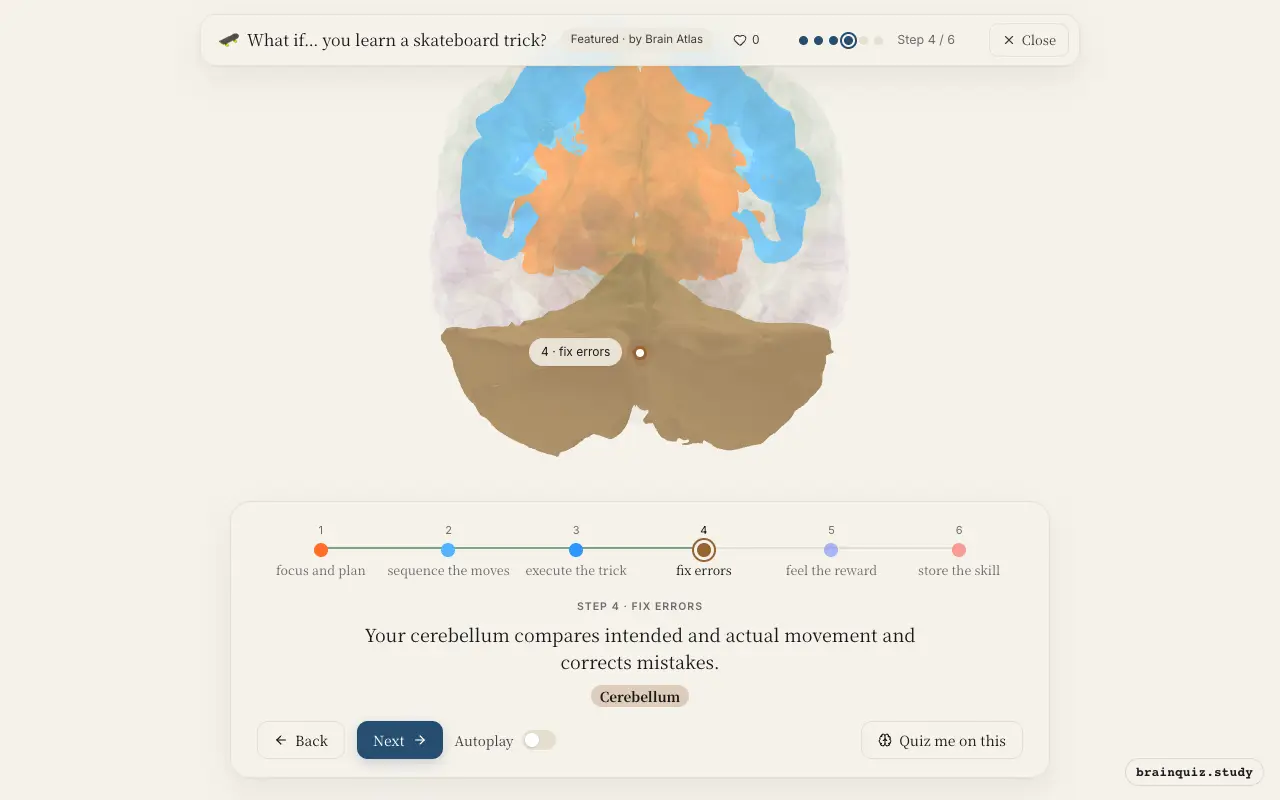
The cerebellum is critical for motor learning. It receives sensory feedback about your body's position and movement, then compares it with the intended plan. When there is a mismatch, it sends corrective signals to motor areas to adjust balance, timing, and force.
5. Basal Ganglia: feel the reward
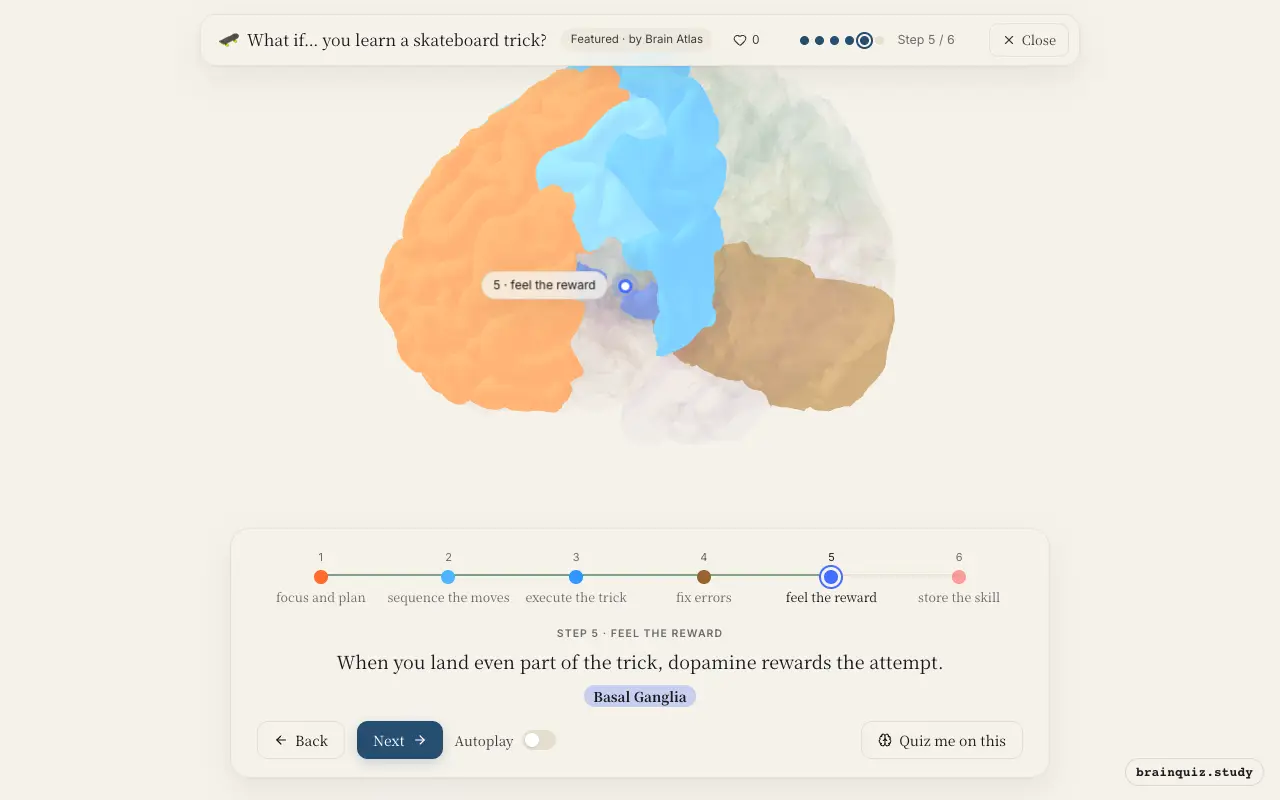
The basal ganglia, including the caudate, putamen, and nucleus accumbens, are central to reward-based learning. When you land even a part of the trick, dopamine is released, signaling that the action was successful. This dopamine strengthens the neural pathways that produced the movement, making it more likely to be repeated.
6. Hippocampus: store the skill
The hippocampus is not essential for forming motor skill memories; the basal ganglia and cerebellum are crucial. During rest and sleep, the cerebellum and basal ganglia consolidate the learned movement sequences, making them more automatic. This process, called consolidation, transforms the conscious effort into an automatic motor program.
Good to know
- The cerebellum contains more than half of all neurons in the brain, reflecting its heavy involvement in movement coordination.
- Dopamine release in the basal ganglia acts as a reward prediction error, reinforcing the specific action that led to success.
- Sleep after practicing a new motor skill improves performance the next day, a process known as offline consolidation.
Learning vs Performing a Skateboard Trick
During learning, prefrontal and premotor cortices dominate as you consciously plan and sequence each element. In contrast, performing a well-practiced trick shifts control to the basal ganglia and cerebellum, allowing automatic, fluid movement with less prefrontal engagement.
Test yourself
Which brain region is primarily responsible for planning and attention when first learning a trick?
What role does the cerebellum play in learning a skateboard trick?
How does the basal ganglia contribute to skill learning?
0 of 3 answered · 0 correct
Simplified: many regions work together at once, and this shows the main players in the order they act.