What happens in your brain when you talk in your sleep?
Updated
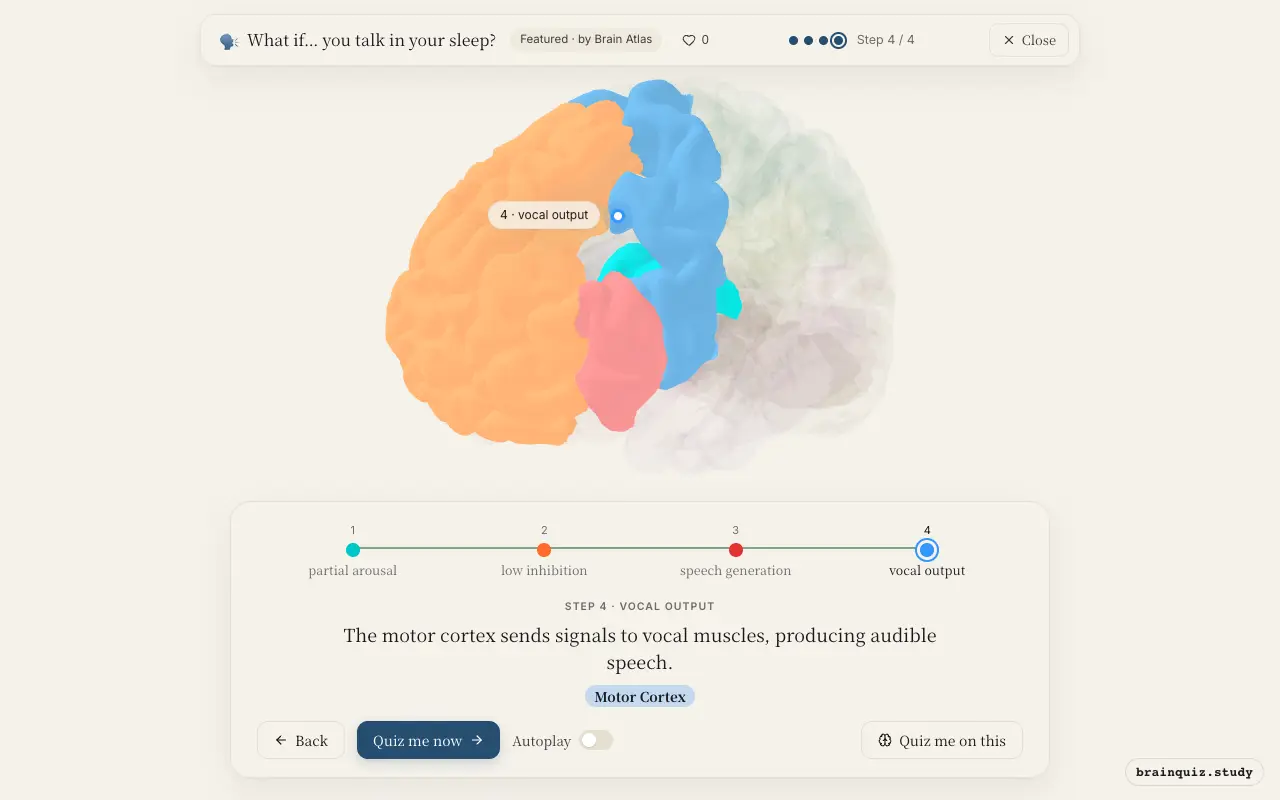
During sleep talking, the thalamus permits partial arousal, the prefrontal cortex reduces its inhibitory control, Broca's area produces language, and the motor cortex drives vocal muscles, resulting in speech without conscious awareness.
Watch it light up on the 3D brain
Brain regions that light up
| Order | Region | What it does here |
|---|---|---|
| 1 | Thalamus | The thalamus allows a brief partial arousal during non-REM sleep. |
| 2 | Prefrontal Cortex | Prefrontal cortex activity is reduced, lessening executive control over speech. |
| 3 | Broca's Area | Broca's area activates, producing words and sentences. |
| 4 | Motor Cortex | The motor cortex sends signals to vocal muscles, producing audible speech. |
1. Thalamus: partial arousal
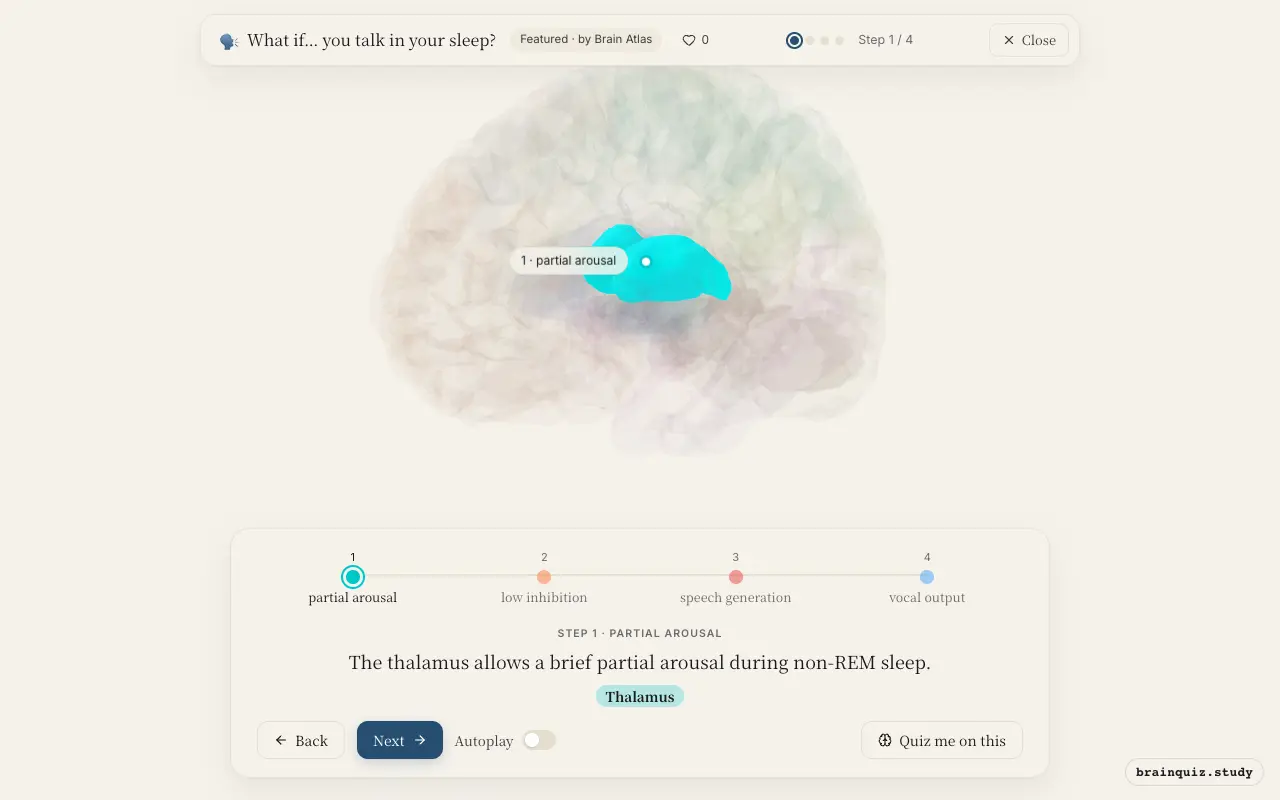
The thalamus relays sensory and motor signals and regulates sleep-wake transitions. During sleep talking, it permits enough cortical activation for speech while keeping the rest of the brain largely asleep.
2. Prefrontal Cortex: low inhibition
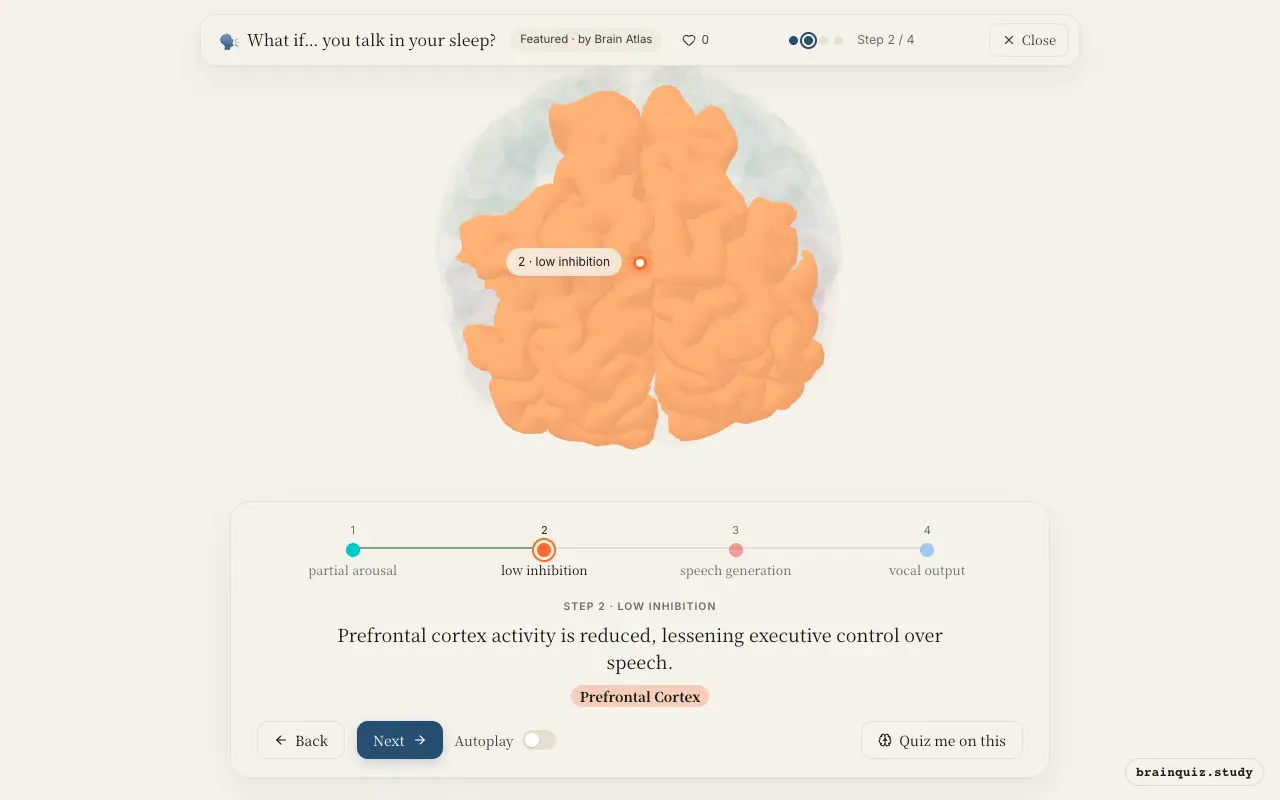
The prefrontal cortex normally suppresses inappropriate behaviors during sleep. Its reduced activity during sleep talking means language areas can activate without higher-level monitoring or intention.
3. Broca's Area: speech generation
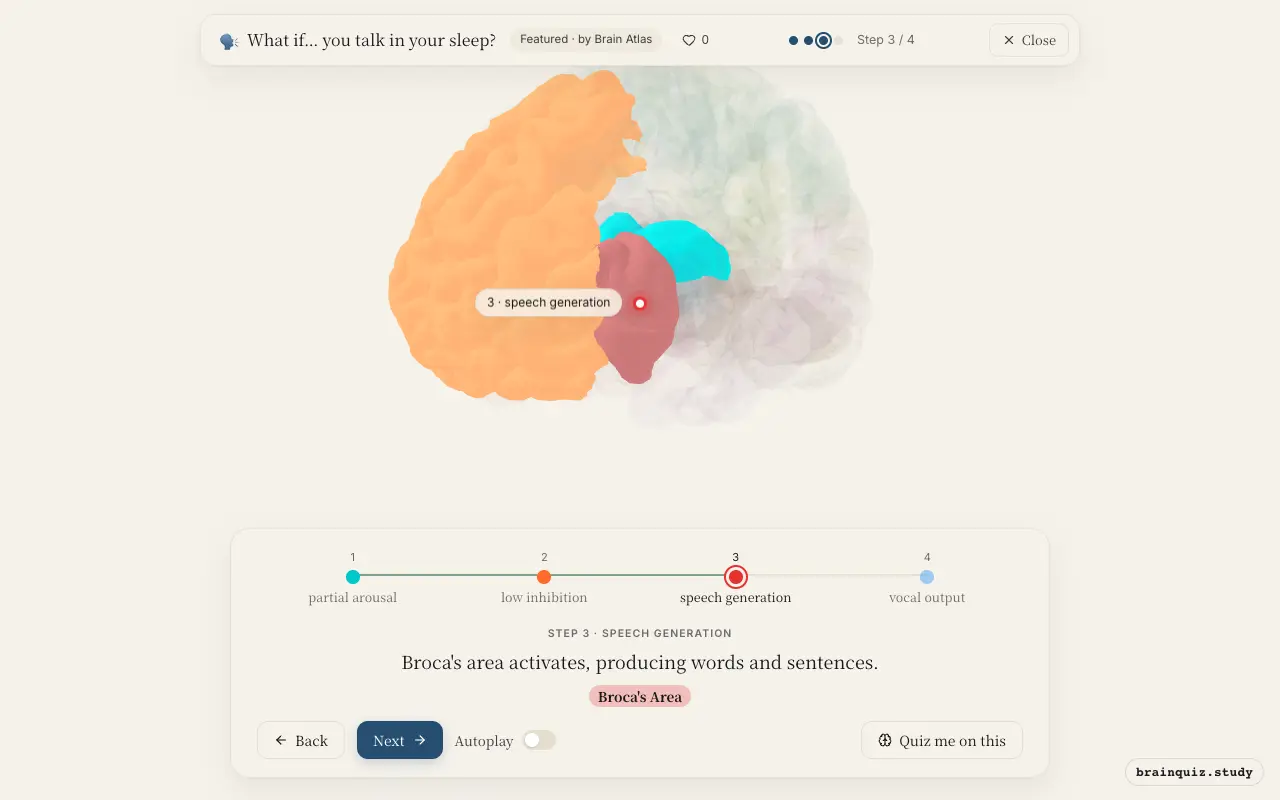
Broca's area is involved in speech production and grammar. In sleep talking, it becomes spontaneously active, but its output lacks the normal planning and coherence of waking speech.
4. Motor Cortex: vocal output
The motor cortex controls voluntary muscles, including those of the larynx and mouth. During sleep talking, it executes the speech patterns generated by Broca's area, even though the person is asleep.
Good to know
- Sleep talking is more common in children and often runs in families.
- Most sleep talking occurs during non-REM sleep, especially stage 2.
- Sleep talking can range from single words to full sentences and is usually harmless.
Sleep talking vs sleepwalking
Both are parasomnias arising from partial arousal, but sleepwalking involves more extensive motor cortex and cerebellum activity to produce walking, while sleep talking primarily engages speech areas like Broca's area and vocal motor control.
Test yourself
Which brain region is most directly responsible for producing the words spoken during sleep talking?
Sleep talking most often occurs during which sleep stage?
How does the prefrontal cortex contribute to sleep talking?
0 of 3 answered · 0 correct
Simplified: many regions work together at once, and this shows the main players in the order they act.