What happens in your brain when you balance on one leg?
Updated
When you balance on one leg, your somatosensory cortex senses body position, your cerebellum computes corrections, your premotor and motor cortices adjust muscle activity, and your basal ganglia fine-tune postural tone.
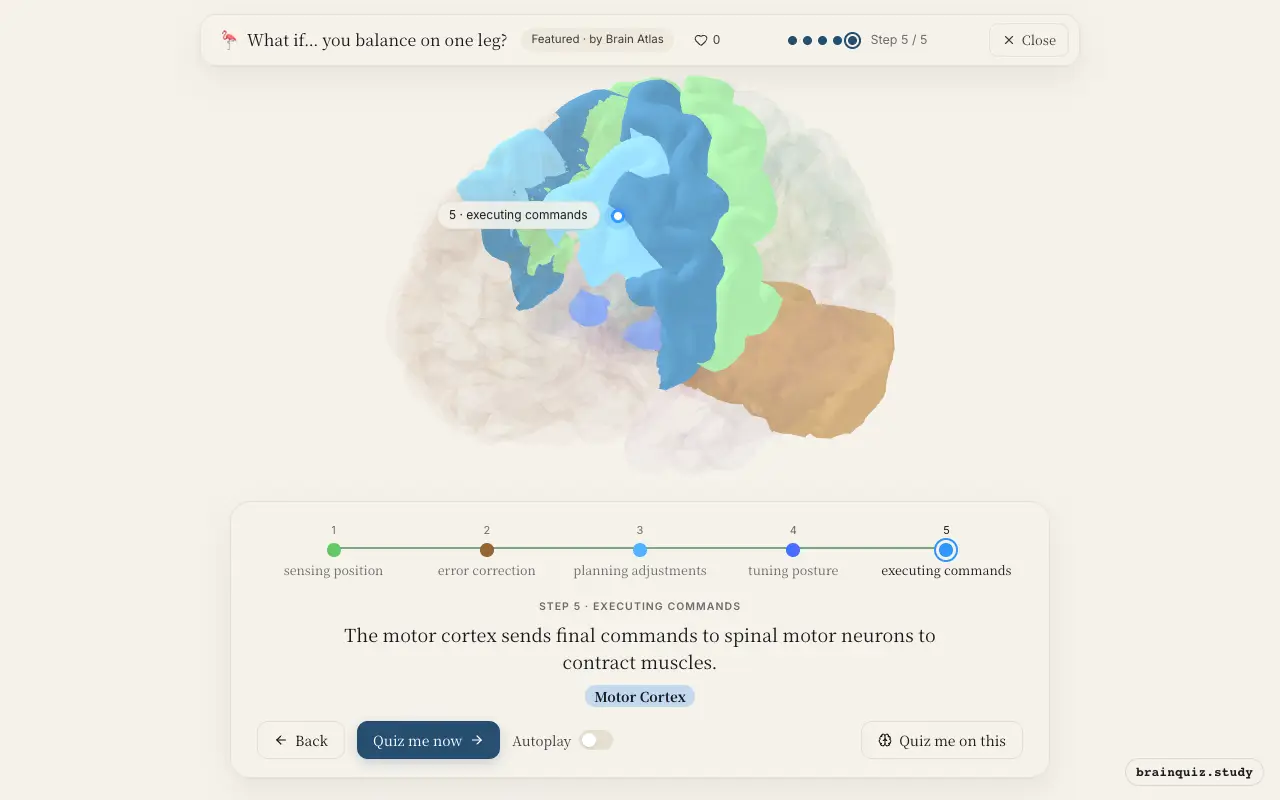
Watch it light up on the 3D brain
Brain regions that light up
| Order | Region | What it does here |
|---|---|---|
| 1 | Somatosensory Cortex | Proprioceptive signals from muscles and joints reach the somatosensory cortex. |
| 2 | Cerebellum | The cerebellum compares actual body position with intended balance and computes corrections. |
| 3 | Premotor Cortex | The premotor cortex plans the sequence of muscle activations needed to regain balance. |
| 4 | Basal Ganglia | The basal ganglia modulate muscle tone and scale the postural response. |
| 5 | Motor Cortex | The motor cortex sends final commands to spinal motor neurons to contract muscles. |
1. Somatosensory Cortex: sensing position
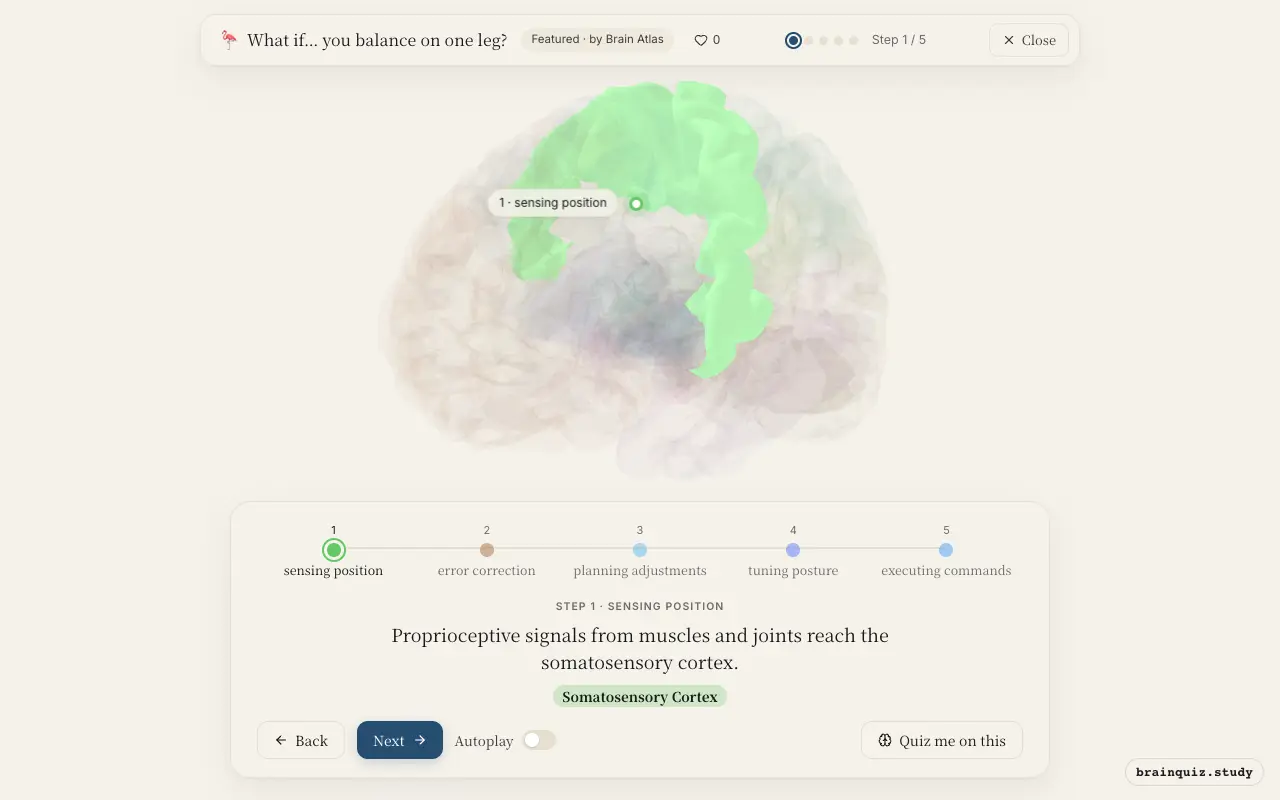
The somatosensory cortex processes information about body position and movement from receptors in muscles, tendons, and joints. This proprioceptive input is essential for knowing where your limbs are without looking, allowing the brain to detect any sway or imbalance.
2. Cerebellum: error correction
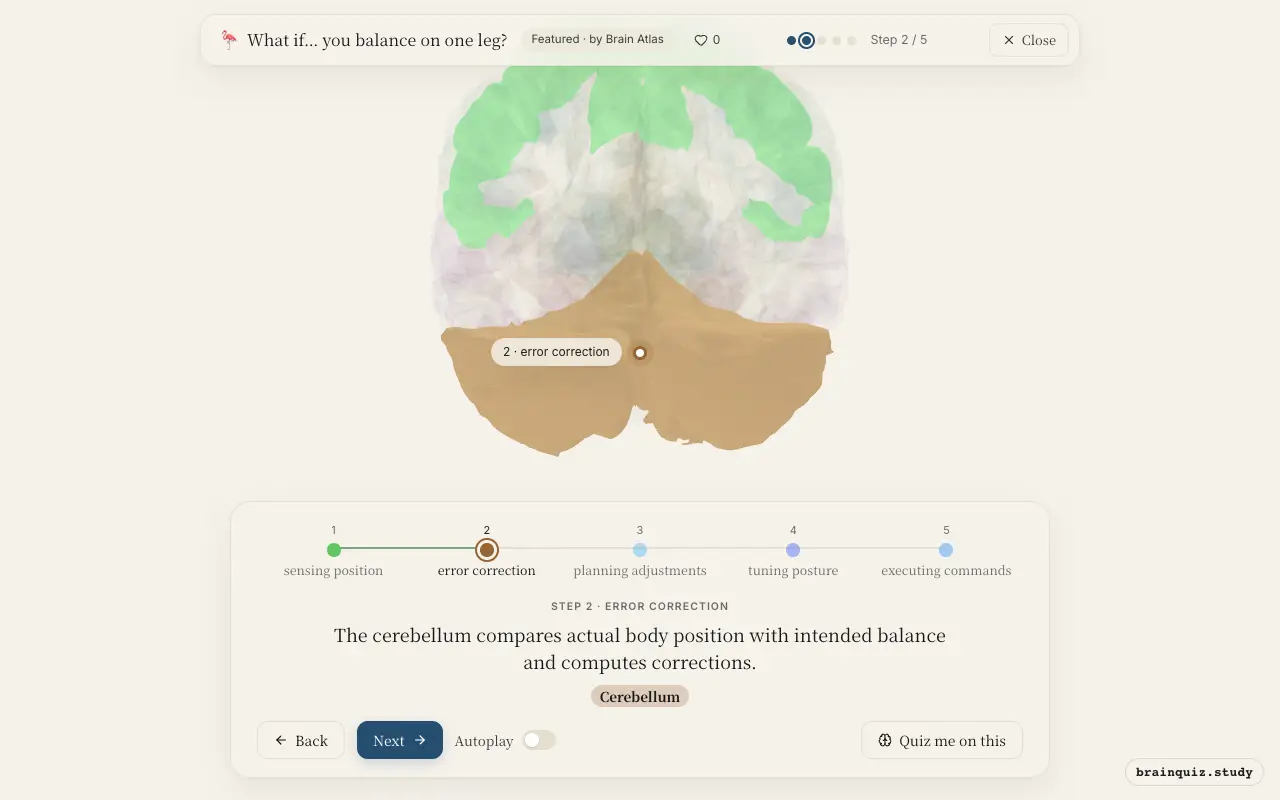
The cerebellum receives proprioceptive, vestibular, and visual information to monitor body sway. It detects errors between the planned posture and actual movement, then sends corrective signals to adjust muscle activity, making it the primary region for balance control.
3. Premotor Cortex: planning adjustments
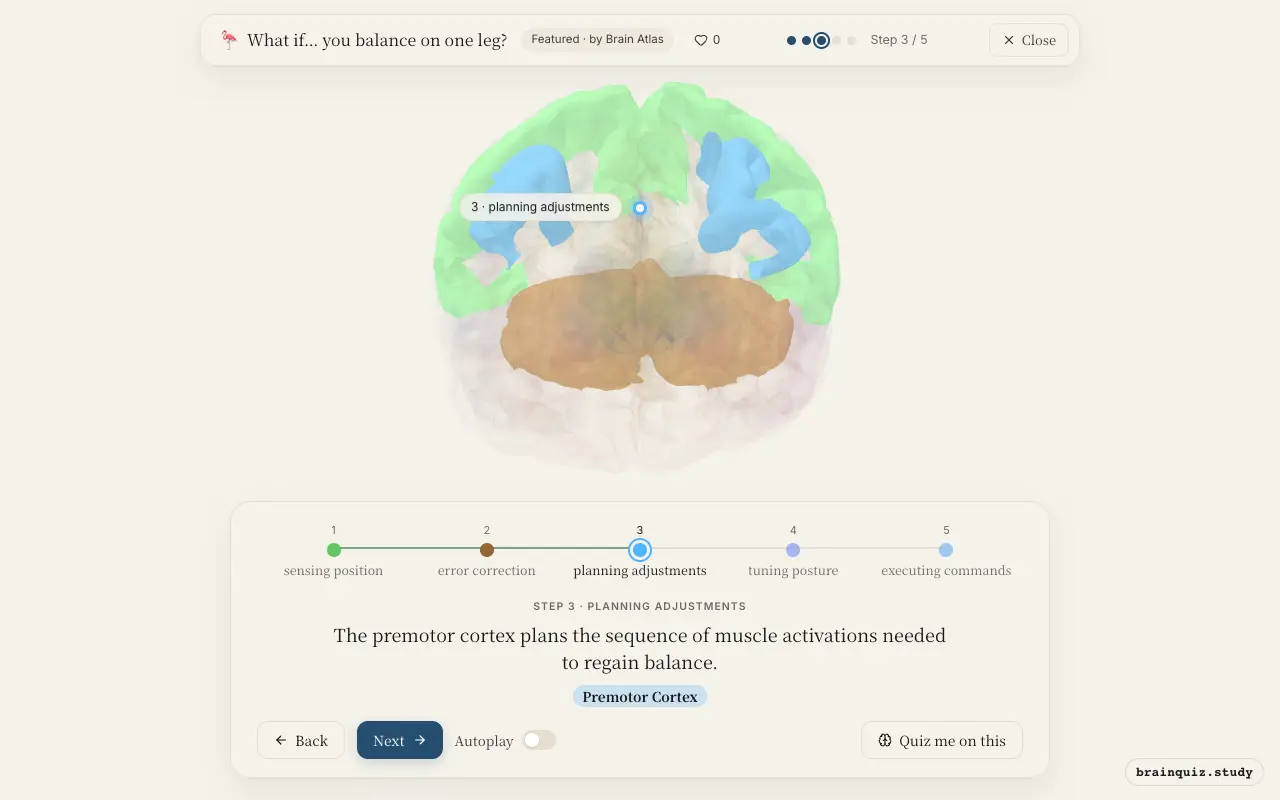
The premotor cortex uses information from the cerebellum to prepare and sequence the specific motor commands required for postural adjustments. It organizes the timing and coordination of muscle groups before execution.
4. Basal Ganglia: tuning posture
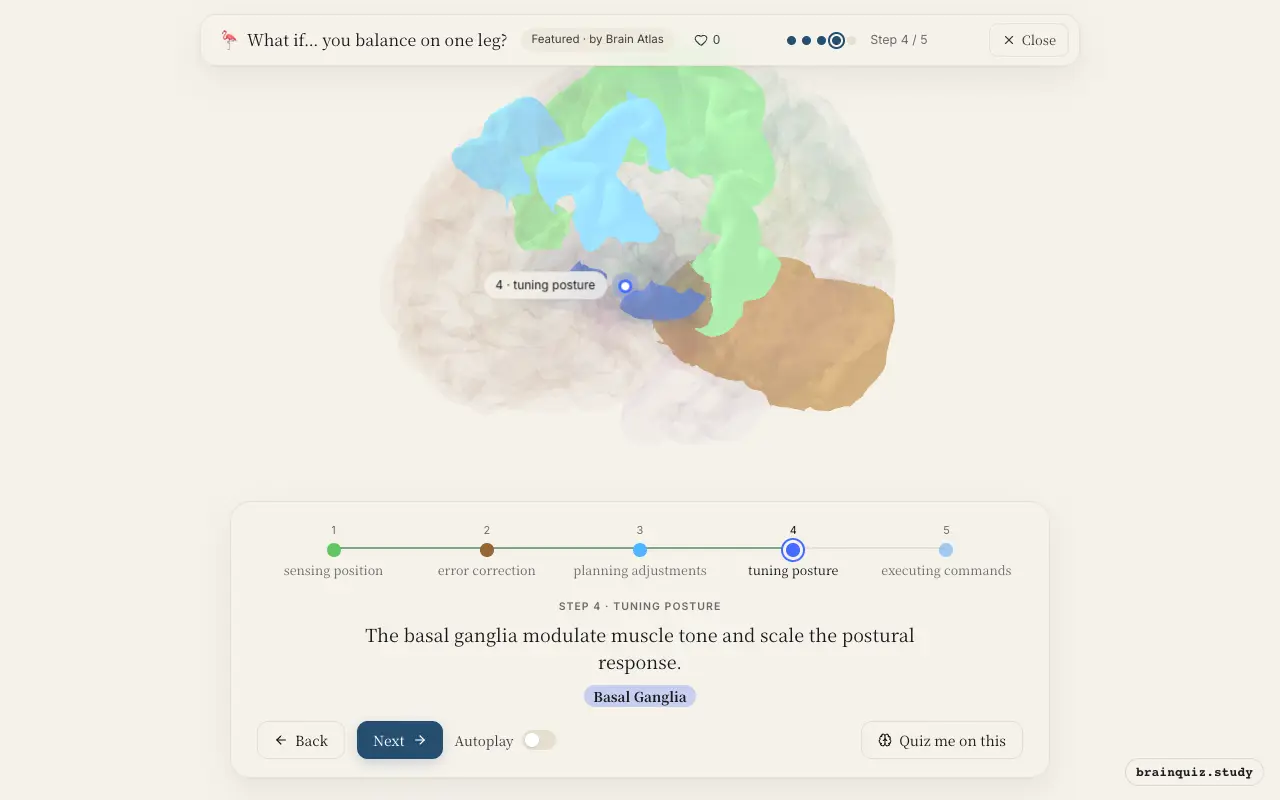
The basal ganglia help regulate the amplitude and speed of movements, ensuring that postural adjustments are not too weak or too strong. They also contribute to maintaining a stable base by adjusting background muscle activity.
5. Motor Cortex: executing commands
The motor cortex integrates the planned adjustments from premotor cortex and basal ganglia, then sends signals down the corticospinal tract to activate specific muscles in the legs and trunk, producing the fine adjustments that keep you upright.
Good to know
- The cerebellum contains more neurons than the rest of the brain combined and is critical for motor learning and balance.
- Proprioception relies on muscle spindles and Golgi tendon organs, which send signals via the dorsal column-medial lemniscus pathway to the somatosensory cortex.
- Postural control involves both feedback mechanisms (responding to unexpected perturbations) and feedforward mechanisms (anticipating postural changes before movement).
One leg vs two legs
Standing on one leg requires greater activation of the cerebellum, somatosensory cortex, and motor cortex compared to two-legged stance. The smaller base of support increases postural sway, demanding more frequent and precise corrective signals. Two-legged standing is more automatic and relies less on conscious motor planning.
Test yourself
Which region is most directly responsible for computing balance corrections?
Proprioceptive information about body position is primarily processed in which region?
What role does the basal ganglia play in balancing on one leg?
0 of 3 answered · 0 correct
Simplified: many regions work together at once, and this shows the main players in the order they act.