What happens in your brain when you become a parent?
Updated
Seeing your baby activates reward and caregiving circuits: fusiform gyrus recognizes the face, amygdala flags emotional salience, orbitofrontal cortex finds the baby rewarding, nucleus accumbens motivates care, and insula creates empathy.
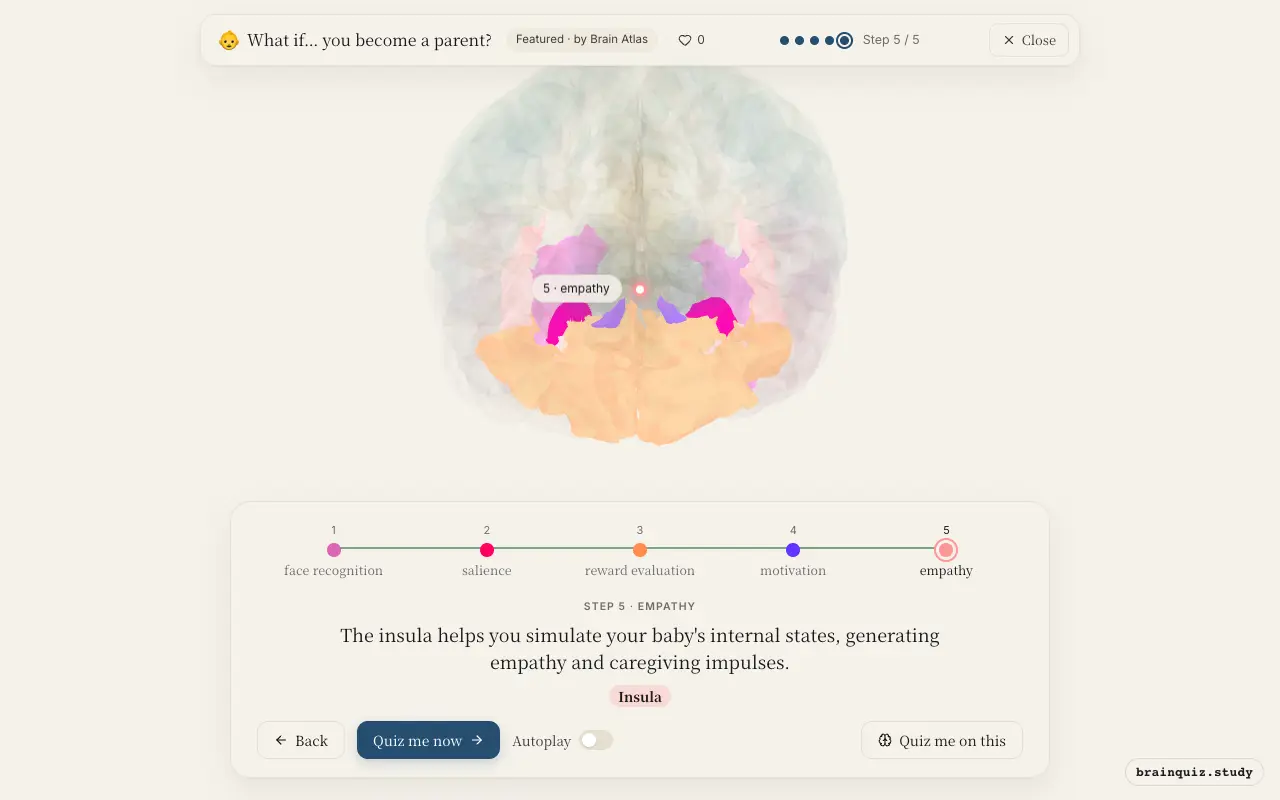
Watch it light up on the 3D brain
Brain regions that light up
| Order | Region | What it does here |
|---|---|---|
| 1 | Fusiform Gyrus | Your fusiform gyrus identifies your baby's unique facial features, enabling you to recognize them instantly. |
| 2 | Amygdala | The amygdala reacts to your baby's cries or expressions, tagging them as emotionally important. |
| 3 | Orbitofrontal Cortex | The orbitofrontal cortex evaluates your baby as a highly rewarding stimulus, reinforcing caring behavior. |
| 4 | Nucleus Accumbens | Dopamine released in the nucleus accumbens drives your motivation to approach and care for your baby. |
| 5 | Insula | The insula helps you simulate your baby's internal states, generating empathy and caregiving impulses. |
1. Fusiform Gyrus: face recognition
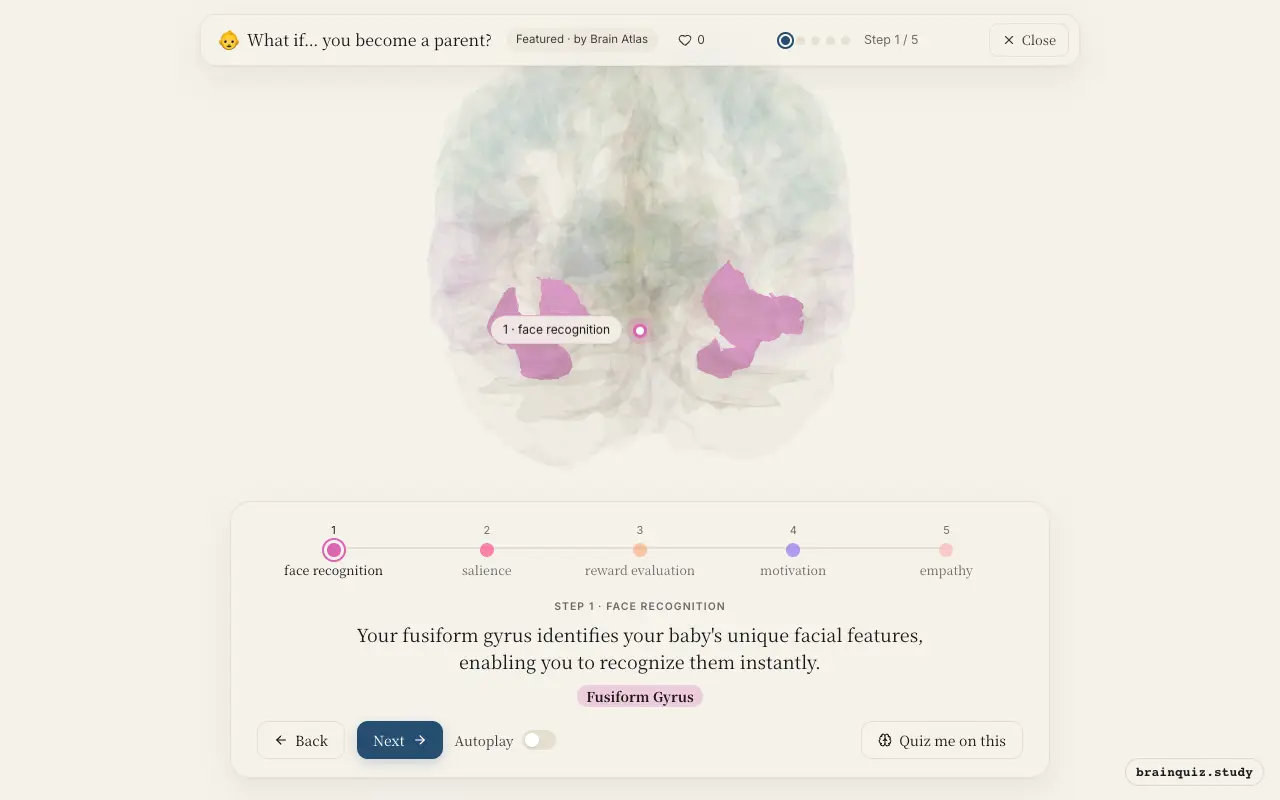
The fusiform gyrus is specialized for face processing and is part of the ventral visual stream. In new parents, this region shows enhanced responses to their own infant's face compared with unfamiliar babies, a change thought to support rapid recognition. This early step is crucial for bonding and prioritizing caregiving.
2. Amygdala: salience
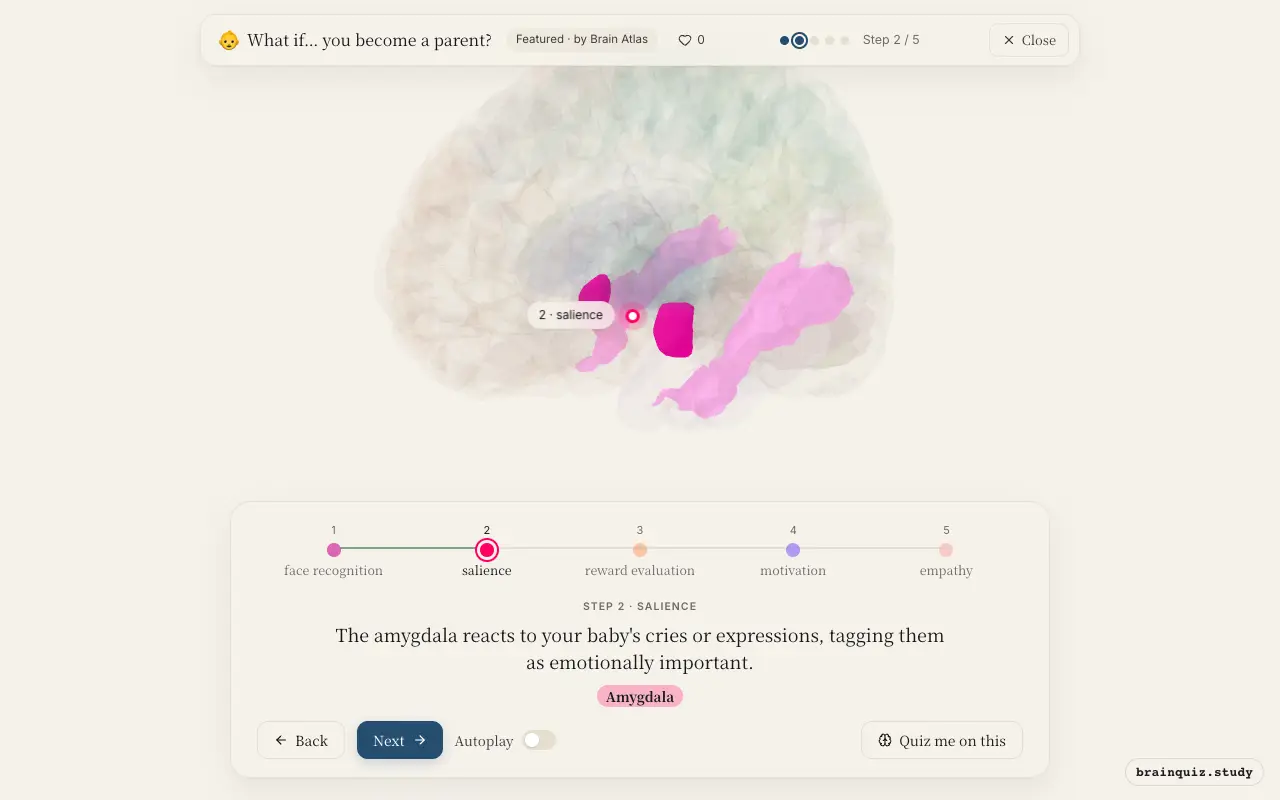
The amygdala detects emotionally salient stimuli like infant distress, becoming attuned to infant cues in parents. Over time, its reactivity to infant cries may decrease as caregiving becomes routine, a change thought to reduce anxiety and support sustained caregiving behavior.
3. Orbitofrontal Cortex: reward evaluation
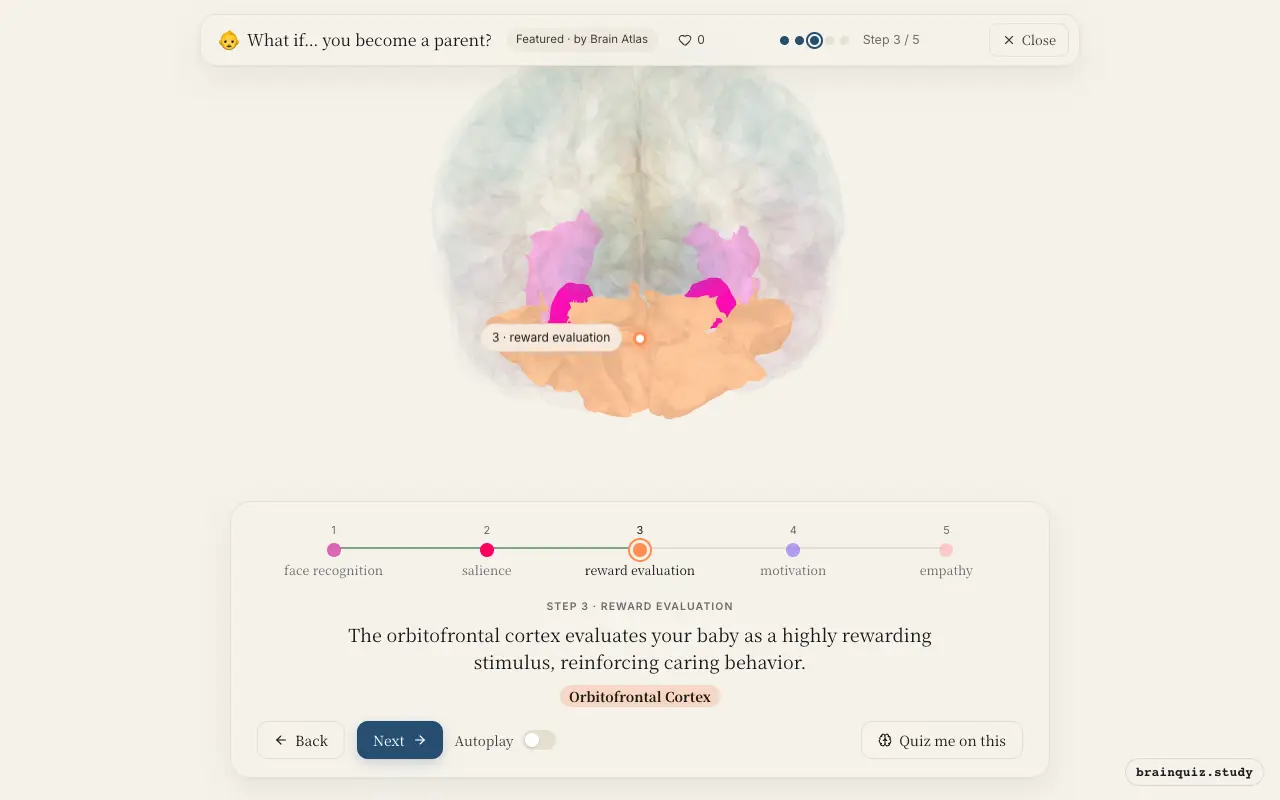
The orbitofrontal cortex assigns value to stimuli based on expected rewards. When you interact with your baby, this region computes the positive value of the interaction, making caregiving feel pleasurable. This reward signal is essential for motivating repeated parental behaviors.
4. Nucleus Accumbens: motivation
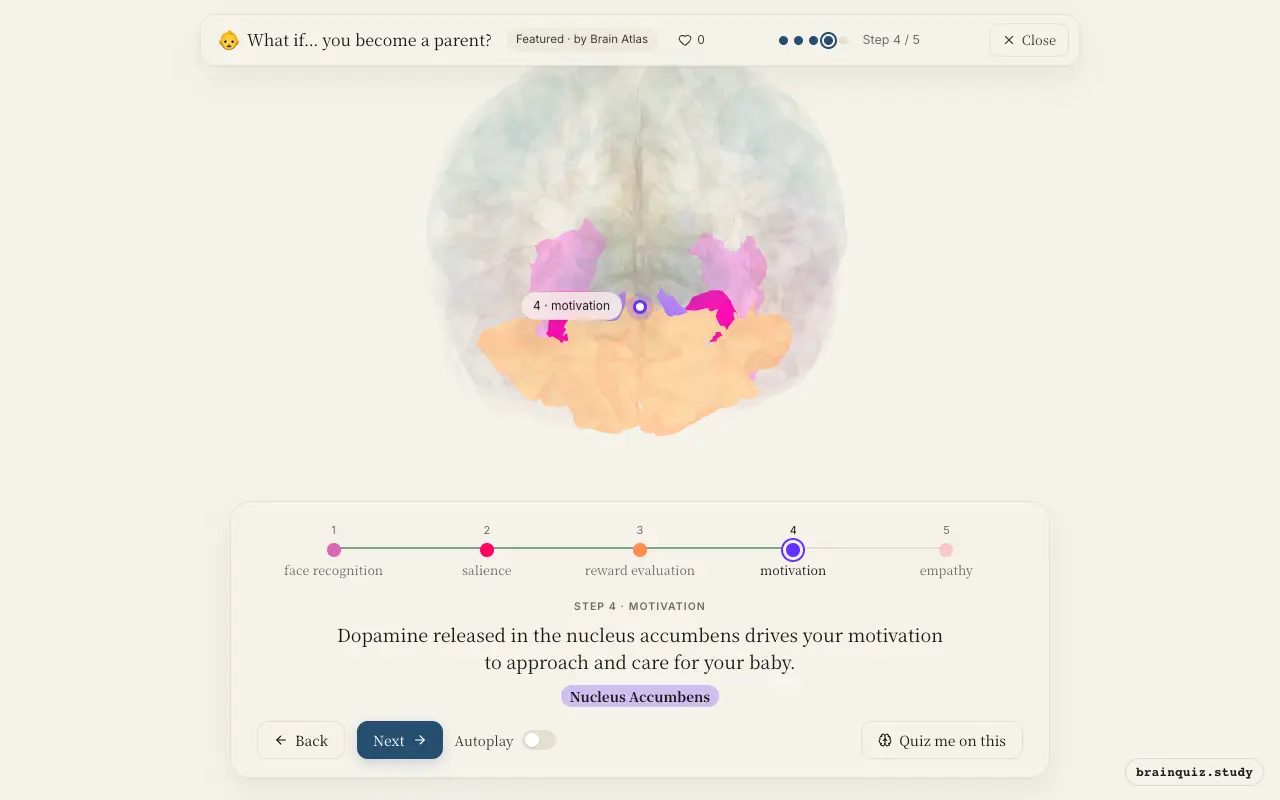
As a key node in the brain's reward circuit, the nucleus accumbens receives dopaminergic input from the ventral tegmental area. In parents, infant stimuli trigger dopamine release here, creating a sense of wanting and drive. This motivational push ensures you seek out and respond to your baby's needs.
5. Insula: empathy
The insula is critical for interoception and emotional awareness. When your baby is distressed, your insula activates, allowing you to feel a trace of their discomfort. This empathic resonance is thought to be a foundation for responsive and sensitive parenting.
Good to know
- The hormone oxytocin, released from the posterior pituitary, strengthens bonding and reduces stress in new parents.
- New parents may exhibit increased gray matter volume in the prefrontal cortex and insula, regions linked to parental motivation.
- Fathers who are primary caregivers show similar neural changes to mothers, indicating that parenting experience, not just biology, shapes the brain.
Own baby vs. unrelated baby
When viewing your own baby, reward regions like the orbitofrontal cortex and nucleus accumbens show stronger activation than when viewing an unfamiliar infant. This difference is thought to reflect the unique motivational salience of your own child.
Test yourself
Which brain region is most directly involved in recognizing your baby's face?
What neurotransmitter is central to the reward and motivation pathway activated during parenting?
The insula is thought to contribute to parental caregiving primarily by:
0 of 3 answered · 0 correct
Simplified: many regions work together at once, and this shows the main players in the order they act.