What happens in your brain when you cook a meal?
Updated
Your prefrontal cortex chooses and sequences the recipe, visual cortex processes ingredients, motor cortex chops and stirs, somatosensory cortex feels textures and heat, and orbitofrontal cortex judges flavor and satisfaction.
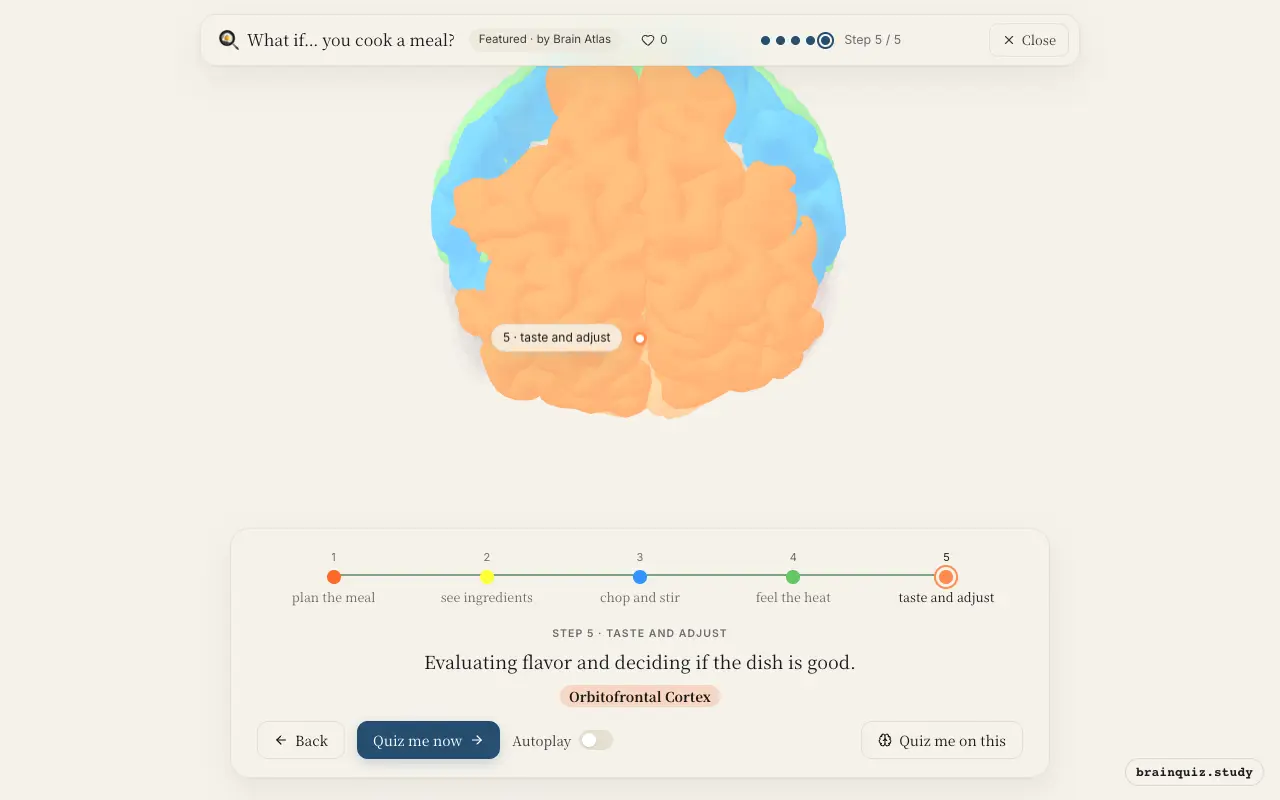
Watch it light up on the 3D brain
Brain regions that light up
| Order | Region | What it does here |
|---|---|---|
| 1 | Prefrontal Cortex | Deciding what to cook and holding the steps in working memory. |
| 2 | Visual Cortex | Identifying ingredients and reading the recipe. |
| 3 | Motor Cortex | Sending commands to your hands for precise movements. |
| 4 | Somatosensory Cortex | Sensing texture, temperature, and pressure from your hands and mouth. |
| 5 | Orbitofrontal Cortex | Evaluating flavor and deciding if the dish is good. |
1. Prefrontal Cortex: plan the meal
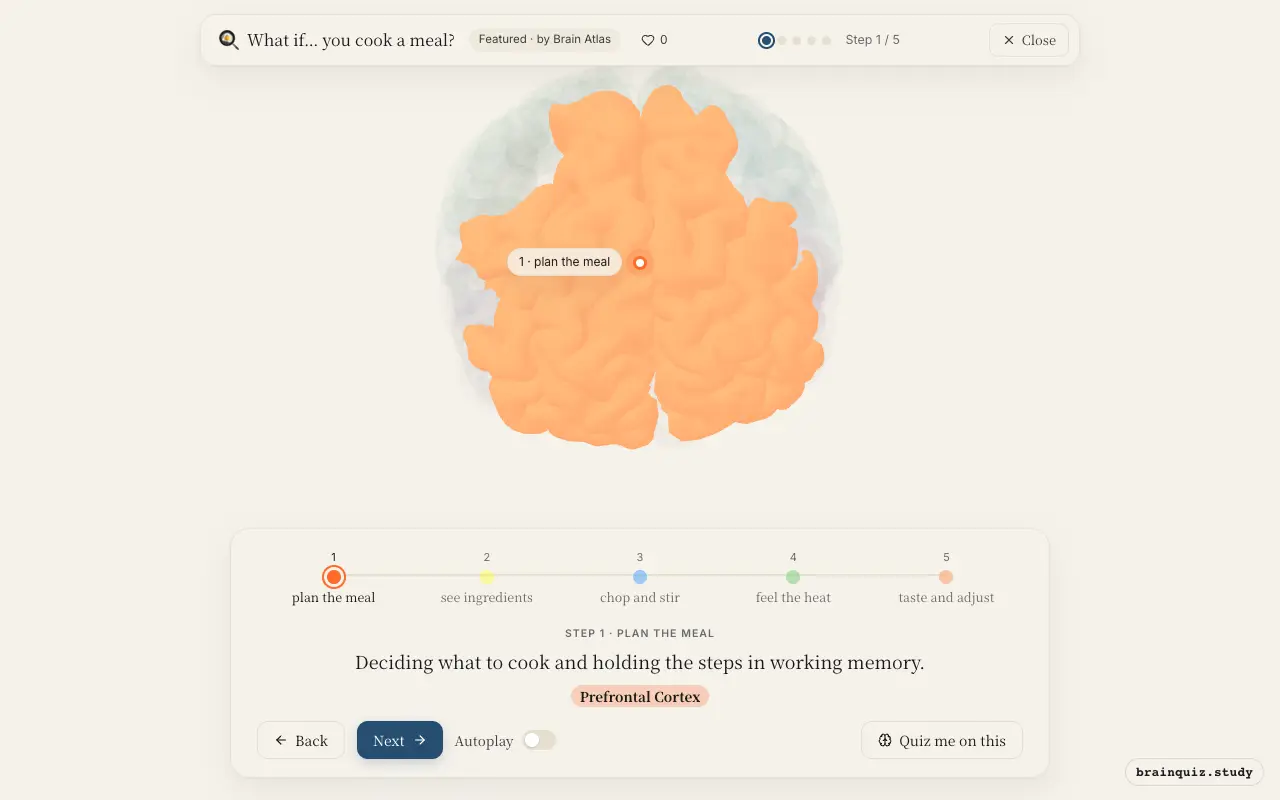
The prefrontal cortex coordinates executive functions: it selects a recipe, sequences steps, and monitors progress. It keeps the goal in mind while suppressing distractions, ensuring the dish comes together as planned.
2. Visual Cortex: see ingredients
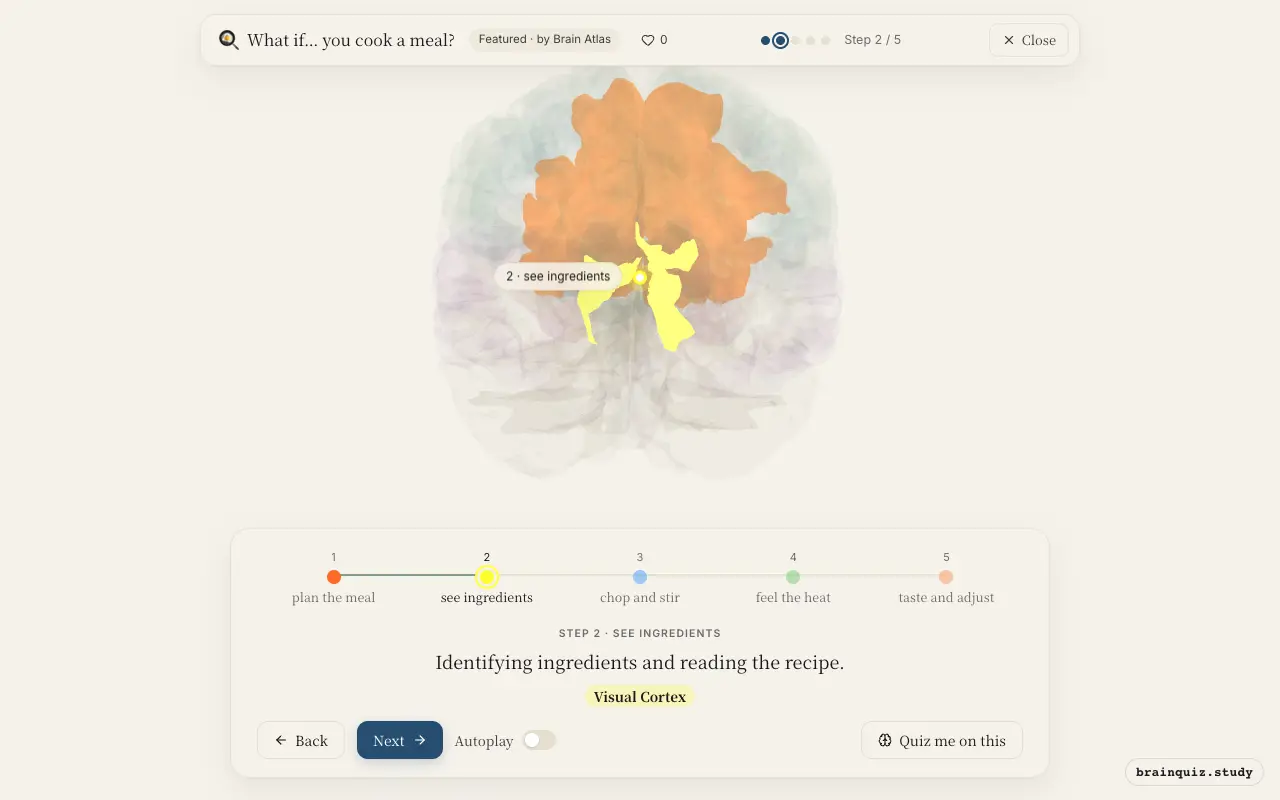
The visual cortex processes shapes, colors, and text. It recognizes vegetables, measures, and instructions, sending this information to parietal and temporal areas for further interpretation.
3. Motor Cortex: chop and stir
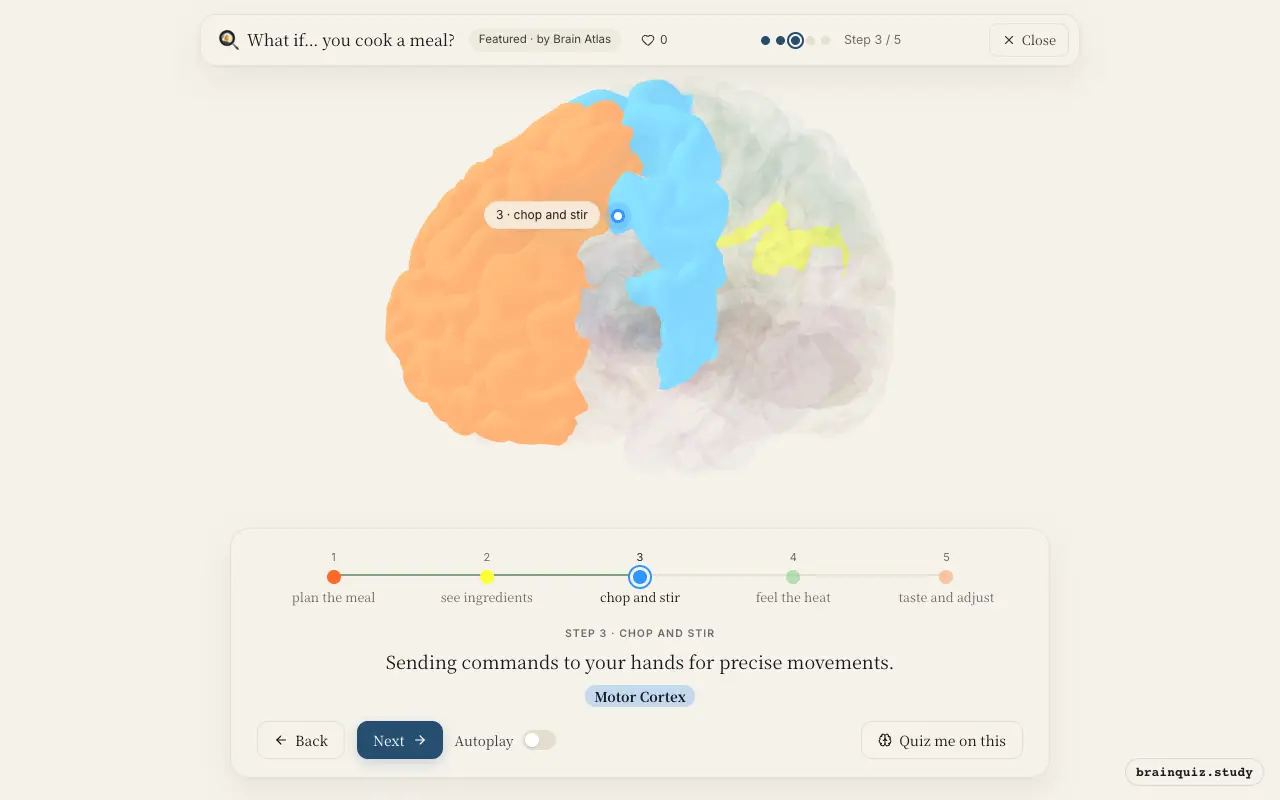
The motor cortex, with input from the premotor cortex and cerebellum, plans and executes voluntary movements. It adjusts force and speed as you chop, whisk, or flip, refining each action through practice and feedback.
4. Somatosensory Cortex: feel the heat
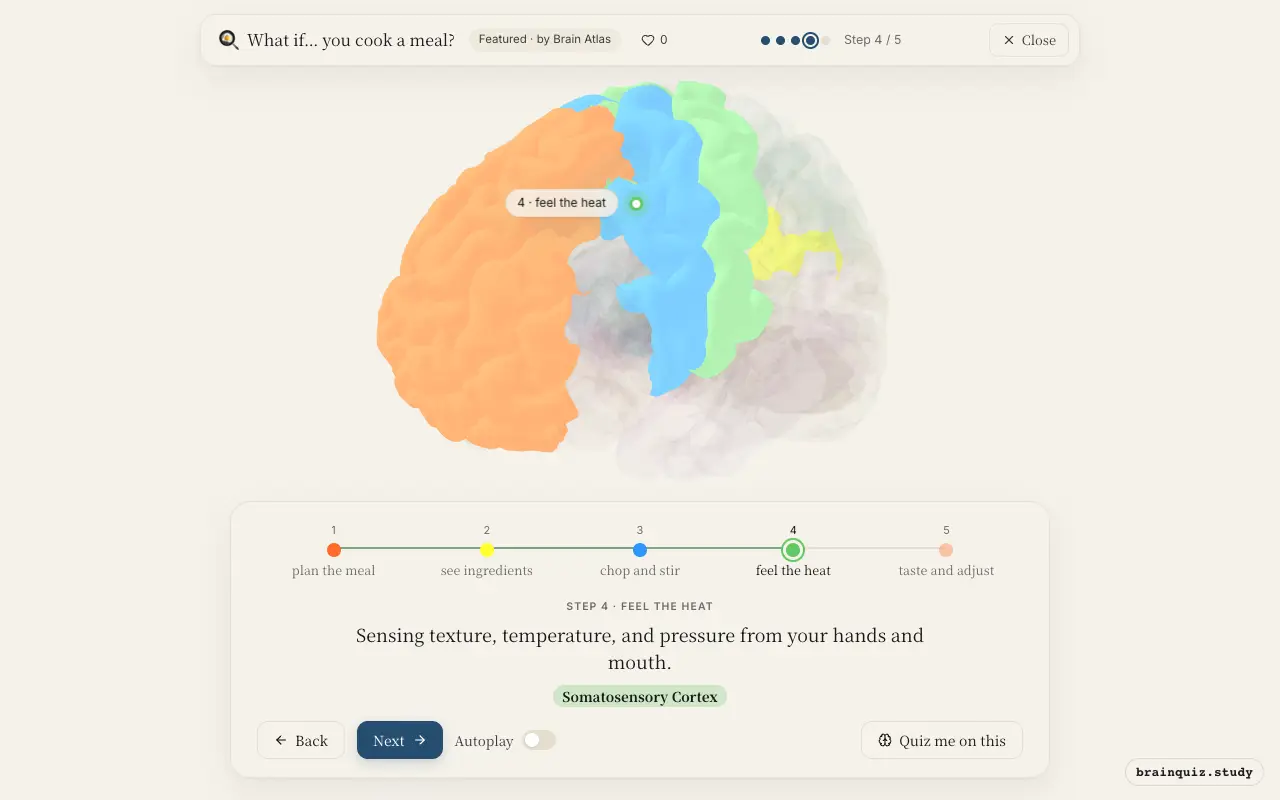
The somatosensory cortex receives touch and temperature signals from your skin. It tells you if the pan is hot, if the dough is sticky, or if the food is tender, guiding your next move.
5. Orbitofrontal Cortex: taste and adjust
The orbitofrontal cortex integrates taste, smell, and texture to assign value. It signals satisfaction when the seasoning is right and prompts you to add salt or acid if something is missing, linking the meal to reward.
Good to know
- Cooking involves procedural memory, which relies on the basal ganglia and cerebellum for smooth, automated actions like flipping a pancake.
- The hypothalamus monitors hunger and satiety, influencing how much you eat and when you stop cooking.
- Multisensory integration in the orbitofrontal cortex combines taste, smell, and texture into a unified flavor percept.
Cooking vs. Eating
Cooking a meal heavily engages executive and motor planning regions like the prefrontal and motor cortices. Eating, after the food is ready, shifts activity toward reward and interoceptive areas such as the orbitofrontal cortex, insula, and hypothalamus, with less demand on motor planning.
Test yourself
Which region is most active when you decide what to cook?
Which region coordinates the precise movements of chopping vegetables?
What happens in the orbitofrontal cortex when you taste the food?
0 of 3 answered · 0 correct
Simplified: many regions work together at once, and this shows the main players in the order they act.