What happens in your brain when you feel a phantom phone vibration?
Updated
Prefrontal cortex primes attention to phone vibrations; somatosensory cortex processes spontaneous or ambiguous signals; parietal cortex integrates sensory and spatial context; insula generates the conscious feeling, making a phantom seem real.
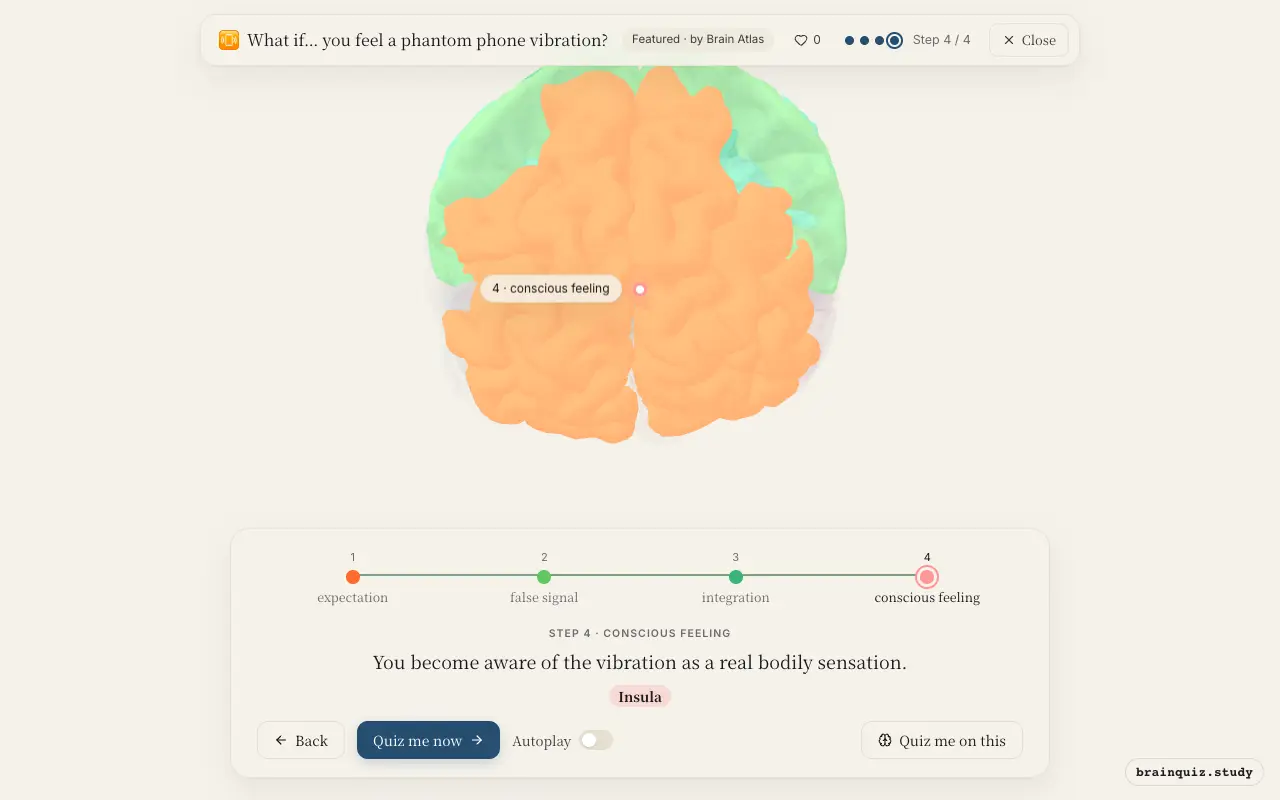
Watch it light up on the 3D brain
Brain regions that light up
| Order | Region | What it does here |
|---|---|---|
| 1 | Prefrontal Cortex | Your brain anticipates a phone vibration, lowering the threshold for detecting one. |
| 2 | Somatosensory Cortex | A spontaneous neural signal or benign touch is processed as if it were a vibration. |
| 3 | Parietal Cortex | Sensory and spatial information combine to localize the vibration to your pocket. |
| 4 | Insula | You become aware of the vibration as a real bodily sensation. |
1. Prefrontal Cortex: expectation
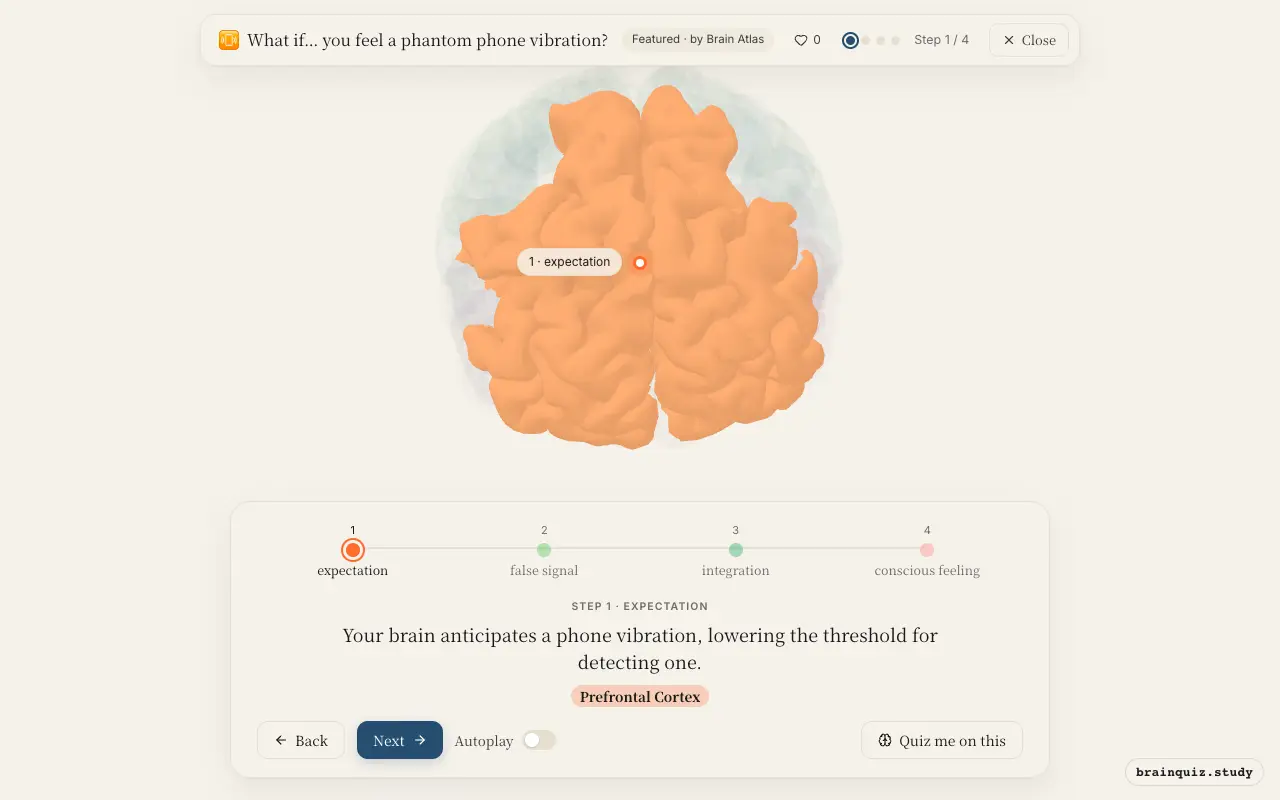
The prefrontal cortex maintains a state of readiness for phone notifications. This top-down attention increases the likelihood that any weak or ambiguous sensory signal will be interpreted as a vibration, even when none exists.
2. Somatosensory Cortex: false signal
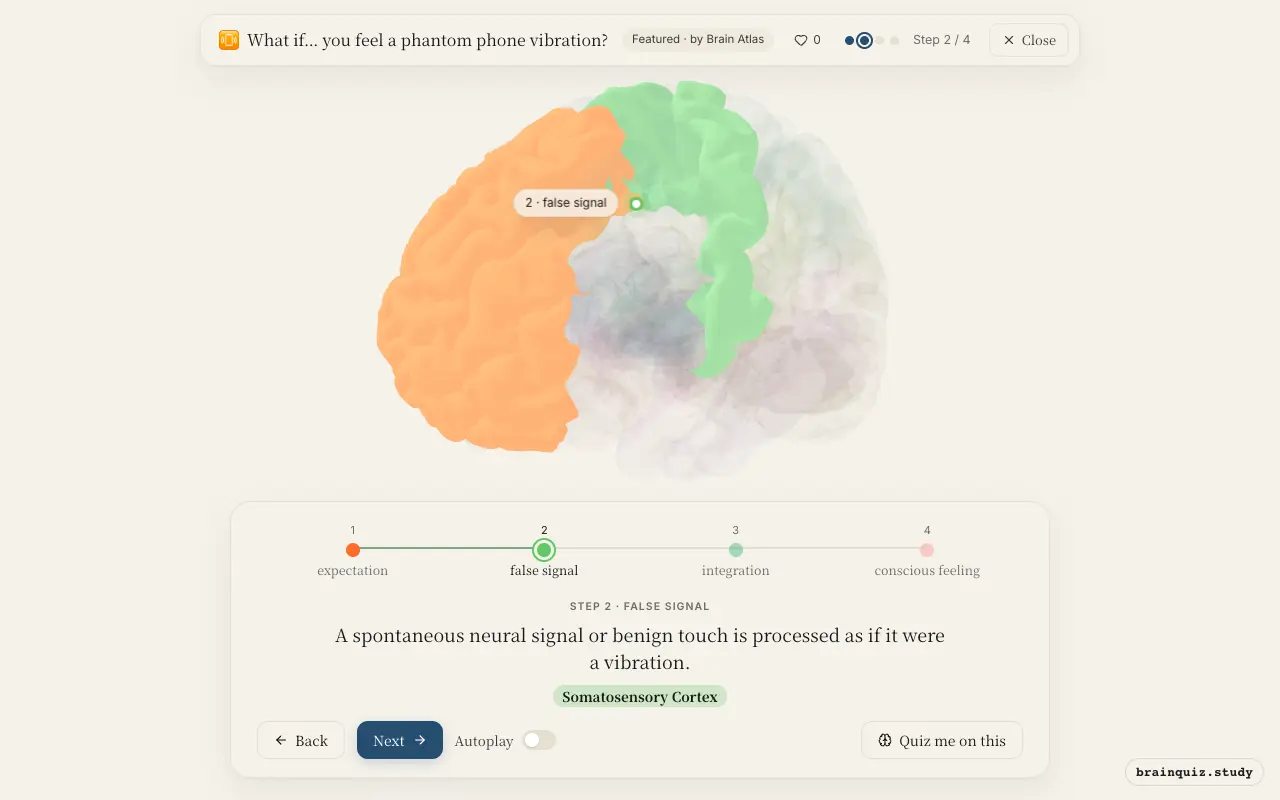
Without a real stimulus, the somatosensory cortex can still receive input from spontaneous neural activity, muscle twitches, or clothing friction. It processes this input as tactile information, laying the groundwork for the phantom sensation.
3. Parietal Cortex: integration
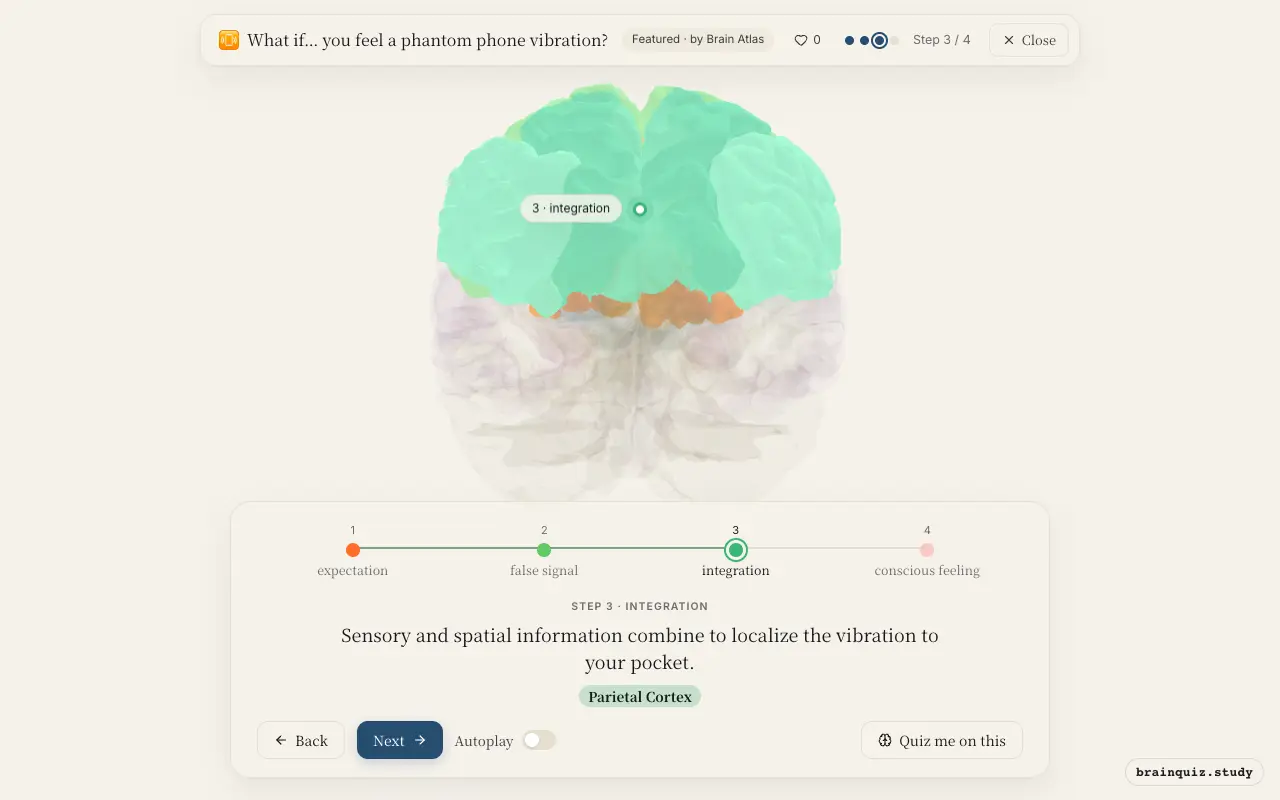
The parietal cortex integrates the somatosensory signal with spatial attention and body schema. This integration helps determine where on the body the sensation is occurring, contributing to the perception that your phone is vibrating in your pocket.
4. Insula: conscious feeling
The insula integrates interoceptive and exteroceptive signals to generate the subjective experience of the vibration. This makes the phantom feel real, prompting you to check your phone even though it did not actually move.
Good to know
- Phantom vibration syndrome is widely reported, with studies suggesting that a majority of smartphone users have experienced it.
- The phenomenon is thought to arise from signal detection theory: the brain is biased toward detecting vibrations because missing a real call may have social costs.
- Similar phantom sensations were reported with pagers before smartphones became common.
Phantom vibration vs real phone vibration
In a real vibration, mechanoreceptors in the skin send strong, consistent signals to the somatosensory cortex, and perception is accurate. In phantom vibration, top-down expectation from the prefrontal cortex biases perception even with weak or absent input, causing a false alarm.
Test yourself
Which brain region initiates the expectation that makes phantom vibrations more likely?
In phantom vibration, the somatosensory cortex likely processes:
What role does the insula play in phantom vibration?
0 of 3 answered · 0 correct
Simplified: many regions work together at once, and this shows the main players in the order they act.