What happens in your brain when you give a gift?
Updated
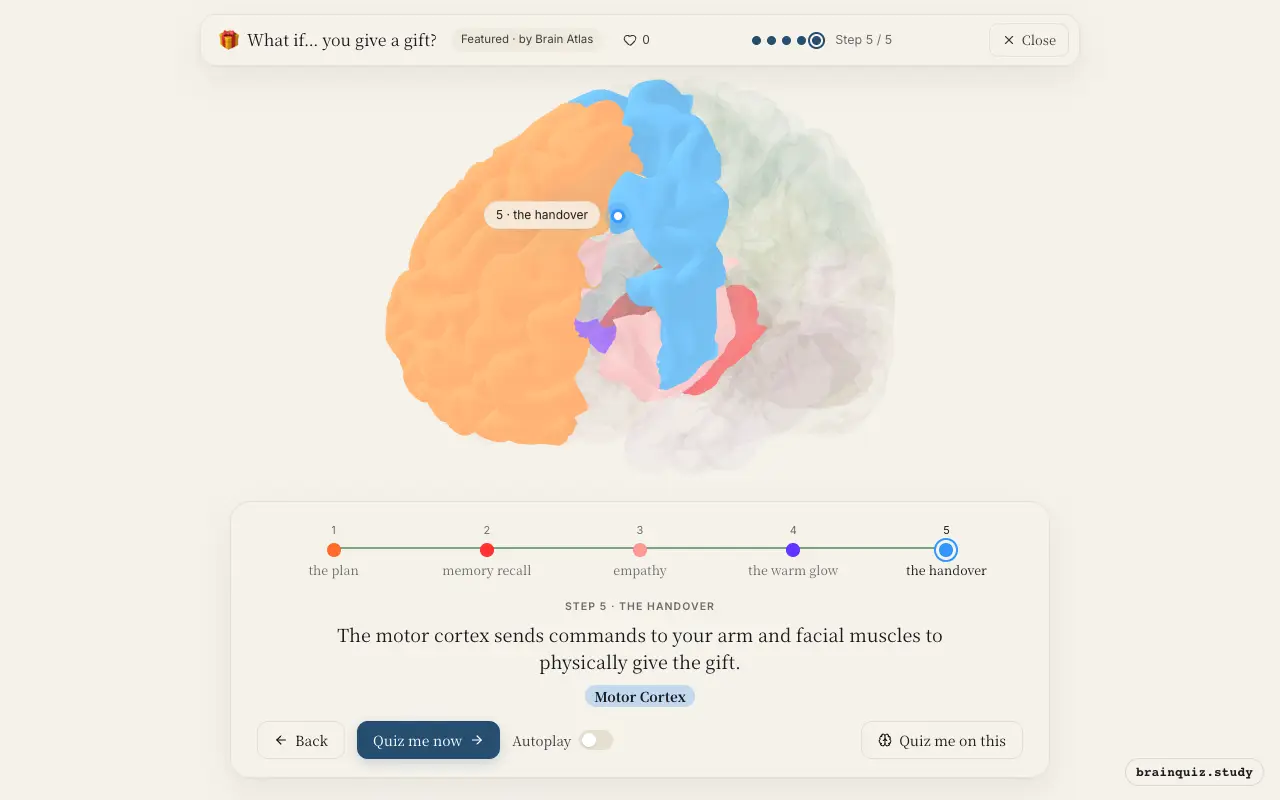
When giving a gift, your prefrontal cortex plans the gesture, hippocampus recalls the recipient's tastes, insula simulates their joy, nucleus accumbens signals reward, and motor cortex executes the hand-over.
Watch it light up on the 3D brain
Brain regions that light up
| Order | Region | What it does here |
|---|---|---|
| 1 | Prefrontal Cortex | Your prefrontal cortex weighs gift options and considers the recipient's personality. |
| 2 | Hippocampus | The hippocampus retrieves memories of what the person likes or has mentioned wanting. |
| 3 | Insula | Your insula simulates the recipient's emotional reaction, letting you feel their anticipated joy. |
| 4 | Nucleus Accumbens | The nucleus accumbens releases dopamine, creating a rewarding feeling from the act of giving itself. |
| 5 | Motor Cortex | The motor cortex sends commands to your arm and facial muscles to physically give the gift. |
1. Prefrontal Cortex: the plan
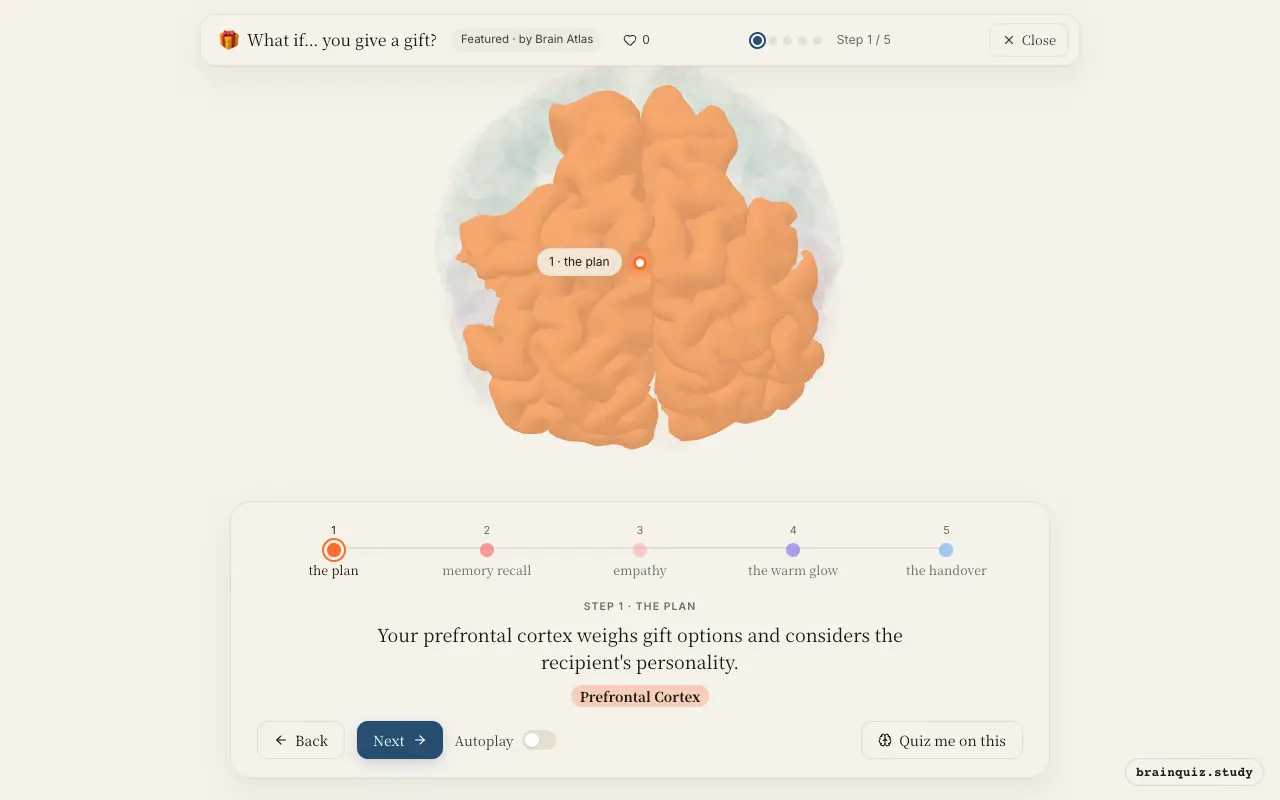
This region handles executive functions like decision-making and working memory. It helps you select an appropriate gift by integrating social norms and the recipient's known preferences, ensuring the choice is thoughtful and contextually suitable.
2. Hippocampus: memory recall
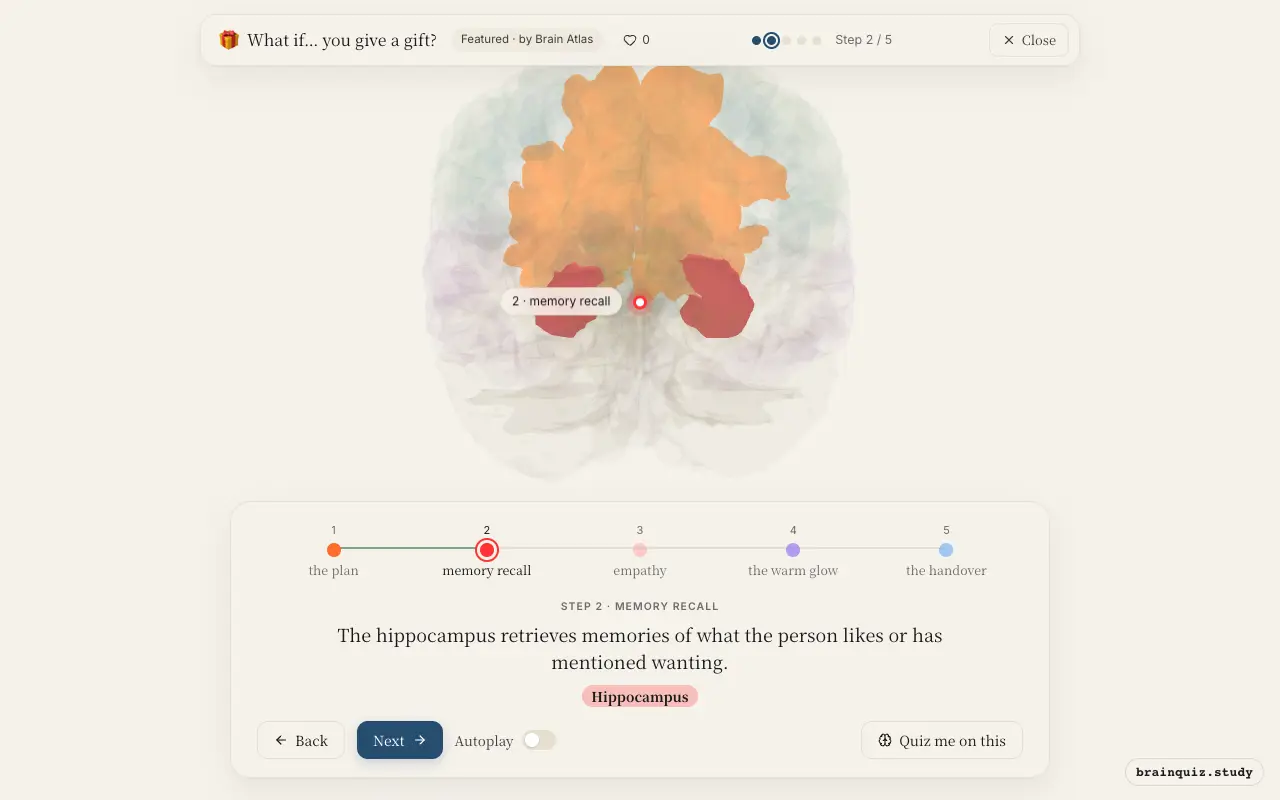
The hippocampus consolidates and recalls episodic memories. It pulls up past conversations, shared experiences, and observed preferences, providing the raw material for a personalized gift that reflects your relationship.
3. Insula: empathy
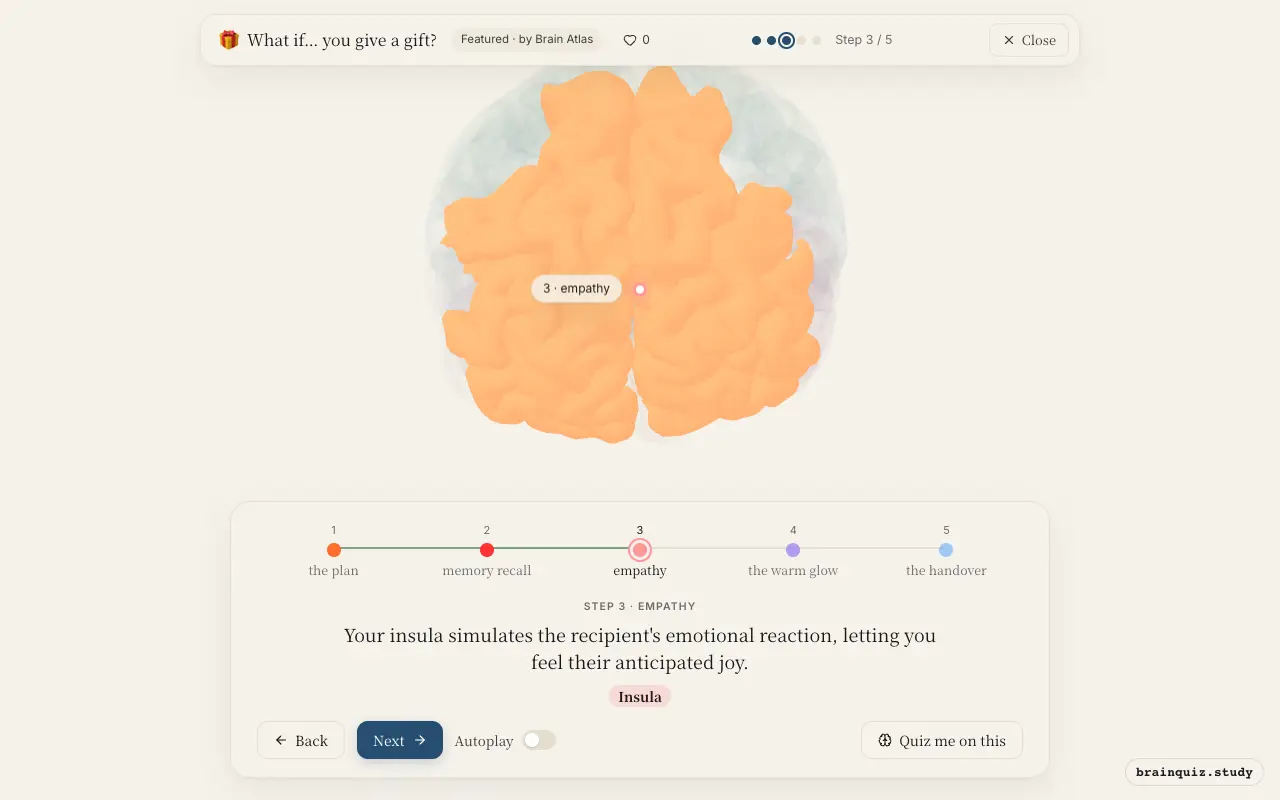
The insula is involved in interoception and empathy. By internally modeling the recipient's state, it generates a gut-level sense of how they will feel, which guides emotional tailoring and strengthens social bonding.
4. Nucleus Accumbens: the warm glow
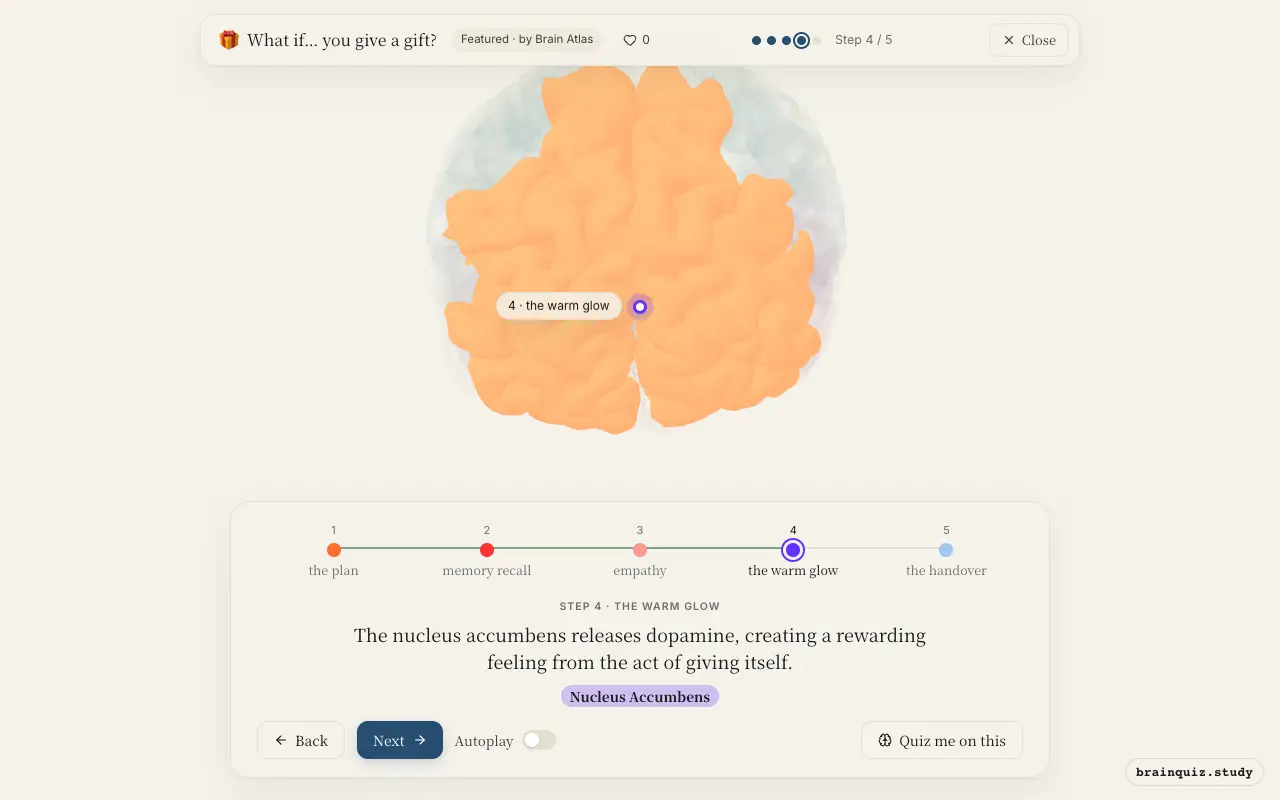
This ventral striatal region is central to reward and motivation. Studies suggest that giving activates the nucleus accumbens even more than receiving, producing a 'warm glow' that reinforces prosocial behavior.
5. Motor Cortex: the handover
The primary motor cortex executes voluntary movements. It coordinates the fine motor sequences of extending your arm, releasing the gift, and producing a genuine smile, transforming the internal intention into observable action.
Good to know
- Neuroimaging studies show that charitable giving activates the brain's reward system, including the nucleus accumbens.
- The insula's activation during gift-giving reflects its role in empathy and predicting others' emotions.
- Dopamine release in the nucleus accumbens is thought to reinforce prosocial behaviors, making giving feel good.
Giving vs receiving a gift
When receiving a gift, reward centers like the nucleus accumbens also activate, but giving may additionally engage areas for empathy (insula) and planning (prefrontal cortex) more strongly. Receiving may involve more sensory processing as you unwrap and evaluate the gift, while giving focuses on the other person's reaction.
Test yourself
Which brain region is primarily responsible for the 'warm glow' feeling when giving a gift?
What role does the insula play in gift-giving?
How does brain activity differ between giving and receiving a gift?
0 of 3 answered · 0 correct
Simplified: many regions work together at once, and this shows the main players in the order they act.