What happens in your brain when you take magic mushrooms?
Updated
Psilocybin reduces posterior cingulate and prefrontal cortex activity, loosening the default mode network. Thalamic sensory gating opens, visual cortex overprocesses, and the insula alters bodily self-awareness.
Watch it light up on the 3D brain
Brain regions that light up
| Order | Region | What it does here |
|---|---|---|
| 1 | Posterior Cingulate Cortex | Psilocybin quiets the posterior cingulate, a core hub of the default mode network. |
| 2 | Prefrontal Cortex | Prefrontal cortex activity drops, releasing top-down control. |
| 3 | Thalamus | Thalamic filtering weakens, letting more sensory data reach the cortex. |
| 4 | Visual Cortex | Visual cortex becomes overactive even without external visual stimuli. |
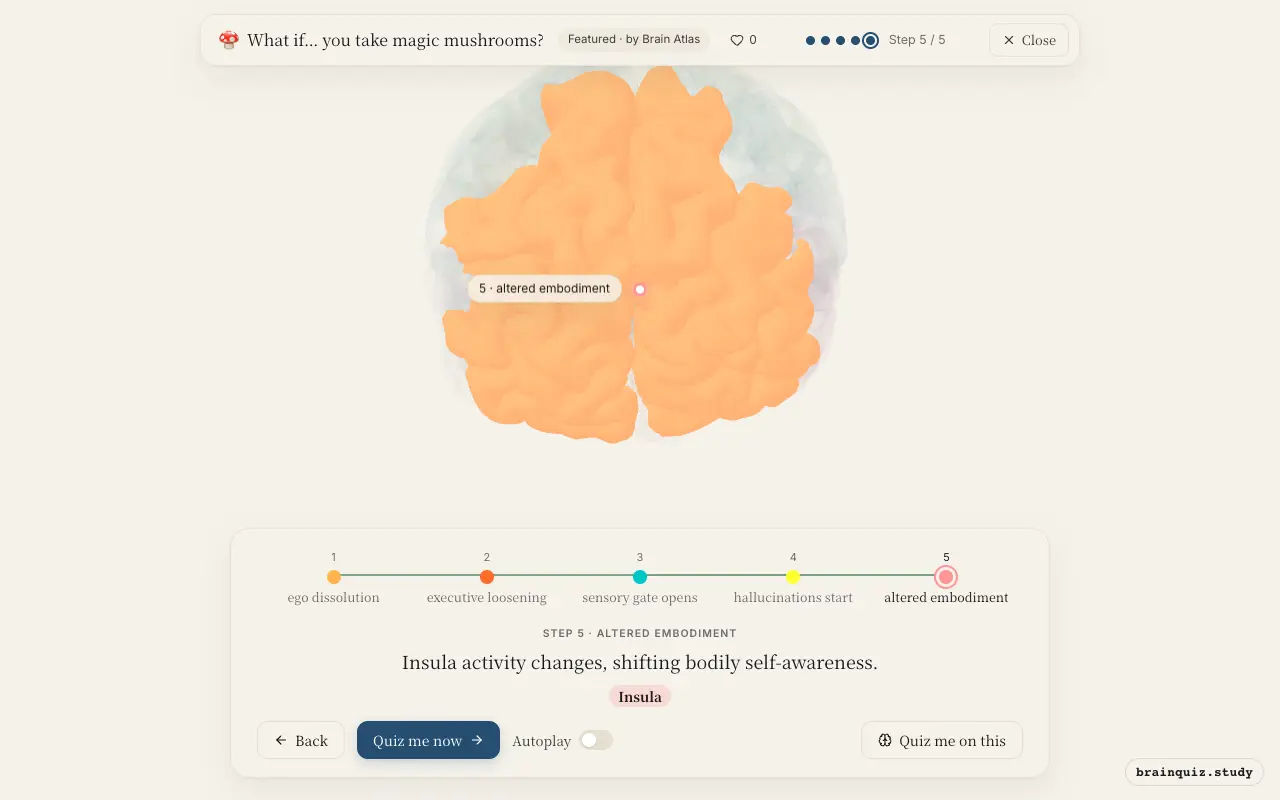
| 5 | Insula | Insula activity changes, shifting bodily self-awareness. |
1. Posterior Cingulate Cortex: ego dissolution
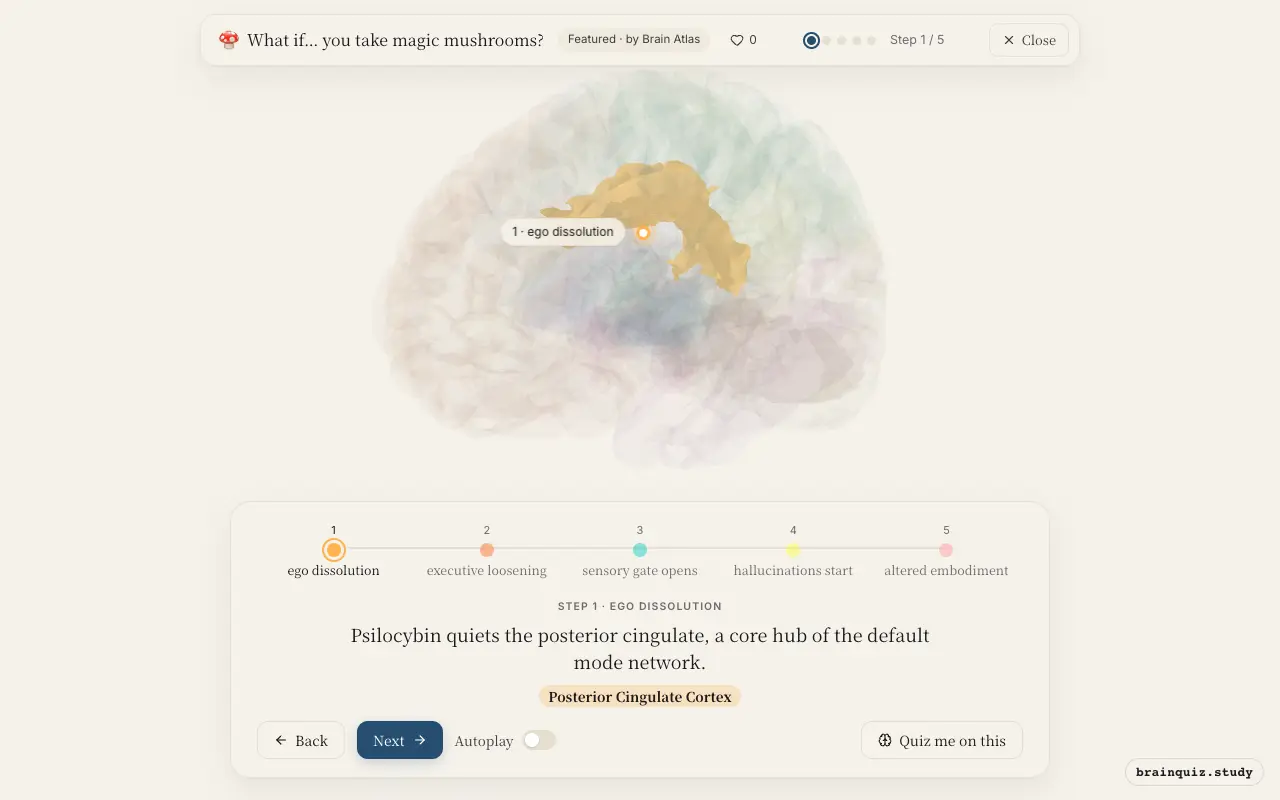
The posterior cingulate is a central node of the default mode network, which is active during self-referential thought and mind-wandering. Psilocybin dramatically reduces its activity and connectivity, leading to a breakdown of the normal sense of self, often described as 'ego dissolution.' This effect is thought to underlie the profound shifts in perspective reported by users.
2. Prefrontal Cortex: executive loosening
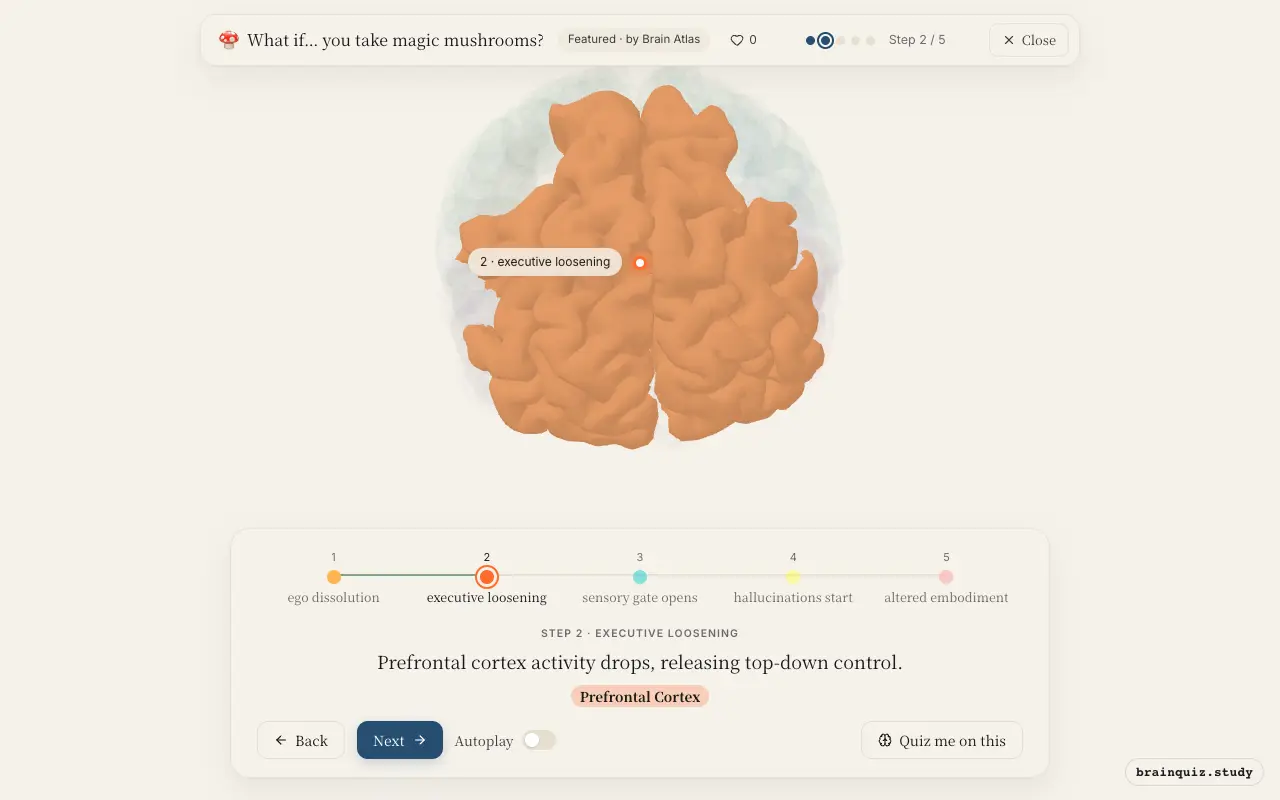
The medial prefrontal cortex, another key default mode network region, shows decreased activity under psilocybin. This reduction in executive oversight allows sensory information to flow more freely without the usual filtering and interpretation. The loss of top-down constraints may contribute to the sense of unity and interconnectedness often experienced.
3. Thalamus: sensory gate opens
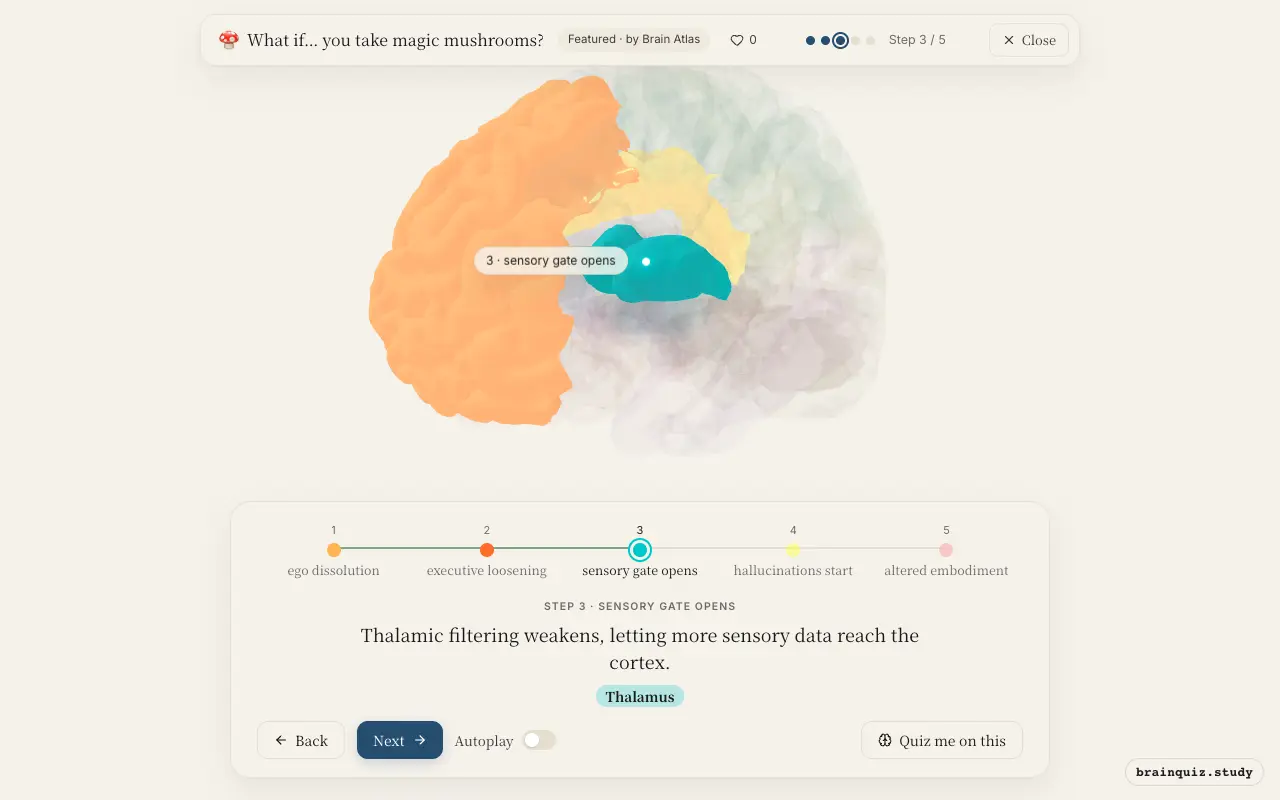
The thalamus normally acts as a relay and filter for sensory information, gating what reaches the cortex. Psilocybin is thought to reduce this gating function, leading to an overload of sensory input. This may explain the intensification of colors, sounds, and tactile sensations, as well as synesthetic experiences where senses blend.
4. Visual Cortex: hallucinations start
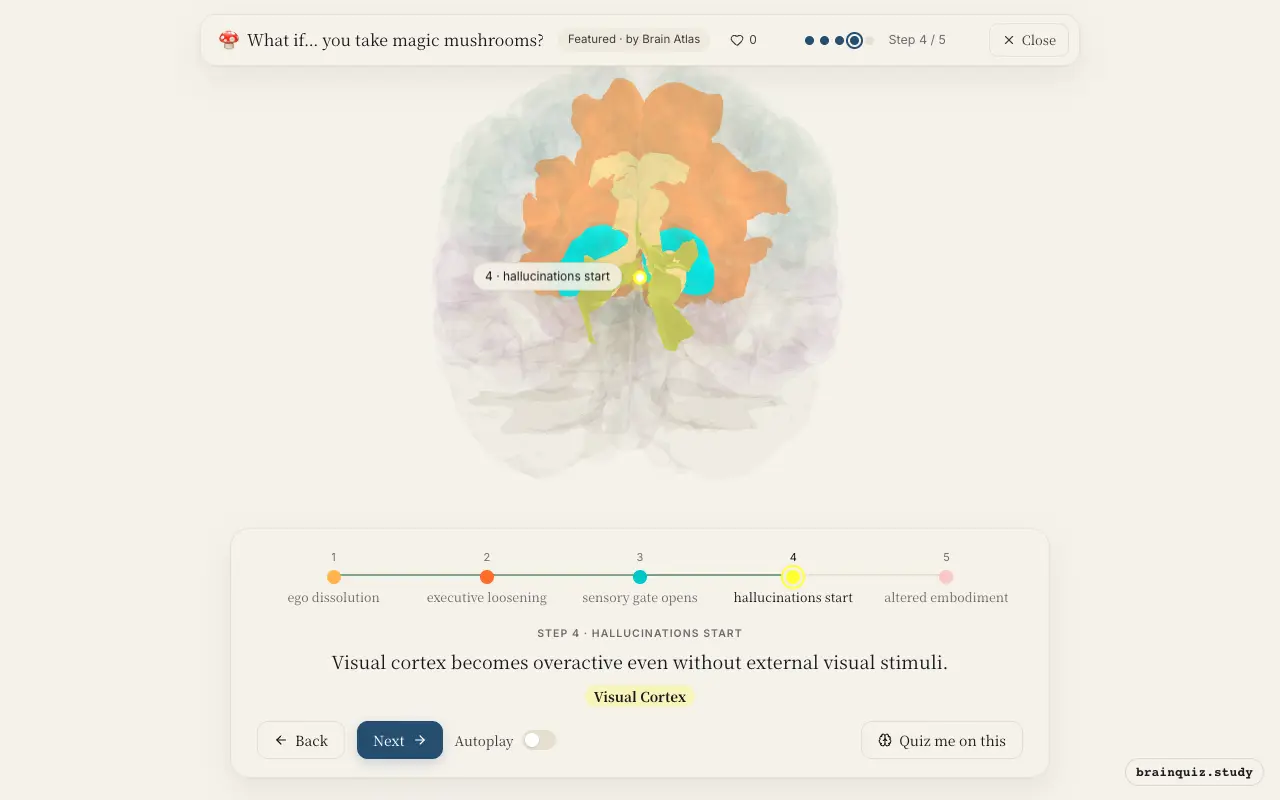
Visual cortex, particularly the primary visual area, shows increased activity and altered connectivity under psilocybin. This can produce vivid geometric patterns, distortions, and full hallucinations with eyes closed. The overactivity may result from the reduced thalamic gating and increased excitability of layer 5 pyramidal neurons via 5-HT2A receptors.
5. Insula: altered embodiment
The insula integrates interoceptive signals from the body, contributing to the sense of being an embodied self. Psilocybin alters insula activity and its connections with default mode and salience networks. This likely underlies the feeling of disembodiment, body distortion, and the blurring of boundaries between self and environment often reported during the experience.
Good to know
- Psilocybin is a classic serotonergic psychedelic that acts primarily as an agonist at 5-HT2A receptors.
- Research suggests psilocybin can produce mystical-type experiences, which have been linked to long-term increases in personality openness.
- Psilocybin-assisted therapy is being studied for treatment-resistant depression and end-of-life anxiety.
Psilocybin vs LSD
Both psilocybin and LSD act on serotonin 5-HT2A receptors and produce similar hallucinogenic effects. However, LSD also binds dopamine D2 receptors with moderate affinity, which may explain its slightly more stimulating and longer-lasting subjective effects. Brain imaging shows both reduce default mode network activity, but LSD's additional dopaminergic action may alter reward circuits differently.
Test yourself
Which brain network is most strongly disrupted by psilocybin?
What neurotransmitter receptor does psilocybin primarily activate?
Which region is thought to act as a sensory gate that opens under psilocybin?
0 of 3 answered · 0 correct
Simplified: many regions work together at once, and this shows the main players in the order they act. For learning only, not medical advice.