What happens in your brain when you write by hand?
Updated
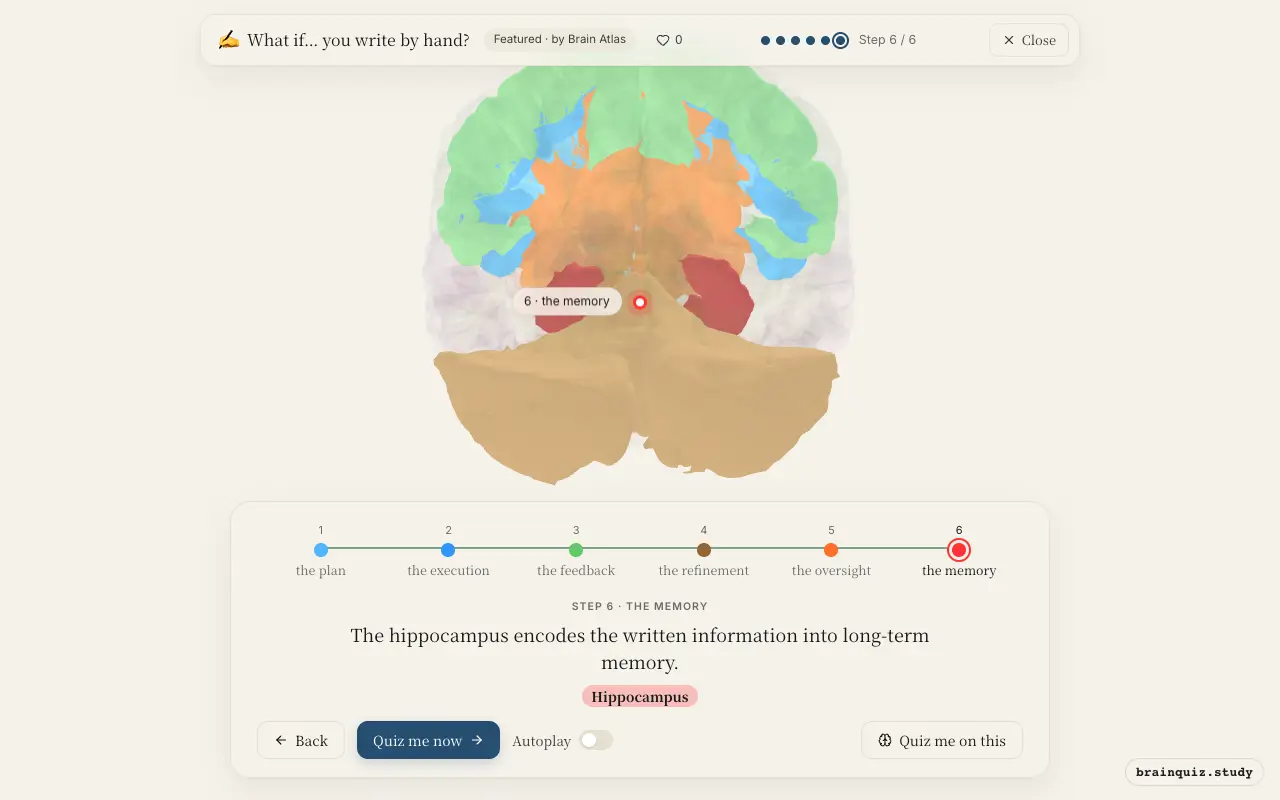
When you write by hand, the premotor cortex plans movements, the motor cortex executes them, the somatosensory cortex provides feedback, the cerebellum refines motion, the prefrontal cortex monitors, and the hippocampus encodes the content into memory.
Watch it light up on the 3D brain
Brain regions that light up
| Order | Region | What it does here |
|---|---|---|
| 1 | Premotor Cortex | The premotor cortex plans the sequence of hand movements needed to form each letter. |
| 2 | Motor Cortex | The motor cortex sends commands to hand muscles to produce the planned writing movements. |
| 3 | Somatosensory Cortex | The somatosensory cortex processes touch and proprioceptive feedback from the writing hand. |
| 4 | Cerebellum | The cerebellum coordinates timing and precision, smoothing out the writing movements. |
| 5 | Prefrontal Cortex | The prefrontal cortex uses working memory to hold the written content and monitor performance. |
| 6 | Hippocampus | The hippocampus encodes the written information into long-term memory. |
1. Premotor Cortex: the plan
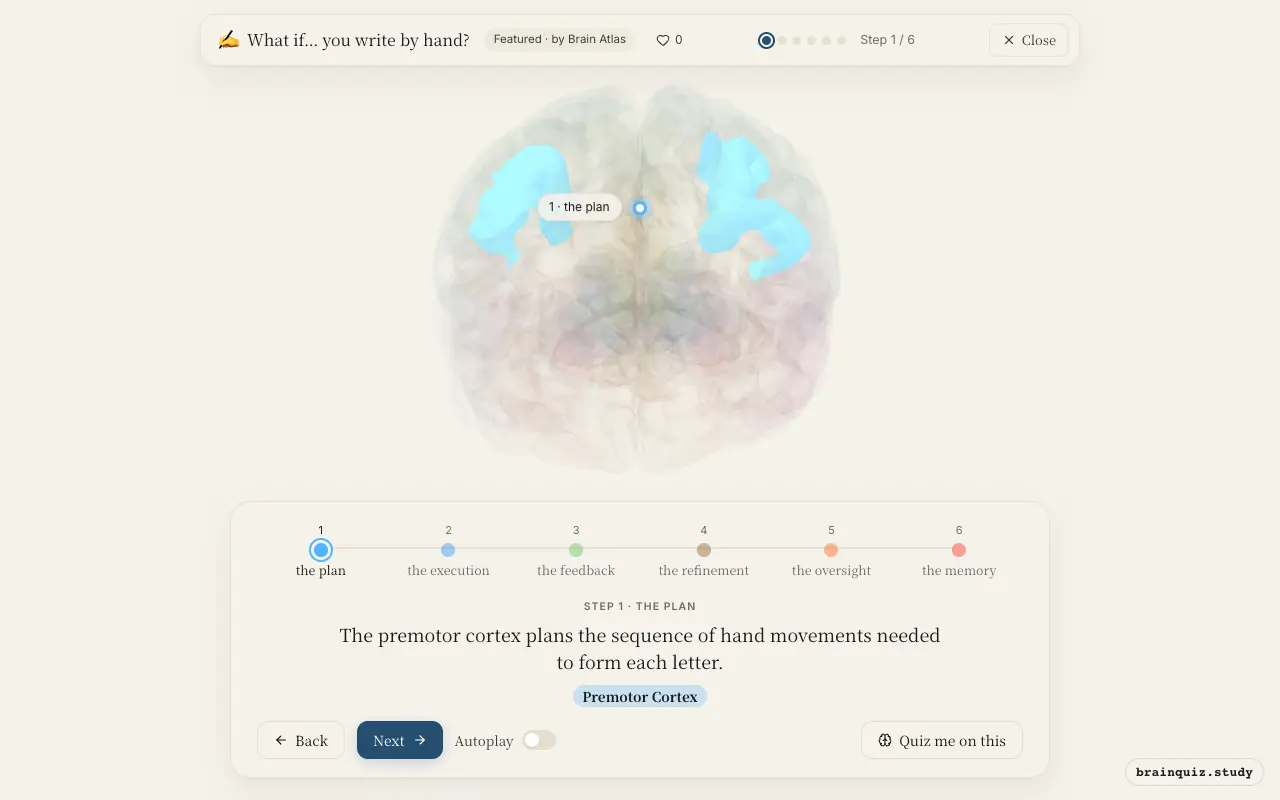
The premotor cortex organizes motor programs for writing, selecting the appropriate order of finger and wrist movements. It relies on learned motor schemas built from years of practice. This planning stage is essential before any actual movement occurs.
2. Motor Cortex: the execution
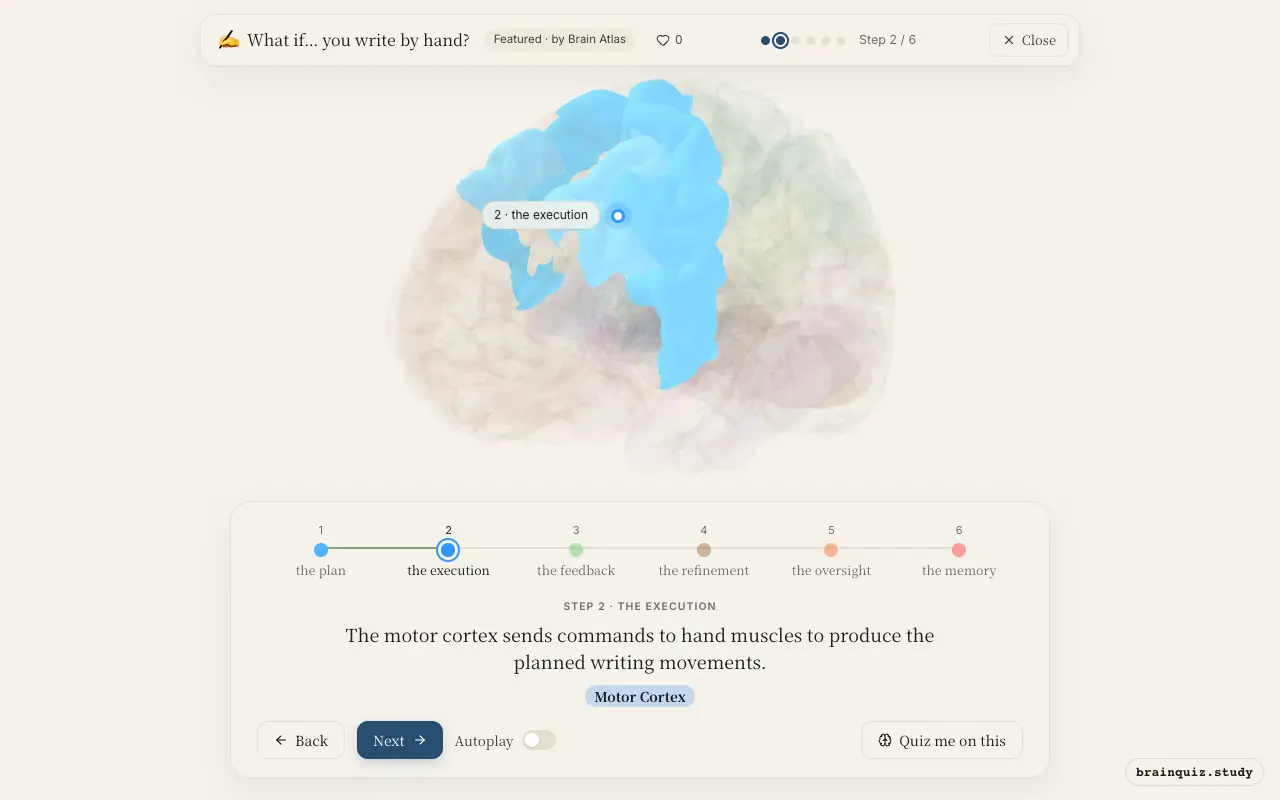
The motor cortex activates specific muscle groups in the hand, wrist, and arm via the corticospinal tract. Its hand representation is disproportionately large due to the fine motor control required for writing. Damage here impairs the ability to write legibly.
3. Somatosensory Cortex: the feedback
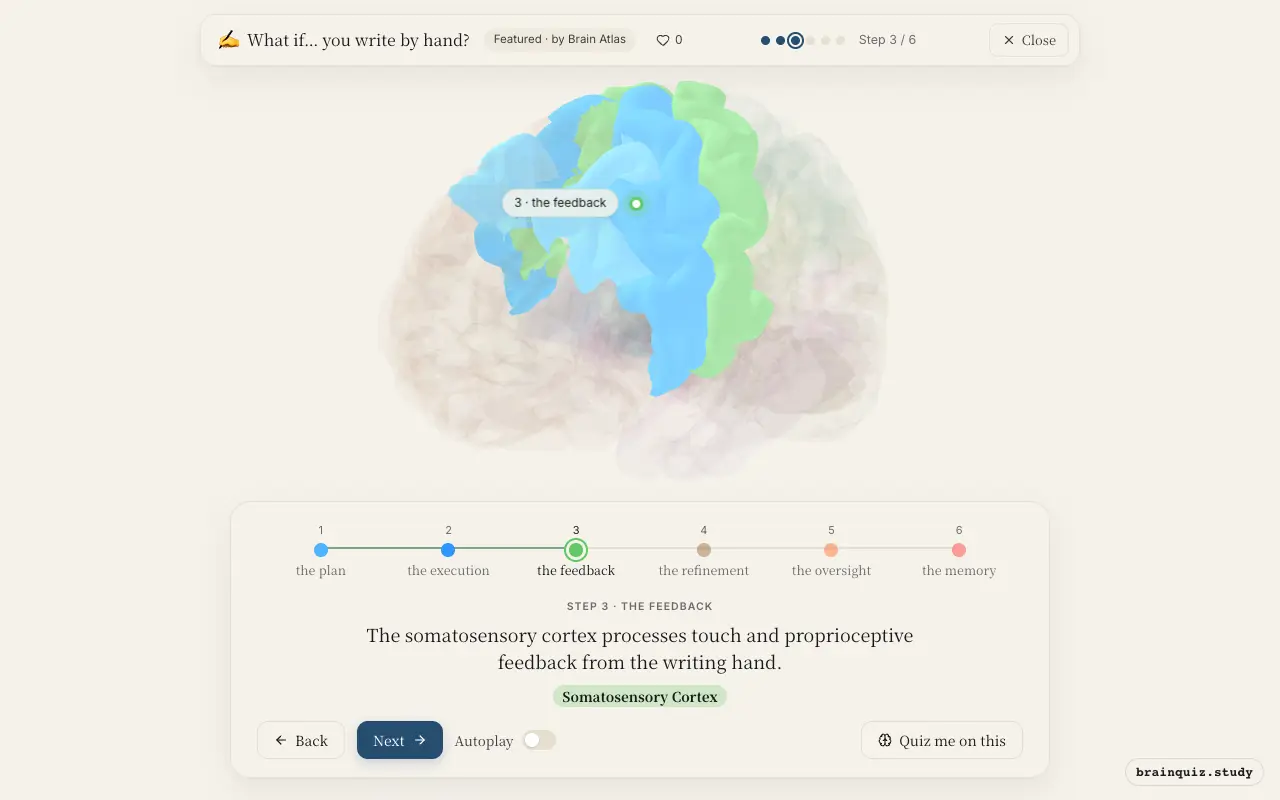
As the hand moves, receptors in skin, muscles, and joints send signals about pressure, position, and movement. The somatosensory cortex integrates this feedback, allowing adjustments in grip force and pen angle. This feedback is crucial for writing without constant visual attention.
4. Cerebellum: the refinement
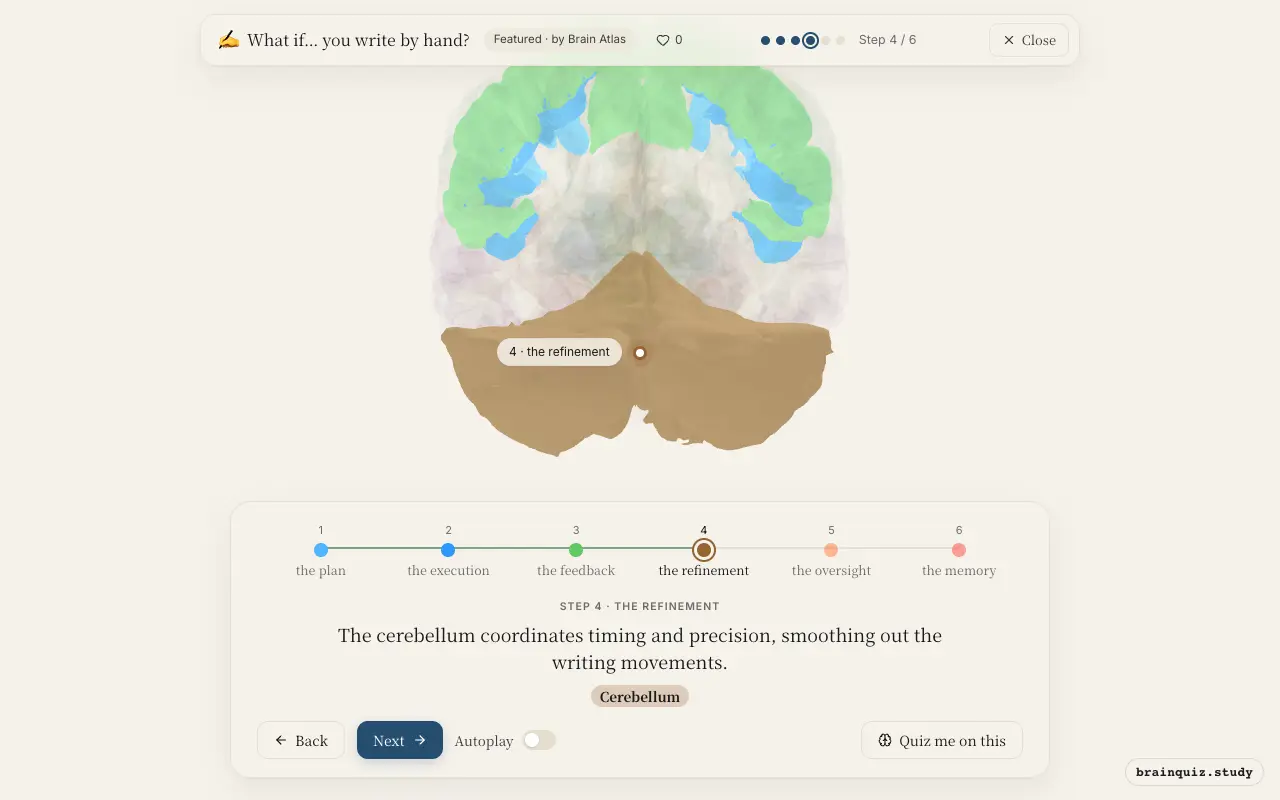
The cerebellum compares intended movements from the motor cortex with actual sensory feedback, correcting errors in real time. It ensures rhythmic, consistent letter formation and adapts to changes like pen type or writing surface. Cerebellar damage often causes jerky, uncoordinated handwriting.
5. Prefrontal Cortex: the oversight
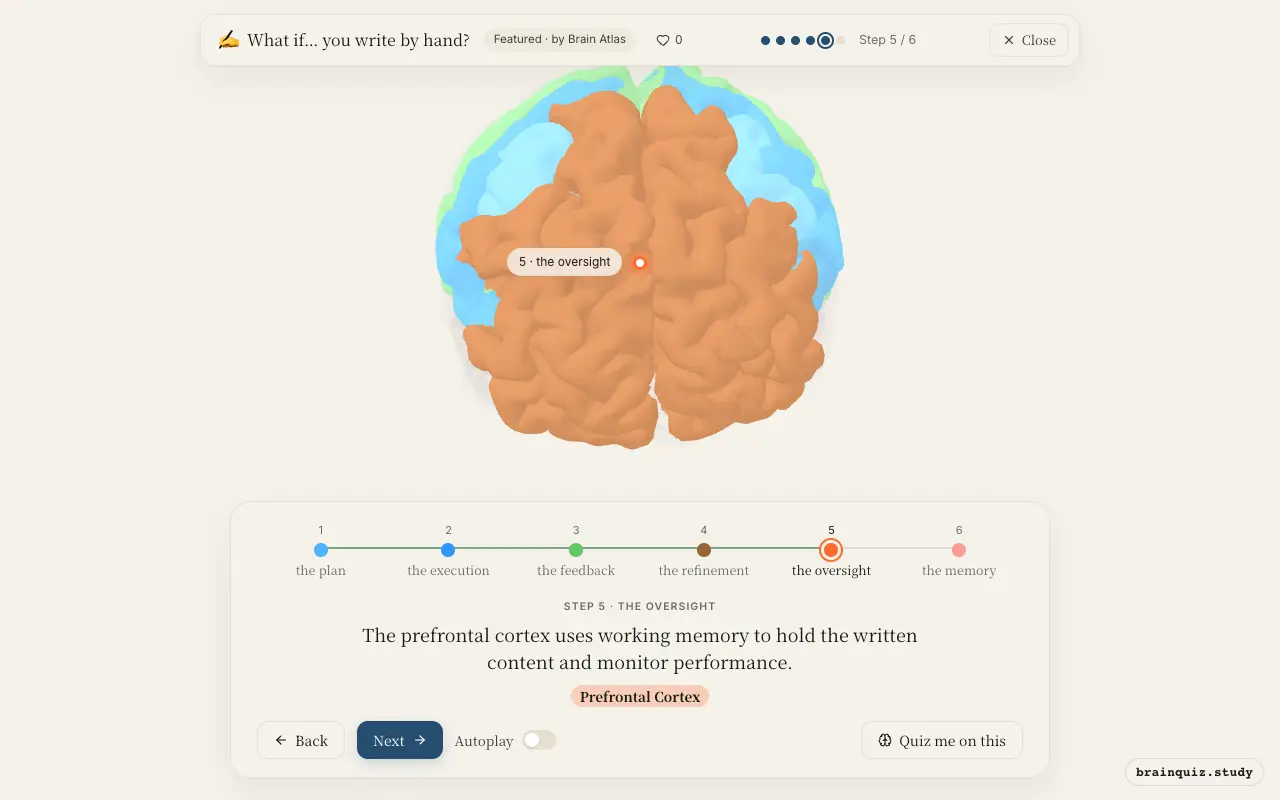
While writing, the prefrontal cortex maintains the words or ideas being transcribed, ensuring they are accurate and coherent. It also monitors for errors and may adjust writing speed or force. This executive control is essential for writing meaningful sentences rather than isolated letters.
6. Hippocampus: the memory
Handwriting is thought to enhance learning because the act of forming letters creates a motor memory trace in addition to visual and semantic traces. The hippocampus binds these multimodal elements together, strengthening recall. This is one reason handwritten notes may be more memorable than typed notes.
Good to know
- Handwriting requires fine motor skills that develop over years of practice and become automatic.
- The cerebellum contains more neurons than any other brain structure and is critical for motor learning.
- Proprioceptive feedback from muscles and joints allows writing without constant visual monitoring.
Handwriting vs Typing
Typing relies on discrete keystrokes with less sequential motor planning, activating motor cortex but less cerebellum and somatosensory feedback. Handwriting's detailed sensorimotor engagement is thought to enhance memory encoding compared to typing.
Test yourself
Which brain region is primarily responsible for planning the sequence of hand movements during writing?
The cerebellum's role during handwriting is to:
Which region is thought to encode the written information into long-term memory, enhancing learning?
0 of 3 answered · 0 correct
Simplified: many regions work together at once, and this shows the main players in the order they act.