What happens in your brain when you hit a golf ball?
Updated
When hitting a golf ball, the visual cortex locates the ball and target, the premotor cortex plans the swing, the motor cortex executes the movement, the cerebellum coordinates timing and balance, and the basal ganglia smooths the action.
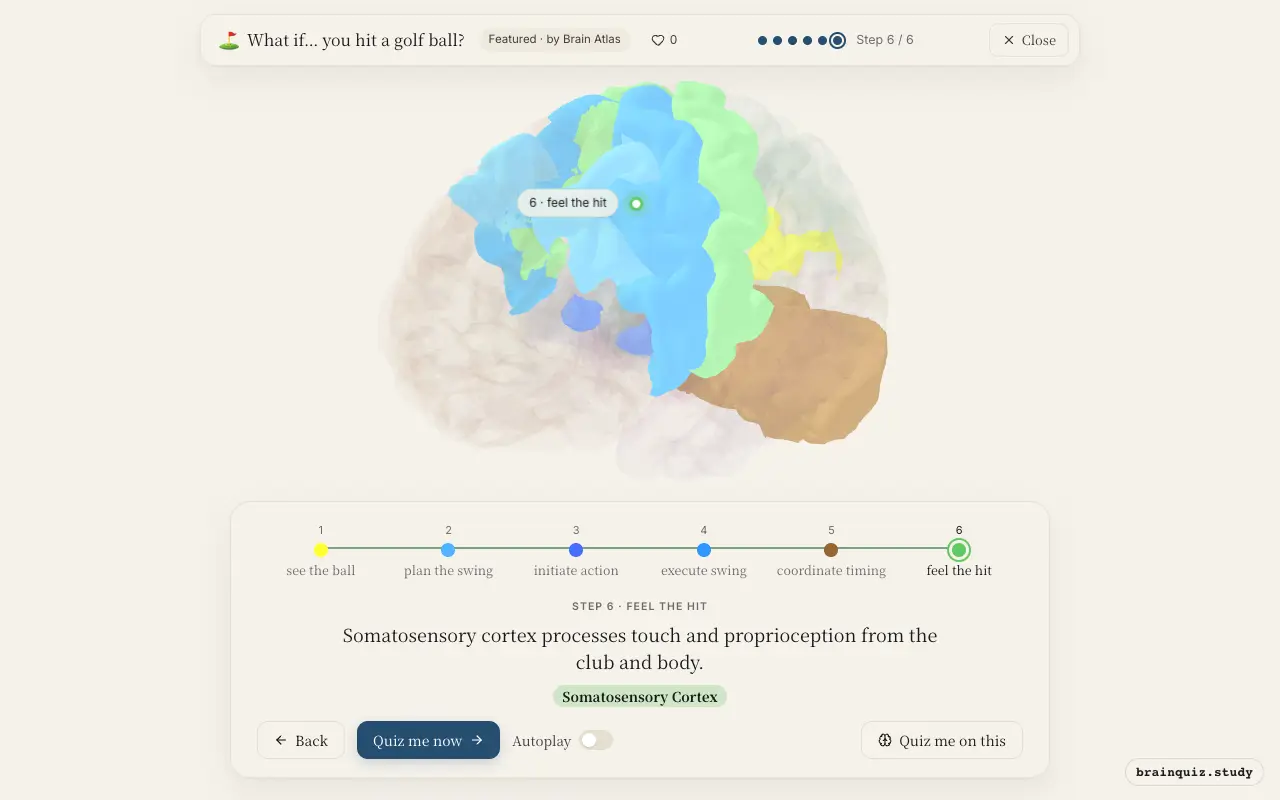
Watch it light up on the 3D brain
Brain regions that light up
| Order | Region | What it does here |
|---|---|---|
| 1 | Visual Cortex | Primary visual cortex processes the ball's position and the target direction. |
| 2 | Premotor Cortex | Premotor cortex prepares the sequence of muscle activations needed for the swing. |
| 3 | Basal Ganglia | Basal ganglia select and initiate the motor program for the golf swing. |
| 4 | Motor Cortex | Motor cortex sends commands to spinal cord to contract muscles in the correct order. |
| 5 | Cerebellum | Cerebellum fine-tunes the movement in real-time based on sensory feedback. |
| 6 | Somatosensory Cortex | Somatosensory cortex processes touch and proprioception from the club and body. |
1. Visual Cortex: see the ball
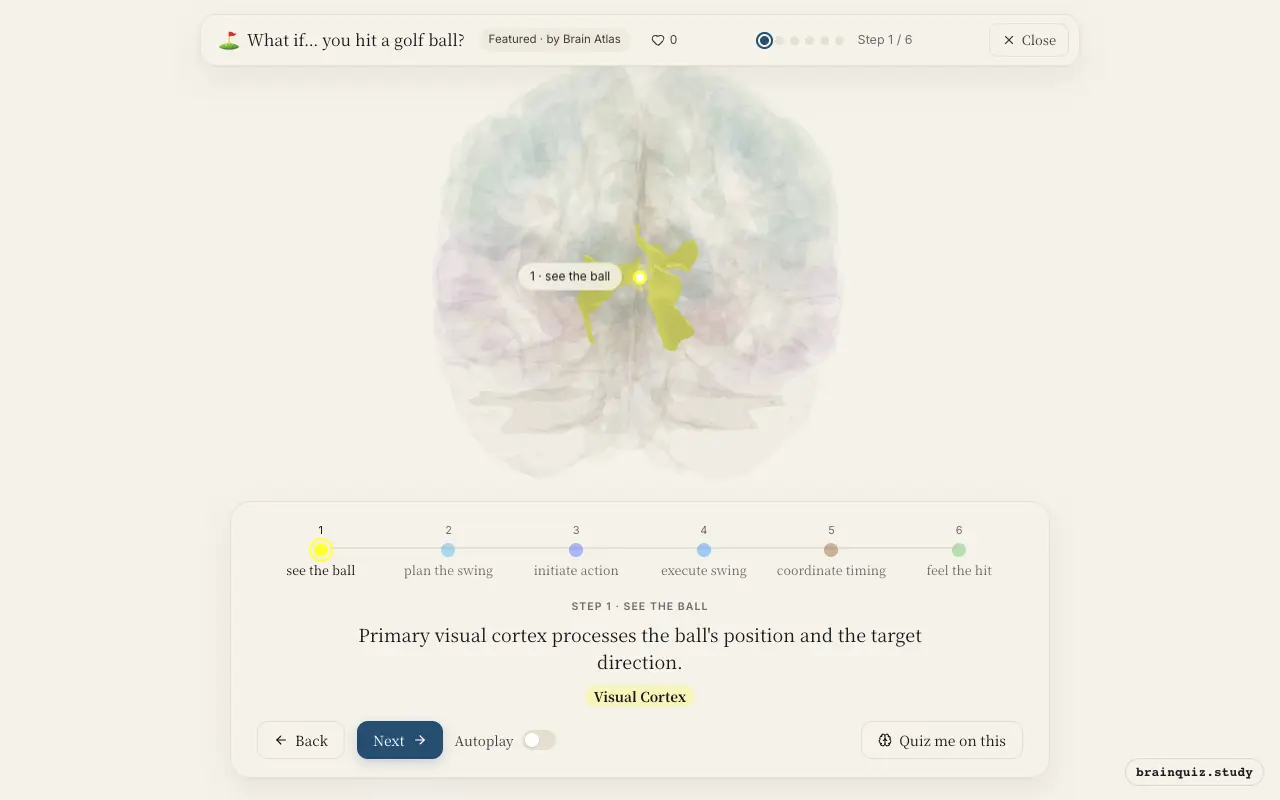
The visual cortex receives input from the eyes and identifies the ball and the target. It extracts edges, orientation, and motion to create a spatial map. This information guides the motor system's aim.
2. Premotor Cortex: plan the swing
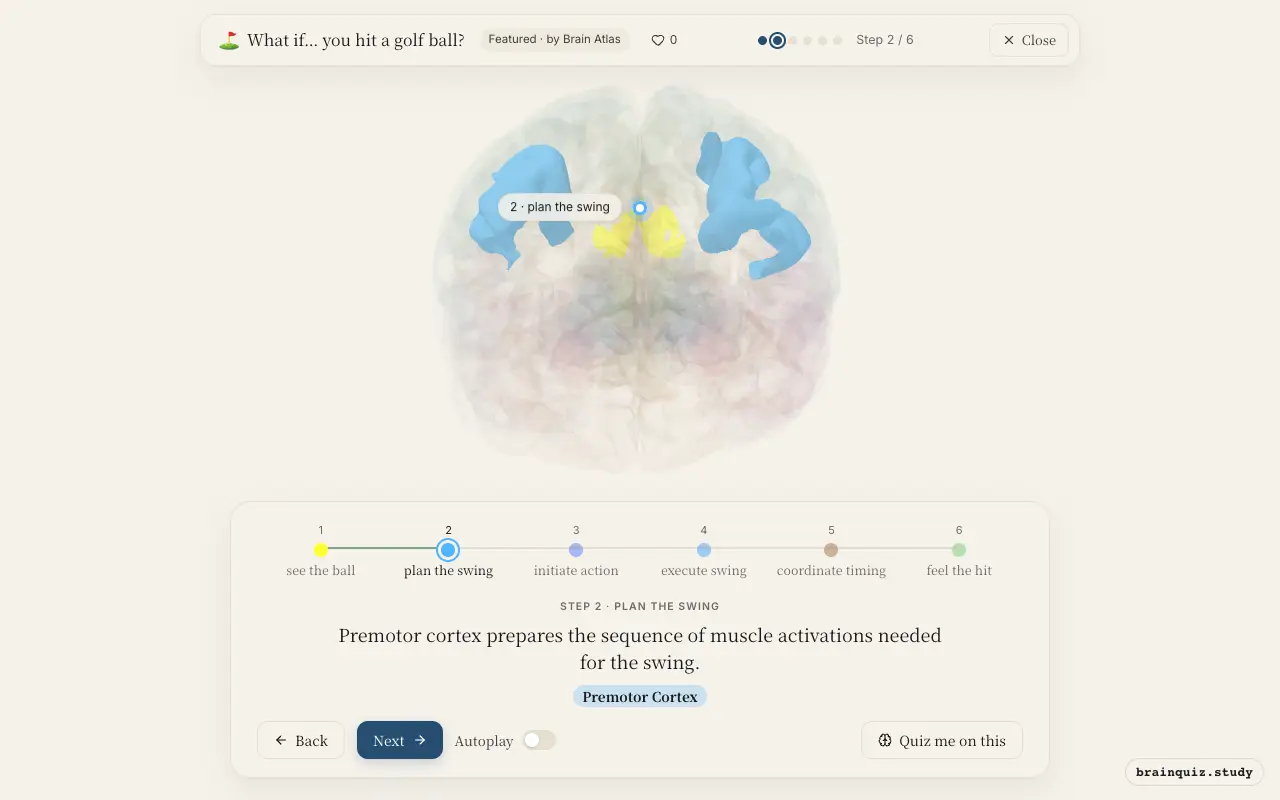
The premotor cortex uses visual information to plan the complex sequence of movements. It integrates sensory input with learned motor patterns to set the swing's trajectory and force. This planning occurs before any overt movement.
3. Basal Ganglia: initiate action
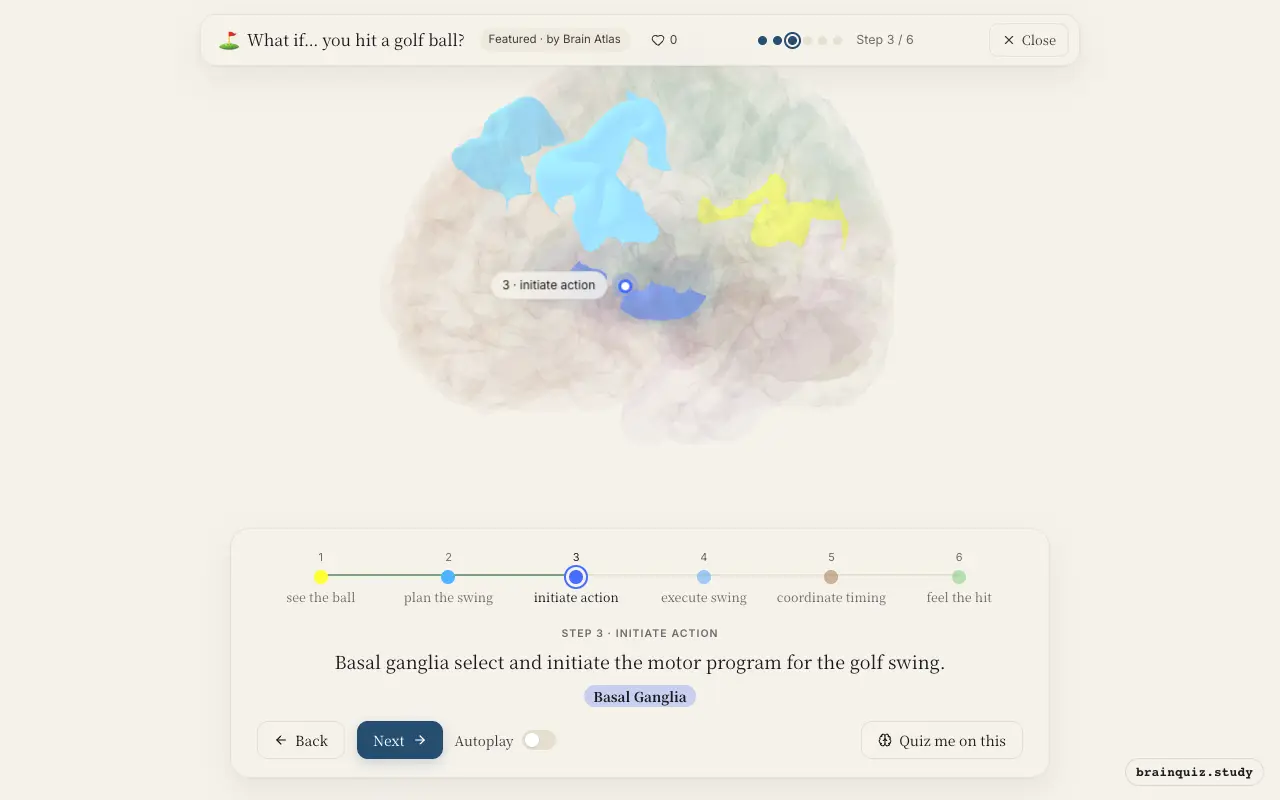
The basal ganglia evaluate competing motor plans and release the chosen program by disinhibiting the thalamus. This allows the motor cortex to execute the swing. For practiced golfers, this process becomes automatic.
4. Motor Cortex: execute swing
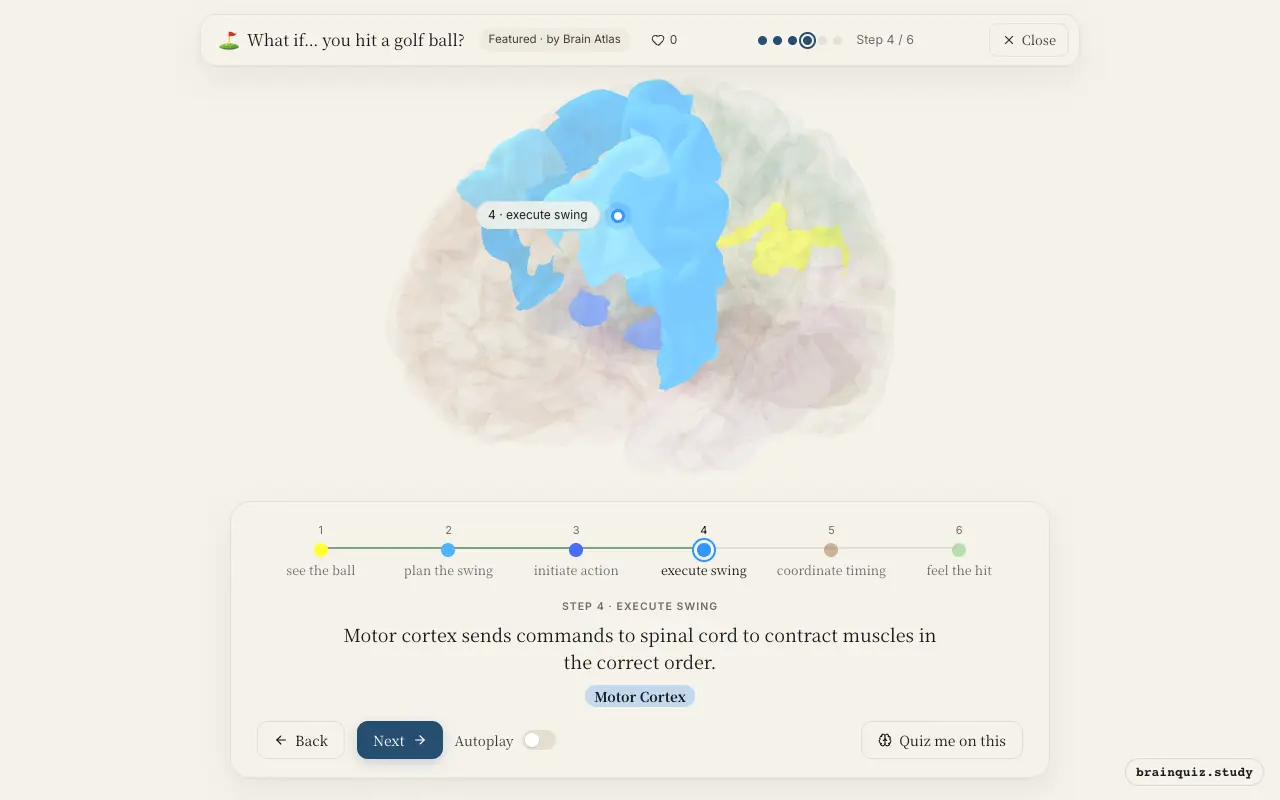
The primary motor cortex activates upper motor neurons that project to the spinal cord. These signals travel down the corticospinal tract to coordinate muscle contractions in the arms, torso, and legs. The firing pattern determines the swing's speed and direction.
5. Cerebellum: coordinate timing
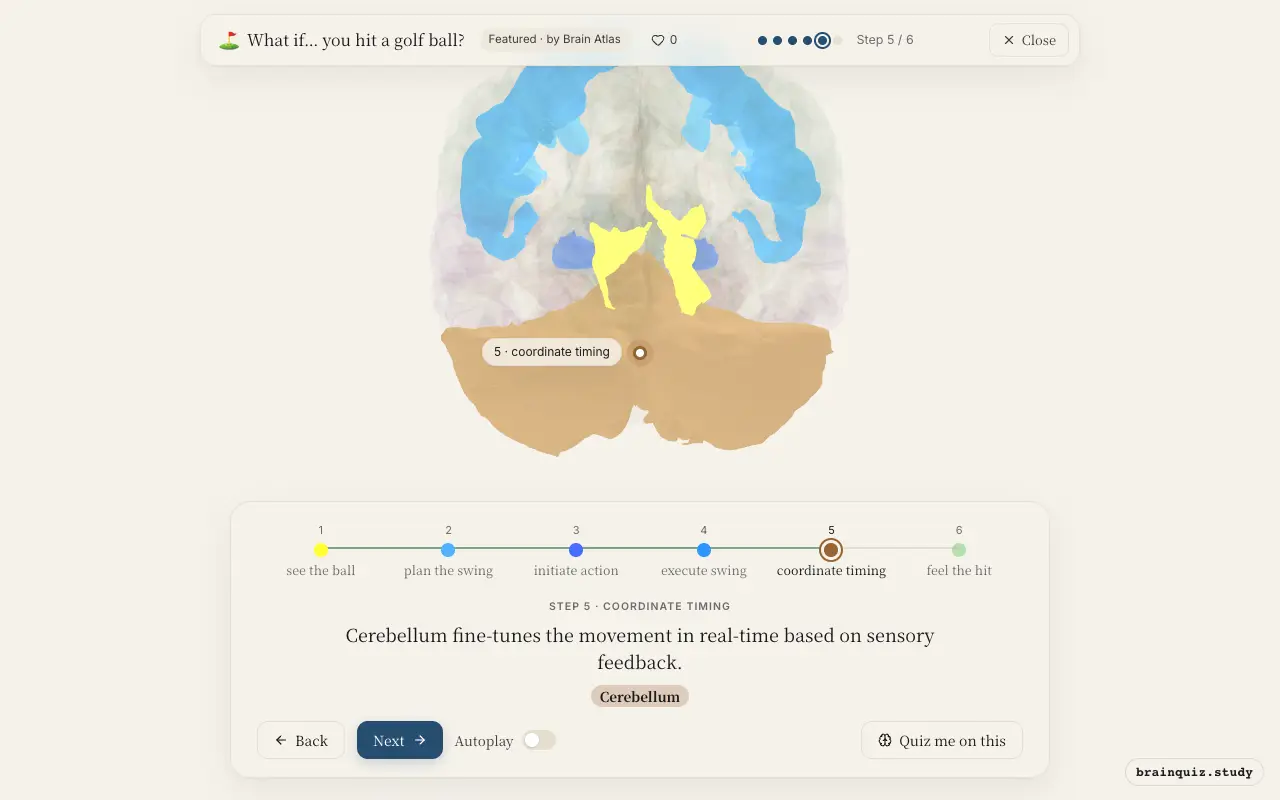
The cerebellum compares intended movement with actual sensory feedback and corrects errors on the fly. It adjusts timing and force to maintain balance and accuracy. This role is crucial for the precise timing of the golf swing.
6. Somatosensory Cortex: feel the hit
Receptors in muscles, joints, and skin send signals about body position, grip pressure, and impact. The somatosensory cortex integrates this feedback to update internal models of the movement. This helps refine future swings.
Good to know
- Procedural memory for golf swings is stored in the basal ganglia and cerebellum, allowing skilled players to perform without conscious thought.
- Dopamine release in the basal ganglia reinforces successful shots, contributing to motor learning.
Expert vs novice golfers
Expert golfers show less prefrontal cortex activation and more reliance on basal ganglia and cerebellum, reflecting automaticity. Novices engage premotor and prefrontal areas more heavily as they deliberately plan each movement. This shift is a hallmark of motor skill learning.
Test yourself
Which brain region is primarily responsible for visually locating the golf ball and target?
Which region is most critical for the fine timing and coordination of the golf swing?
In expert golfers, which brain regions are more active compared to novices during a swing?
0 of 3 answered · 0 correct
Simplified: many regions work together at once, and this shows the main players in the order they act.