What happens in your brain when you catch a yawn from someone?
Updated
Seeing a yawn activates visual cortex and fusiform gyrus to recognise it, then premotor cortex mirror neurons may simulate the action. The insula adds an empathic urge, and motor cortex triggers your own yawn.
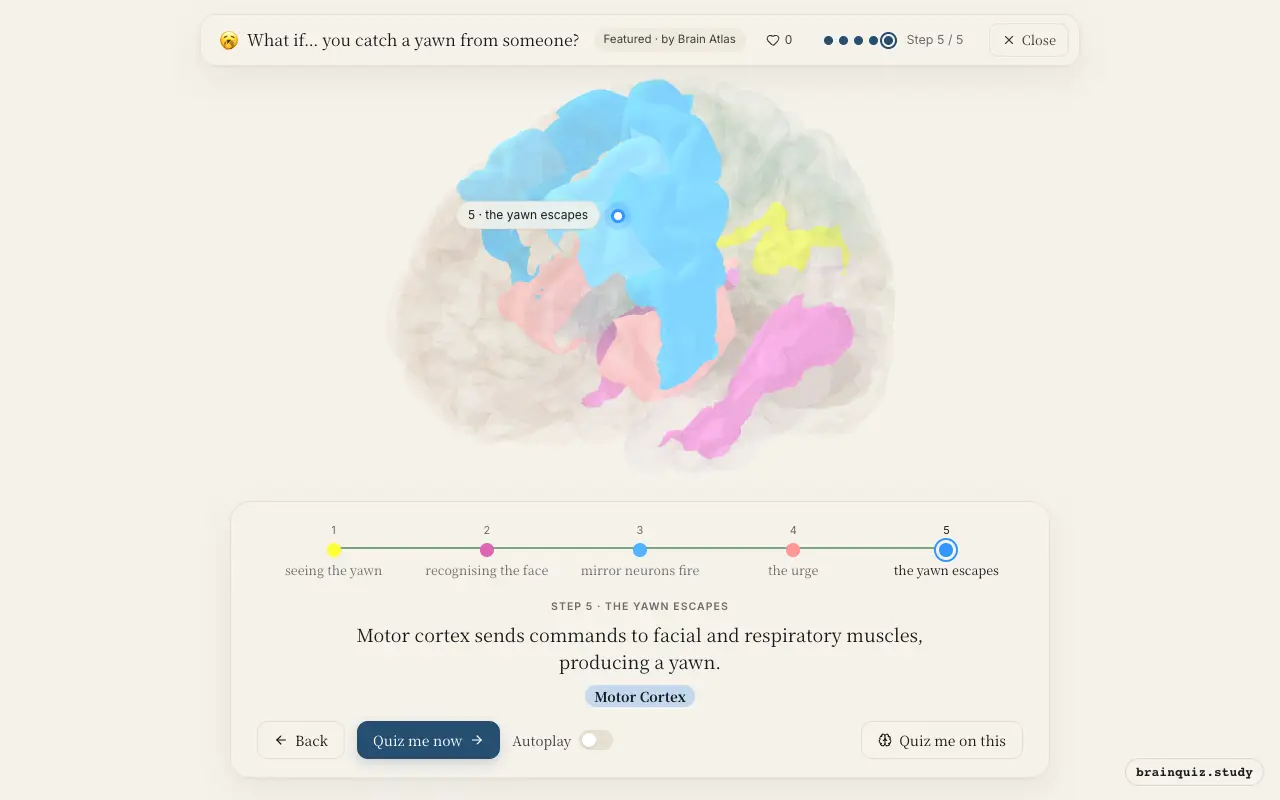
Watch it light up on the 3D brain
Brain regions that light up
| Order | Region | What it does here |
|---|---|---|
| 1 | Visual Cortex | Primary visual cortex processes the sight of another person yawning. |
| 2 | Fusiform Gyrus | The fusiform gyrus identifies the facial expression as a yawn. |
| 3 | Premotor Cortex | Premotor cortex mirror neurons may activate the motor pattern for yawning. |
| 4 | Insula | The insula integrates the perceived yawn with your internal state, creating a contagious urge. |
| 5 | Motor Cortex | Motor cortex sends commands to facial and respiratory muscles, producing a yawn. |
1. Visual Cortex: seeing the yawn
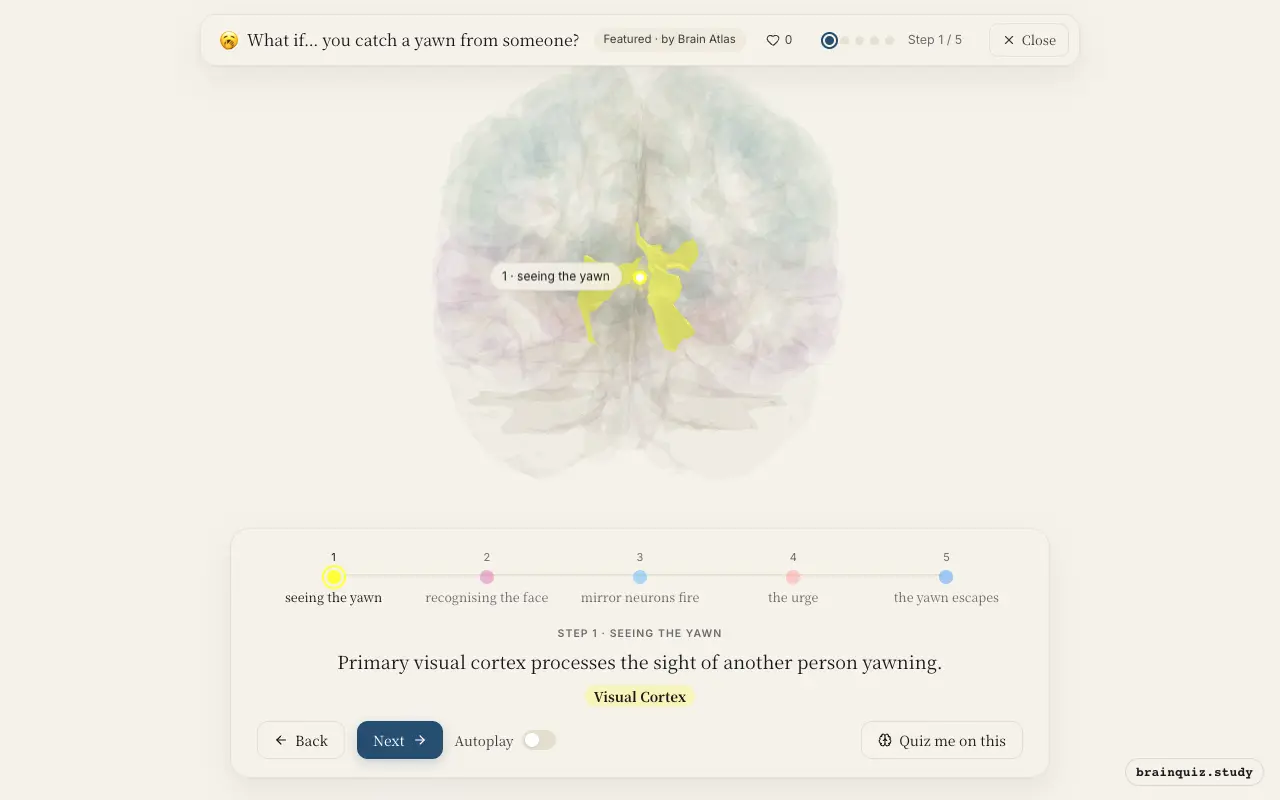
Visual information from the eyes first reaches the primary visual cortex at the back of the brain. Here, basic features like motion and shape are extracted before being sent to higher visual areas for interpretation.
2. Fusiform Gyrus: recognising the face
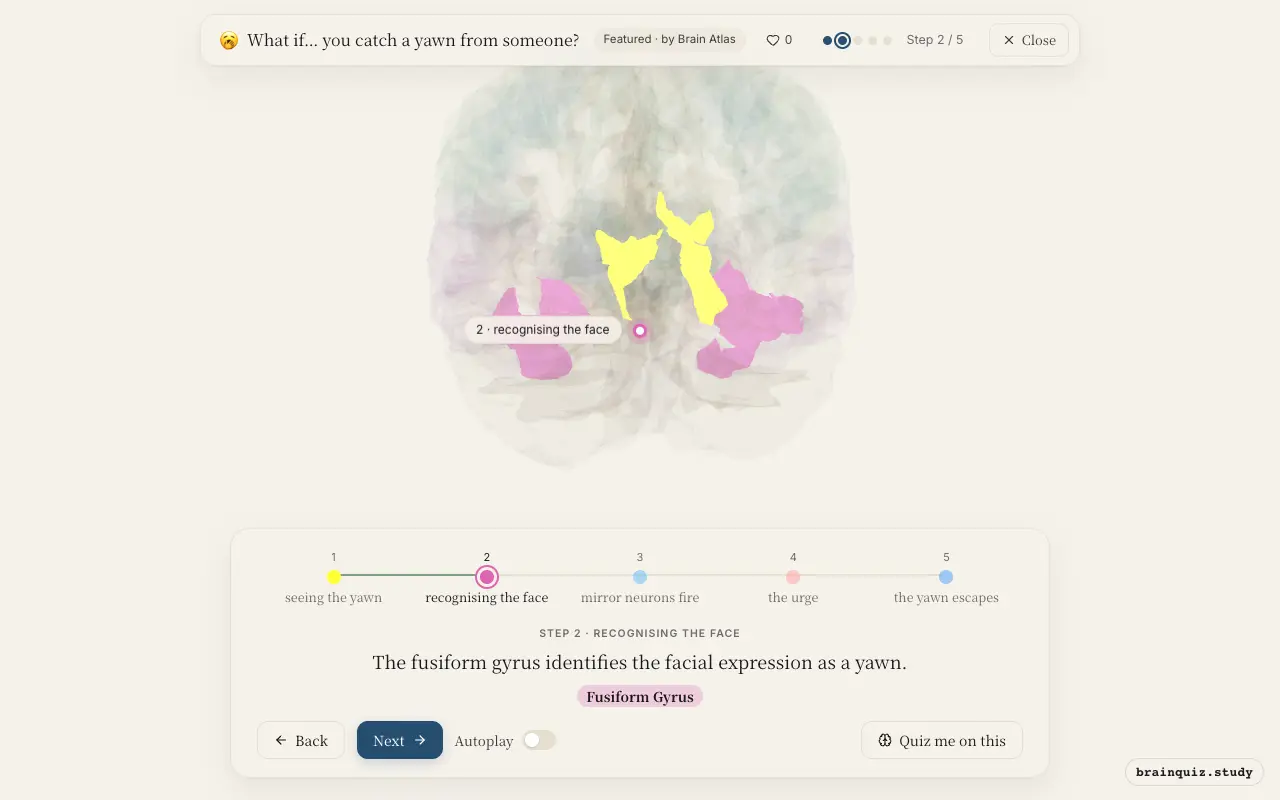
The fusiform gyrus is specialised for face recognition. It decodes the stretching mouth and closed eyes as a yawn, linking the visual input to a known social cue.
3. Premotor Cortex: mirror neurons fire
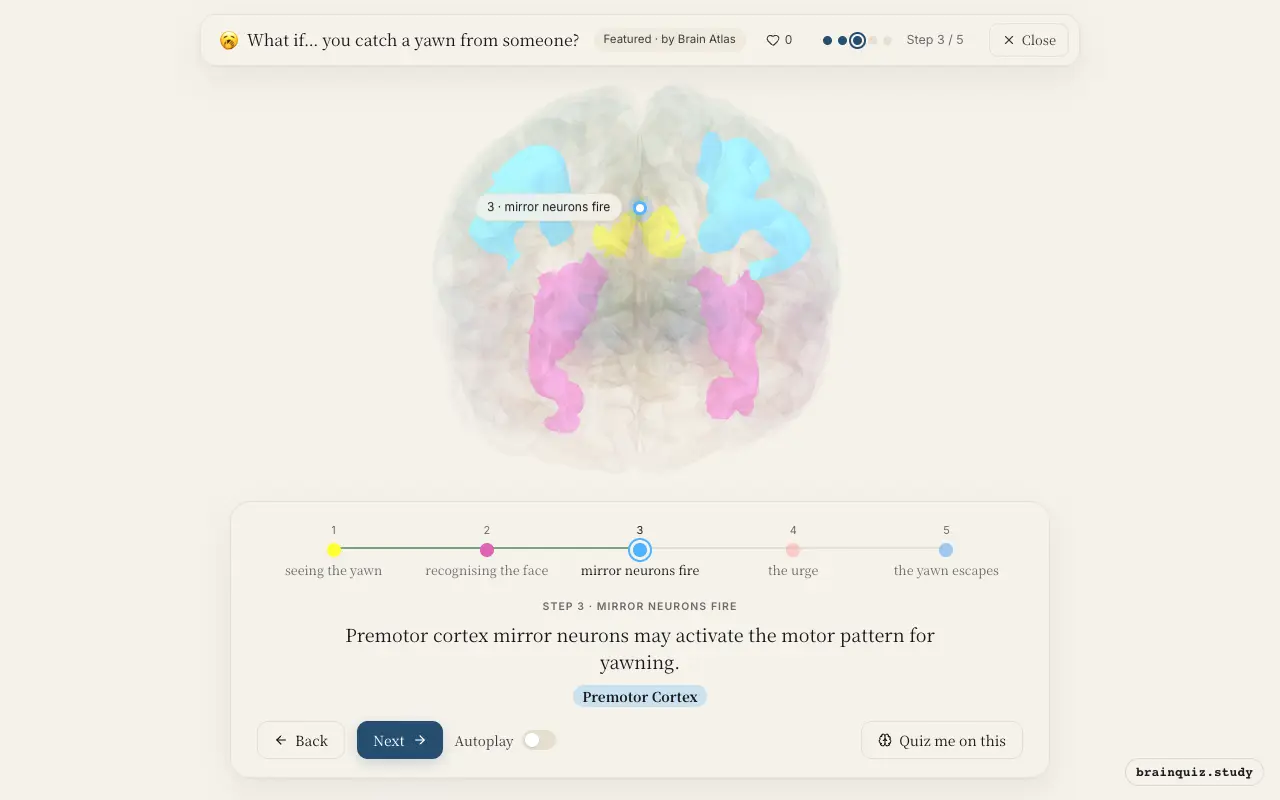
Mirror neurons in the premotor cortex are thought to fire both when we perform an action and when we see someone else perform it. Here, they may simulate the yawn motor sequence, preparing your body to copy it.
4. Insula: the urge
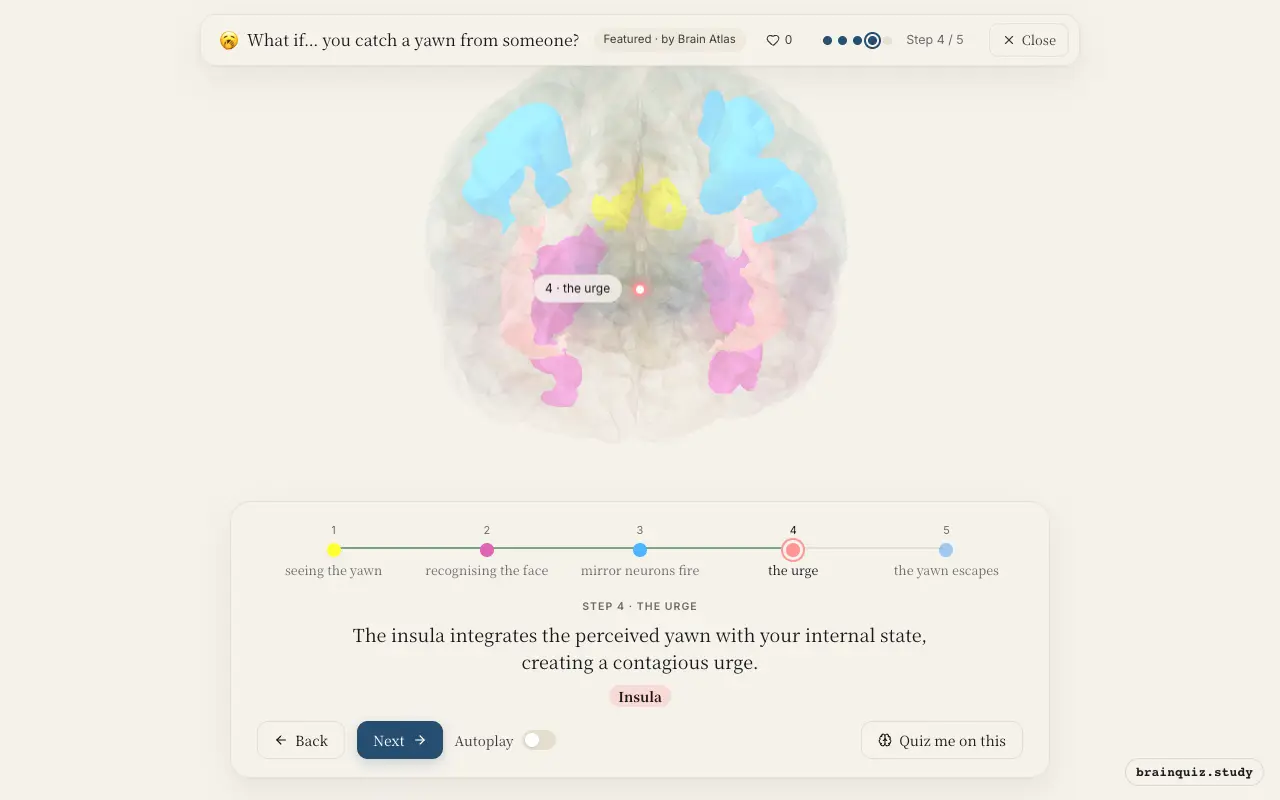
The insula processes interoceptive signals and empathy. It links the observed yawn to your own bodily feelings, strengthening the automatic tendency to yawn in response.
5. Motor Cortex: the yawn escapes
Once the motor plan is activated and the urge builds, the primary motor cortex executes the yawning movement. It coordinates jaw opening, deep inhalation, and stretching of facial muscles.
Good to know
- Contagious yawning is more common in humans and some primates with strong social bonds, and is thought to be linked to empathy.
- Mirror neurons were first discovered in the premotor cortex of macaque monkeys by Rizzolatti and colleagues in the 1990s.
- Yawning may help cool the brain by increasing blood flow and altering cerebral temperature.
Contagious yawning vs spontaneous yawning
Spontaneous yawning is driven by brainstem and hypothalamic circuits that regulate arousal and temperature, with little cortical involvement. Contagious yawning additionally recruits visual, face-processing, and putative mirror neuron regions, making it a social phenomenon rather than a purely physiological reflex.
Test yourself
Which brain region is thought to contain mirror neurons that fire when you see someone yawn?
The insula's role in contagious yawning is primarily linked to:
Which region is responsible for the final execution of the yawn movement?
0 of 3 answered · 0 correct
Simplified: many regions work together at once, and this shows the main players in the order they act.